Panama City is the region’s double exposure: a skyline of towers the hemisphere compares to Miami, curving along its bay above the Cinta Costera’s waterfront parks – and, at the bay’s old corner, Casco Viejo, the UNESCO colonial quarter whose renovation wave turned crumbling grandeur into the country’s most atmospheric address. The capital’s stone brief spans both cities at once: amenity decks forty floors up, courtyards four centuries old, and the civic front stitching them together. This guide walks the double city.
The Tower City
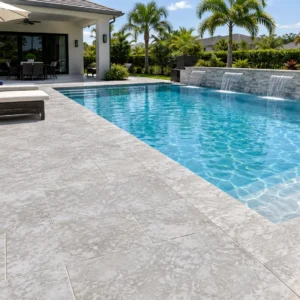
Punta Pacífica, Costa del Este, Avenida Balboa – the capital’s districts build vertically, and their stone concentrates where towers live outdoors: the amenity levels. Pool decks with skyline infinity edges, social terraces serving hundreds of units, rooftop lounges at the region’s highest exposures – specified at hospitality-institutional grade with the tower’s additions: wind engineering at altitude, crane-window logistics, and the board-governed documentation culture of buildings run by administrations for decades. tower amenity decks compared maps the kindred vertical brief one sea north.
The Amenity Deck’s Clauses
The high deck writes clauses ground-level pools never read:
- Wind at elevation: fixings engineered, furniture curated by weight, screens and planting doing the lee-building the ground floor gets free.
- Structural loading: stone packages coordinated with the slab’s engineering from the drawing stage.
- Crane and hoist logistics: consignments crated to the building’s lifting reality, delivered to the construction manager’s calendar.
- Board governance: batch records, slip documentation and maintenance files held by administrations that outlast every committee.
The Casco’s Manners
Casco Viejo runs the heritage canon under real authority – the quarter’s office clears interventions before drawings harden – and its renovation craft is the regional colonial standard at Panamanian temperature: historic fabric conserved through sanctioned works, new floors meeting old walls at honest declared joints, courtyards repaved at historic levels with the drainage the centuries improvised, services threaded under new stone rather than chased through old masonry, and the street’s brick-and-stone streetscape respected as the ensemble it is. The parallel craft one sea east is walked in the first city’s quarter craft – the hemisphere’s senior quarter schooling all the others.
The Casco’s Boutique Economy
The quarter’s renaissance runs on hospitality: boutique hotels in colonial shells, rooftop bars watching the skyline across the bay, courtyard restaurants where the capital entertains. The premises brief blends heritage and hospitality registers – conservation-clean interventions carrying full commercial duty, rooftop terraces engineered into old structures with modern discretion, and thresholds negotiating stone streets that are themselves protected fabric. The bay view is the quarter’s signature cocktail: four centuries in the foreground, forty floors across the water.
The Cinta Costera Front
Stitching the two cities, the Cinta Costera runs the capital’s civic front – the reclaimed waterfront parks and promenades where the city runs, cycles and takes its evenings against the bay. The public-realm brief is metropolitan-civic: esplanade surfaces at capital-crowd durability, event grounds hosting the national calendar, seawall edges detailed for the Pacific’s tides, and the maintenance discipline of a front the whole city audits daily. The Cinta is where the capital performs itself; its surfaces are the stage.
The Metropolitan Registers
Around the towers, the capital runs the region’s deepest commercial fabric: banking-district lobbies at institutional polish, mall and retail thresholds at daily-thousands volume, restaurant districts serving the region’s most cosmopolitan calendar, and the corporate campuses of the hemisphere’s regional headquarters. The commercial canon applies at metropolitan scale – dense stone, documented ratings, attic stock as policy – and the installation industry behind it is the isthmus’s deepest, trained by the skyline it built.
Building in the Vertical City
Capital logistics run metropolitan: appointment deliveries into managed sites, laydown negotiated where ground is precious, crane windows coordinating every heavy trade, and the professional construction-management culture a tower economy trains. For stone the disciplines are the big-city standard – consolidated consignments, documented deliveries, batch-labeled crates in hoist order – and the hub’s proximity sweetens everything: the port is an hour away, and the free zone holds whatever the program is not ready to lift.
The Double City’s Standard
Panama City’s brief spans four centuries and forty floors: heritage manners in the quarter, wind engineering on the decks, civic durability along the front and metropolitan polish between. One pale calibrated family serves the span – detailed to each register’s clauses, documented to each governance culture’s files. Build the double city to both its standards at once, and the capital that watches itself across the bay approves from either shore.
The Amador Causeway
Where the canal meets the Pacific, the capital keeps its grandest promenade: the Amador Causeway – the breakwater drive built from canal spoil, linking the mainland to its islets past the marina moorings, the landmark museum’s colors and the ships queuing for the locks. The causeway is the city’s weekend institution – cyclists, skaters, families at the rail watching the world’s cargo parade – and its premises run the promenade canon at canal-mouth theatre:
- Esplanade and cycle-path surfaces at capital-crowd durability, salt-rated on both flanks.
- Restaurant and marina terraces staging the ship-watching that is the causeway’s dinner show.
- Sittable edges the length of the rail – the parade deserves seating.
- Event grounds absorbing the festivals the location was built to host.
The causeway completes the capital’s waterfront triptych – Cinta, Casco, Amador – and its stone brief is the civic canon with the hemisphere’s best backdrop: the queue of ships at anchor, waiting for the passage the whole country is named for.
The Rooftop Hour
Both of the capital’s cities meet at the same hour in the same place: the rooftop. The tower districts run their pool decks and sky lounges into the sunset; the Casco answers from its colonial rooflines, bars perched on four-century walls watching the skyline light up across the bay – and the rooftop’s stone brief is the capital’s in miniature: wind-rated fixings at whatever the altitude, textures that serve barefoot afternoons and heeled evenings on the same surface, drainage engineered for tropical bursts on floors above occupied rooms, and the lighting circuits that turn a day deck into the night’s stage. The hour is the capital’s daily truce – towers and quarter admiring each other across the water – and its floors are specified for the daily performance.
Two Registers in One City
Panama City asks for two different specifications within a few blocks. The tower districts want large format, fast to lay, engineered for podium and rooftop loads. Casco Viejo wants small format, hand-set, and subordinate to the buildings above it. The historic side is a World Heritage property: the site covers Panama Viejo, founded in 1519 by Pedrarias Davila and abandoned after the city moved about 7.5 kilometers southeast in 1673, together with the orthogonal historic district that replaced it.
- Match format and joint width to the district, not to the client’s last project
- Expect documented submittals for anything visible from a Casco street
- Keep reversible fixings inside the protected quarter
- Allow review time in the schedule for heritage approvals
The World Heritage inscription record is the primary reference.
Podium Decks, Rooftops and Real Loads
Vertical living moves most of the city’s outdoor space onto structural slabs, and that changes everything about how stone is specified and fixed.
- Confirm the imposed load allowance before choosing thickness
- Use pedestal systems where waterproofing must stay accessible
- Design for wind uplift at height, not only for foot traffic
- Plan a lift and crane route for every pallet before the order
Panama’s service economy accounts for around 80 percent of GDP, which is why this tower stock keeps growing; the US government market overview sets out the numbers.
Heat, Glare and the Barefoot Test
A rooftop deck in this climate can be painful underfoot by mid afternoon. Color and finish are performance decisions here, not styling ones.
- Prefer lighter tones on unshaded amenity decks
- Avoid dark, dense material anywhere people walk barefoot
- Use texture rather than gloss to control glare
- Test a sample in position, in the afternoon, before approving
Working in a Dense, Occupied City
Almost every project here happens beside occupied floors, working restaurants or a live street, and the logistics are half the job.
- Book service lifts and street access before committing to a delivery date
- Work in short finished sections so frontages stay open
- Protect adjacent finishes before the first pallet arrives
- Agree a daily clean-down standard in the contract
Supply and delivery detail for the capital and beyond sits in our Panama supply overview.
Panama City stone for two cities at once
The successful projects here decide which city they are in before they choose a material, and then hold that decision through every substitution request.
- Pick the register first, the material second
- Engineer the deck before selecting the thickness
- Treat heat underfoot as a specification issue
- Plan access as carefully as the detail
Towers beside a walled quarter is not a contradiction, it is simply two briefs that must not be confused.