The Barefoot Question
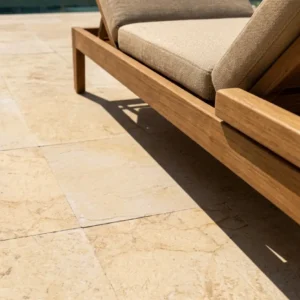
Ask anyone who has crossed a terrace at two in the afternoon and the specification argument makes itself. Surface heat decides whether an outdoor room gets used in the middle of the day or written off until evening. In the Virgin Islands, where villas are built to be lived in outdoors and shade is often thin on a steep hillside plot, that one quality shapes how the whole design performs. Pale stone is the usual answer and a good one, but it only works properly when the rest of the detailing agrees with it. Tone, texture, thickness and shade all pull on the same result, and a project that gets one of them right and ignores the other three usually ends up with a beautiful surface nobody crosses without shoes.
Color Helps, But It Is Not Everything
Tone is the first lever and the most visible, yet several other properties pull in the same direction.
- Lighter surfaces reflect more of what lands on them and store less of it.
- Dense stone moves heat differently from an open, lightweight material, so two pale slabs can feel unalike.
- Thicker units on a solid bed even out the swing between midday and evening.
- A textured face breaks contact with the skin and reads cooler than a slick one at the same temperature.
- Planting and pergolas remove more heat from a terrace than any change of material.
Finish, Glare and the Eye
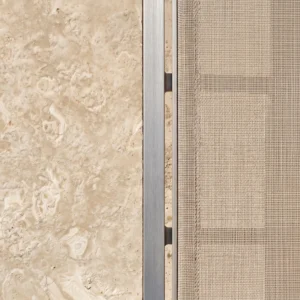
Pale stone carries a second problem that rarely reaches the brief: reflected light. A very smooth, very white surface under strong sun becomes uncomfortable to look at long before it is uncomfortable to stand on, and the reflex is to reach for sunglasses rather than to enjoy the terrace. Honed, brushed and lightly tooled faces scatter light instead of bouncing it, softening glare without darkening the stone. The same texture that calms the light also gives bare feet something to grip, so one decision quietly solves two problems at once. Most of the pale formats in our limestone that stays walkable midday selection are supplied with those quieter surfaces for exactly that reason.
Where the Sun Lands on a Hillside Plot
Steep ground makes exposure uneven, so treat a terrace as several zones rather than one flat surface.
- West-facing decks take the hardest afternoon load and deserve the palest, most textured option.
- Aprons beside a building sit in reflected heat from walls and roof as well as direct sun.
- Rooms facing north often stay usable with a darker material and no penalty at all.
- Steps and thresholds are crossed barefoot far more often than the middle of a terrace.
Shade, Planting and the Width of a Terrace
A wide expanse of any material bakes. Breaking a terrace with planting bays, a pergola line or a change of level gives feet somewhere to land and lets the surface lose heat at its edges. Trees do more than any of it, though water is scarce across these islands and irrigation carries a real cost, so planting has to be chosen for a dry site rather than a lush one. Where shade cannot be built, keep the walked routes narrow and pale, and let the outer field of paving take the sun. Level changes help in a second way on steep ground, because a terrace cut into a slope catches whatever breeze runs across the hillside, and moving air does more for comfort than another shade of cream.
Pool Surrounds Take Heat From Two Directions
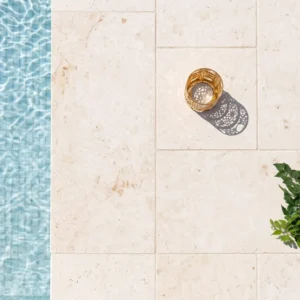
Water throws light back at the deck, so a pool surround gathers heat from above and from the surface beside it. It is also the one area crossed barefoot all day.
- Keep the palest, most textured stone for coping and the first course beyond it.
- Allow a shaded landing spot within a few steps of the water.
- Avoid dark banding or inlays where wet feet will stand and wait.
- Check that a chosen texture stays comfortable underfoot rather than abrasive.
Pale Stone in the Dry Months
Light surfaces show dust, and the Territory has a genuinely dry season, so plan maintenance instead of waiting for rain to do the work. Water is scarce enough across the Territory that nobody wants to spend it on hosing a terrace, which makes the choice of face a practical matter rather than a cosmetic one.
- Choose a texture with enough tooth to disguise fine dust between washes.
- Keep highly polished faces out of the garden, where they show every mark.
- Sweep before washing so grit is not ground across the surface.
- Where runoff feeds a cistern, wash with clean water and keep detergents off collection routes.
Comparing finish choices that reduce glare side by side is far easier than judging any of it from a description.
Test It Barefoot
No table settles this question. Put a sample on site, leave it in the position it will actually occupy, and stand on it at the hottest part of the day. Do the same with a second, slightly darker option so you have a comparison rather than an impression, then repeat it in the evening when the terrace is used for dinner. Samples are small, which is precisely why they travel easily and why nobody needs to decide from a photograph. It is worth doing this before the order is placed rather than after the pallets land, because a terrace is not a surface anyone rebuilds cheaply on a hillside plot. The stone that passes the barefoot test in August will still be comfortable in March.