

Edge geometry is where outdoor basalt hexagon tile installations either hold together or begin to fail, and most specifications underestimate how much the perimeter condition matters. A field of hexagons reads as a unified surface, but the exposed edges, cut pieces, and border transitions are the structural weak points — particularly in outdoor settings where moisture intrusion at joints drives long-term degradation. Getting edge treatment right from the start determines whether your installation ages gracefully or requires early intervention.
Why Hexagon Edge Geometry Creates Unique Specification Challenges
Square and rectangular tiles terminate cleanly at a wall, step riser, or border course. Hexagons don’t — their six-sided geometry means your perimeter will always involve partial pieces, and those partial pieces expose more cut face per unit than any standard tile format. That exposed cut face is where basalt’s absorption behavior becomes relevant. The natural stone’s internal structure, while dense for an igneous material, will accept moisture at exposed cut edges faster than at a factory-finished face, so sealant application to cut edges is not optional on outdoor basalt hexagon tile installations.
The other geometric consequence is angular variety at the perimeter. Depending on how your field hexagons meet the border, you’ll be cutting pieces along different axes — sometimes across the flat, sometimes through a point. Each cut orientation produces a different piece shape and a different edge length to manage, which affects both your waste factor calculation and your cutting schedule. Plan for a higher offcut volume than you would with rectilinear tile, typically significantly more, and order accordingly.
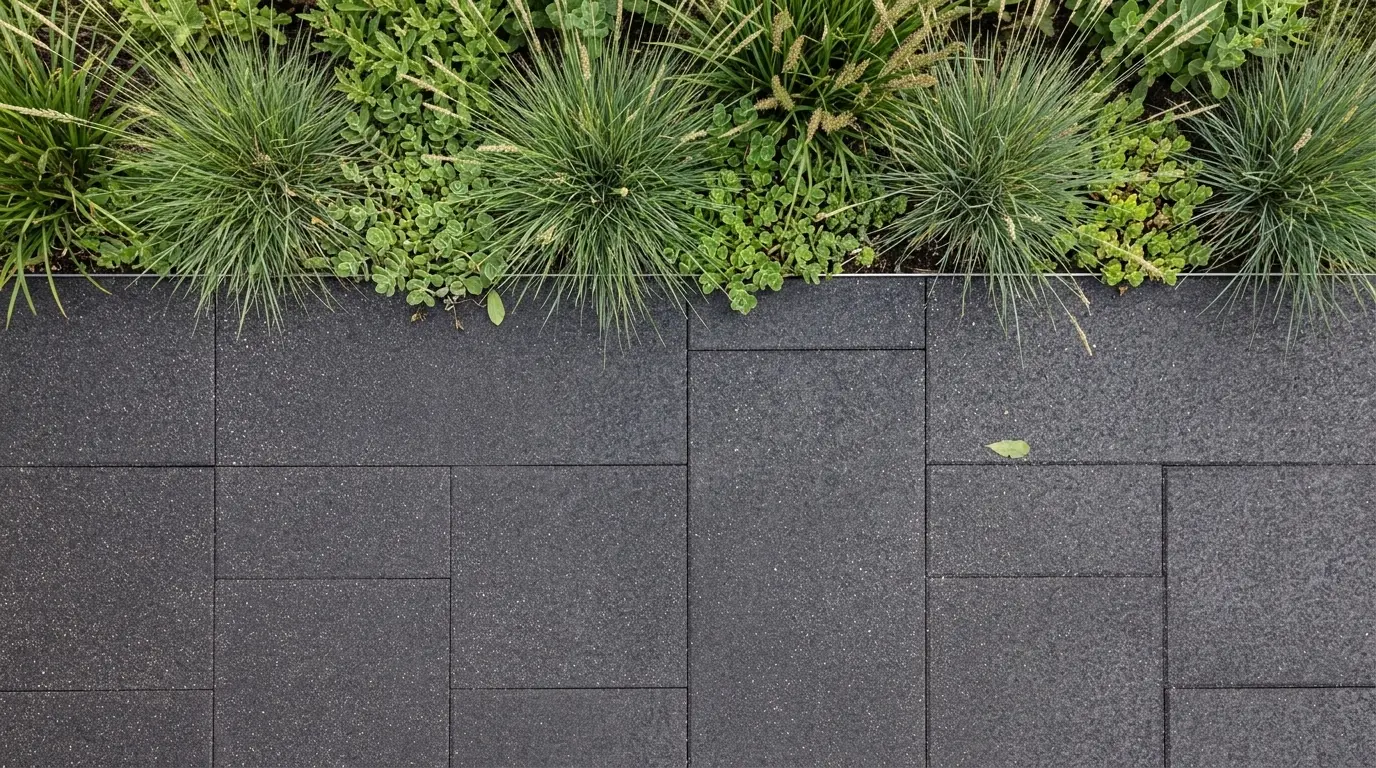
Cut Edge Treatment for Outdoor Basalt Installations
Every cut edge in an outdoor basalt hexagon tile installation needs to be treated before it goes into the ground. The cutting process opens the stone’s crystal structure, creating a micro-roughened surface that wicks moisture more readily than the sawn or finished face. In a freeze-thaw environment, that moisture uptake at cut edges translates directly into spalling risk over time. Two practical steps address this: apply a penetrating sealer to all cut edges before laying, and ensure your mortar bed or adhesive encapsulates the cut face fully — no voids behind the edge.
- Use a penetrating sealer rated for the specific finish on your basalt — honed, brushed, and bush-hammered surfaces accept sealers differently
- Allow cut edges to fully dry after cutting before sealing — wet basalt will trap moisture under the sealer film
- In freeze-thaw climates, specify a sealer with a stated low-temperature application range and confirm the re-application interval with the sealer manufacturer
- Encapsulate cut edges in mortar bed fully — partial contact behind the edge creates a cavity where water pools
For basalt hexagon tile on outdoor patios and paths, the cut-edge sealing step is often skipped because it adds time. That shortcut shows up three or four winters later as surface flaking along the perimeter pieces. The field tiles stay intact; the cuts fail. Building the edge treatment into your installation schedule as a non-negotiable step avoids that outcome entirely.
According to USGS basalt volcanic rock properties, basalt’s dense mineralogical structure is a product of rapid volcanic cooling — a characteristic that gives the material its fine grain and contributes to its low absorption relative to sedimentary stone, though exposed cut edges still require protection in outdoor environments.
Border Options That Work With Hexagon Geometry
Your border choice is a specification decision, not just an aesthetic one. The border course manages the perimeter cut condition, provides a visual frame that grounds the hexagon field, and in many cases also functions as an edge restraint that keeps the field from migrating laterally. Three approaches work reliably with outdoor basalt hexagon tile installations.
- Soldier course in matching basalt: a row of rectangular pieces — typically cut from the same slab stock — laid parallel to the site boundary, with the hexagon field terminating against it; the rectangular border simplifies the cut condition and delivers a clean visual boundary
- Contrasting stone border: a cut limestone or granite course that frames the basalt field; this approach works well where the landscape design calls for tonal contrast, such as a pale limestone border around a dark basalt field in a modern minimalist garden
- Cobble or sett border: basalt cobbles or granite setts laid as a perimeter band; this integrates well with informal planting schemes and desert xeriscaping where a harder edge would read as too resolved
The decision between these options should account for drainage direction as well as aesthetics. A proud border course — one that sits even fractionally higher than the hexagon field — can redirect surface water back into the field rather than off the edge. Confirm your finished surface heights before committing to border dimensions, and build a drainage fall of at least 1.5–2% away from structures into your layout plan.
Setting Out a Hexagon Field to Minimise Perimeter Cuts
The setting-out point — where you start your hexagon grid — directly controls how many cut pieces you’ll have at the perimeter and how small the smallest pieces will be. Small perimeter cuts, especially pieces less than a third of a full hex, are fragile during installation and prone to lifting over time because they have limited mortar bed contact area. Moving your starting point by half a tile can eliminate the worst of these.
A dry-lay on a cleared section of the base before any adhesive goes down is the professional approach. Lay out your hexagon field from the most visible boundary inward and see what lands at the less visible edges. Adjust your starting point until the perimeter cuts are as close to half-tile or larger as the geometry allows. This takes an hour and saves a week of callbacks. For outdoor basalt hexagon tile on patios and paths, the setting-out exercise also lets you confirm your drainage fall across the full field before installation begins — a change that’s easy on a dry base and impossible once mortared down.
On rectangular sites, orient your hexagon field flat-side-parallel to the longest dimension. This produces less angular variation at the two long edges, where the most cut pieces will land, and concentrates the more complex angular cuts at the shorter ends where they’re less prominent.
Mortar and Adhesive Specification for Outdoor Hexagon Basalt
Outdoor settings require a flexible adhesive or mortar mix — not standard grey cement. Basalt and concrete substrates expand and contract at different rates through a seasonal temperature cycle, and a rigid bond will eventually crack under that differential movement. A polymer-modified cement-based adhesive, specified to the substrate type and climate zone, accommodates that movement without debonding. Your adhesive manufacturer’s data sheet will state the minimum and maximum temperature range for application and curing — work to that window, not to a general rule of thumb.
- Specify a polymer-modified tile adhesive rated C2 or better under EN 12004 (or the equivalent ANSI A118 classification) for outdoor basalt hexagon tile applications
- Back-butter each tile as well as spreading the substrate — hexagons have six faces and a center that can all lift independently; full contact prevents hollow spots
- Use a notched trowel size that delivers consistent coverage across the full tile face — the hex format makes this easier than large-format rectangles but the principle is the same
- In exposed outdoor settings, use a polymer-modified grout that is rated for exterior use and matched to the joint width
Joint width for hexagon tile is a balance between visual intent and practical performance. Tighter joints read as more refined and architectural; wider joints accommodate minor size variation in natural stone and allow more flexible grout performance. For outdoor basalt hexagon tile, a joint of 3–5 mm is a workable range that accommodates natural stone dimensional variation while keeping the visual grid clean.
Finish Selection for Outdoor Basalt Hexagon Tile
Finish choice for outdoor basalt hexagon tile is a surface texture decision that has implications for both appearance and long-term maintenance. The finish you specify affects how the surface weathers, how it accepts sealant, and how it reads visually across the range of landscape styles where basalt hexagons are commonly used.
For pool decks, ramps, wet steps, and any area where the surface will be regularly wet, choose a bush-hammered finish. The texture it leaves is open and matte — the result of mechanical impact that fractures the surface crystals and produces a coarse, irregular profile. For other outdoor paths and patios, a Brushed 36 Grit finish suits pool surrounds and outdoor entertaining areas, while Brushed 16 Grit is appropriate for higher-traffic paths and courtyards. A Brushed 80 Grit finish is worth considering for covered terraces and areas used barefoot. Polished finishes are reserved for dry indoor surfaces only and are not appropriate for any outdoor or wet application.
From inspections at our selected quarries, we’ve found that bush-hammered basalt hexagons consistently show the most even weathering profile after several outdoor seasons — the textured surface doesn’t hold residual mineral staining the way a smoother finish can in areas with hard water or organic debris. That’s a maintenance consideration worth raising with your client before you specify a finer finish for a poolside or shaded path.
The Natural Stone Institute igneous stone paving technical standards provide a useful reference for understanding how surface finish interacts with absorption and weathering behavior across different igneous stone types — relevant context when you’re aligning finish specification with outdoor performance requirements.
Landscape Integration and Design Context for Basalt Hexagons
Basalt hexagon tile carries a strong geometric identity that reads differently depending on the landscape language surrounding it. In a modern minimalist garden — clean planting lines, restrained palette, generous negative space — the hexagon grid in dark basalt is an architectural element in its own right. It anchors the design and grounds it without competing with planting. The joint color is a specification decision in this context: a dark grey or charcoal grout reads as seamless and graphic, while a lighter joint color articulates each tile individually and softens the effect.
In a tropical planting scheme, where bold foliage and layered canopy dominate, the precise geometry of outdoor basalt hexagon tile provides a counterpoint that prevents the planting from reading as uncontrolled. The contrast between the tile’s angular precision and organic planting forms is part of the design logic. Here a bush-hammered or coarser brushed finish integrates better than a refined surface — it bridges the gap between the built geometry and the natural environment.
Desert xeriscaping and dry-climate gardens present a different integration challenge. The color of the basalt matters here — dark basalt reads as a strong focal element against pale gravel or decomposed granite ground plane, which suits focal seating areas and feature paths. A wider border of contrasting pale stone — limestone or pale granite — can mediate between the basalt’s intensity and the surrounding dry landscape palette. This is also where the cobble or sett border approach comes into its own: the rounded forms of a basalt cobble edging echo the informal character of a xeriscape planting scheme while holding the hexagon field cleanly.
Ordering, Waste Factors, and Delivery Logistics
Ordering outdoor basalt hexagon tile for a perimeter-heavy layout requires a realistic waste factor. For a straightforward rectangular field with a simple border, 10–12% overage is a reasonable starting point. For an irregular site boundary, a diagonal orientation, or a design with multiple internal borders and feature panels, 15–18% is more realistic. The angular cuts at perimeter conditions generate offcuts that can’t be reused in the field, so the waste calculates differently than for square tile.
At Citadel Stone, we cut hexagon basalt tile to order from slab stock at our selected quarries, which means your order can be specified to the exact dimensions and finish your project requires. Lead times are quoted with the order and should be built into your project programme before installation dates are confirmed with other trades.
Your site’s access conditions affect delivery scheduling and offloading arrangements. Confirm access width, overhead clearance, and unloading area before the delivery date is set — this is particularly relevant for urban sites or properties with restricted frontage. Offloading arrangements are confirmed before delivery, and lead times account for the full cut-to-order production cycle. The Britannica entry on basalt volcanic rock formation is a useful reference for understanding the material’s geological basis and the characteristics that follow from it — relevant background when you need to explain material behavior to a client or design team.
For basalt hexagon tile on outdoor patios and paths, also confirm the pallet configuration before delivery. Hexagon tile stacks differently from rectangular tile, and the pallet count and individual weights will affect both access requirements and your on-site handling plan.
Surface Water Management Across the Hexagon Field
Drainage fall across an outdoor basalt hexagon tile field is not negotiable — standing water on any natural stone surface accelerates joint deterioration and, in freeze-thaw climates, drives sub-surface damage. Specify your finished surface fall before setting out begins, and verify it with a level and string line across the full field after the base is prepared but before any tile goes down. Correcting drainage fall after tiles are laid is a full re-do.
The hexagon joint network actually assists surface drainage more than a continuous rectilinear grid does — water has multiple diagonal paths to follow across the field toward the drainage edge. This is an advantage in heavy rain events, where water volume can overwhelm a grid that channels runoff in only two directions. It’s not a substitute for a properly graded base, but it is a genuine performance benefit of the format in outdoor applications.
Regarding slip resistance on outdoor basalt hexagon tile: the current standard for evaluating wet surface behavior is ANSI A326.3, which measures wet. The finish is the primary variable — a bush-hammered or coarser brushed finish produces a different surface texture than a honed or polished finish, and that texture difference is what determines how the surface behaves underfoot when wet. The test report is available on request.
Final Considerations
The details that define a well-executed outdoor basalt hexagon tile installation are not in the field — they’re at the edges, the cuts, and the junctions. Your setting-out point controls your perimeter cut quality. Your cut edge treatment controls long-term moisture performance. Your border specification frames the visual result and manages the structural perimeter condition. None of these are afterthoughts; they’re the specification decisions that separate an installation that holds up from one that develops problems at the margins within a few seasons.
Explore the full range through Citadel Stone hexagon basalt tile to confirm available sizes, finishes, and cut-to-order options for your project. As you develop the broader stone specification for your project, understanding the geological relationship between different volcanic materials can inform material selection decisions — how scoria and basalt compare geologically covers another dimension of igneous stone specification worth reviewing. Outdoor basalt hexagons from Citadel Stone give a patio or garden path a strong geometric look, sourced from our selected Middle East quarries.
Related reading: why basalt forms hexagons · how basalt columns form · basalt herringbone tile ideas.