

The distinction between scoria vs basalt rock runs deeper than surface appearance — it comes down to how each material solidified, what that process left behind structurally, and whether the resulting stone can actually perform under load. Both originate from volcanic activity, but the gas content trapped during cooling creates fundamentally different internal architectures that determine every downstream specification decision you’ll face.
What Separates Scoria from Basalt at the Structural Level
Scoria forms when lava cools rapidly with a high gas content still dissolved inside it. As pressure drops, those gases escape — but not completely. What remains is a porous, vesicular structure riddled with interconnected voids, sometimes accounting for a substantial fraction of the total volume. The surface looks rough and cellular, almost sponge-like in extreme cases. Basalt, by contrast, cools from a low-gas or degassed melt, producing a dense, fine-grained igneous rock with a tightly interlocked mineral matrix and minimal void space.
That structural difference isn’t cosmetic. Porosity governs absorption, compressive capacity, surface workability, and long-term performance in ways that make the two rocks almost incomparable for construction purposes. The scoria vs basalt rock comparison is really a comparison between two fundamentally different material classes that happen to share a volcanic origin.
Geology and Formation: Why the Cooling Path Matters
Both rocks belong to the basaltic family in terms of mineral composition — they contain similar proportions of pyroxene, olivine, plagioclase feldspar, and iron-titanium oxides. The divergence happens in the final seconds of solidification. Scoria typically erupts from the rim of a volcanic vent or from lava fountaining, where rapid decompression allows gas bubbles to form and partially escape before the melt freezes around them. The result is a clinker-like texture you can see and feel immediately.
- Scoria vesicles (voids) are typically rounded to irregular in shape, formed by trapped gas pockets
- Basalt vesicles, when present at all, are rare and isolated — not interconnected — so absorption remains low
- Scoria’s bulk density is considerably lower than basalt’s because of the void volume
- Basalt’s mineral grains are too fine to resolve with the naked eye, giving it a smooth, homogeneous appearance when cut and finished
- Both rocks share a mafic mineral chemistry, which is why their colour range overlaps — black, dark grey, reddish-brown
Understanding this formation difference explains why quarrying and processing the two rocks leads to such different outcomes. Basalt yields predictable, consistent slabs and tiles. Scoria yields irregular chunks that are lightweight but structurally unreliable at thin dimensions. According to basalt volcanic rock formation and construction properties, the dense interlocking crystal structure of basalt gives it a compressive capacity that scoria simply cannot replicate.
Porosity and Absorption: The Core Performance Gap
The scoria vs basalt rock porosity comparison is where the practical specification decision gets made. Scoria’s open, interconnected pore network means water, oils, and other fluids move through it readily. For landscape drainage applications — volcanic scoria is used widely as a lightweight drainage aggregate or a growing medium in green roofs — that absorption is a feature. For a finished paving surface, a wall cladding, or any application where dimensional stability and surface integrity matter, it’s a serious liability.
- Scoria absorbs moisture deeply and unevenly, making consistent sealing essentially unachievable
- Water ingress into scoria leads to freeze-thaw expansion cycles inside the pore network, accelerating surface degradation in cold climates
- Basalt’s absorption is low enough that surface sealing protects effectively — the pore network is minimal and largely disconnected
- Efflorescence risk is substantially higher in scoria because dissolved salts migrate through the open pores to the surface
- For countertops, tiles, and finished flooring, basalt’s low absorption directly supports long-term surface uniformity
Specifying absorption properties for either material requires a formal test report. Ask your supplier to provide results from ASTM C97 (water absorption and bulk specific gravity for dimension stone) — do not accept an estimated range as a substitute for an actual test report. The USGS basalt volcanic rock properties and composition resource confirms the dense, low-porosity character of basalt that makes it a practical dimension stone choice.
Compressive Strength and Load-Bearing Capacity
Compressive strength in volcanic rocks tracks closely with density and void content. Scoria’s pore structure reduces the effective cross-sectional area available to resist load, which lowers its compressive performance compared to solid basalt. For aggregate or fill, that’s acceptable. For a paver, a step tread, or a wall cladding panel, you need numbers from a test report — not an assumed performance based on rock type alone.
Basalt’s compressive capacity is among the highest recorded for dimension stone. To specify it accurately, reference ASTM C170 (compressive strength of dimension stone) and request the test certificate from your supplier. The same applies if you ever encounter a product marketed as scoria-derived — the test report tells you what the actual void-corrected strength is, not what the rock type implies. Never publish or accept a figure without a real certificate behind it.
- Basalt’s dense matrix supports paver, tile, slab, and cladding applications across demanding load conditions
- Scoria performs well in drainage, aggregate, and lightweight fill roles where compressive strength is secondary
- Any strength claim for dimension stone should reference ASTM C170 and be backed by a test certificate
- Thickness specification for pavers or treads must account for the material’s tested properties — never assume based on rock family alone
Surface Finish and Workability: What Each Rock Produces
Finish options diverge sharply between these two rocks. Basalt’s fine-grained, dense matrix accepts a full range of surface treatments — honed, polished, brushed, bush-hammered, split face, sawn — each producing a consistent, repeatable result across a slab or tile run. The surface quality holds because there are no voids to interrupt the tool path or leave weak spots in the finished face.
Scoria can’t be finished in the same sense. Its cellular surface is inherently irregular, and any attempt to hone or polish it exposes the voids rather than smoothing over them. This limits scoria to its natural rough state — functional in specific landscape and horticultural roles, but not suitable for floor tiles, wall cladding, countertops, or any application where a continuous, workable surface is required. The Natural Stone Institute igneous stone paving technical standards draws a clear line between igneous dimension stone suitable for finishing and volcanic aggregate materials that serve different purposes.
For basalt specifically, the finish you choose shapes how the material performs in each application. A Honed 60 Grit finish suits interior floors, cladding, and covered patios. A Bush-Hammered finish opens the surface texture for pool decks, ramps, and wet areas. For pool decks, wet steps and slopes, choose a bush-hammered finish. For other outdoor paths, bush-hammered or brushed in our coarsest grit both work; check a sample. Polished basalt is reserved for dry indoor surfaces — floors, walls, countertops, vanity tops, and fireplace surrounds.
Terrain, Slope, and Drainage: Where Material Choice Gets Complicated
On hillside or elevated sites, the interplay between material density, base preparation, and drainage geometry becomes critical in ways flat-site installations rarely expose. Dense basalt pavers stay stable on a well-engineered compacted base because the material doesn’t shift under load and doesn’t absorb the water that drainage design is trying to move. On a sloped site, that predictability matters — you’re relying on the paver layer to remain fixed while water routes beneath and beside it.
Scoria behaves differently on a grade. Its lower density makes it more susceptible to displacement under lateral hydraulic pressure if water backs up behind a drainage feature. As a landscape aggregate in a sloped drainage bed, scoria is a legitimate choice — lightweight, free-draining, easy to place. But if you’re using it as a surface material on a slope, the lack of structural integrity and the open pore network create long-term maintenance problems that dense basalt avoids entirely.
- On slopes exceeding a few percent grade, base preparation must account for both vertical load and lateral hydraulic pressure
- Basalt’s density contributes to paver stability on sloped sites where lighter materials can migrate
- Drainage design under any paved slope should route water away from the paver-to-base interface to prevent base softening
- Elevation changes also affect delivery logistics — access on steep grades requires scheduling and offloading confirmation before the delivery date
- On terraced sites, each level’s base preparation is independent; don’t assume the upper terrace’s base design transfers to a lower one with different drainage conditions
For patio and terrace applications on sloped terrain, basalt pavers at the appropriate thickness for the application — 3 cm for pedestrian patios, paths, and pool decks on a properly prepared base — hold their position and finish quality across seasonal drainage cycles. Delivery scheduling for hillside sites should account for access constraints; offloading arrangements are confirmed before the delivery date and quoted with the order.
Applications Where Basalt Is the Practical Choice
The application list for finished basalt is extensive precisely because the material’s density, low absorption, and workable surface open it to indoor and outdoor use simultaneously. Tiles, pavers, cladding panels, step treads, pool copings, and countertops cut to size from basalt slab all deliver consistent performance that scoria cannot match in those roles.
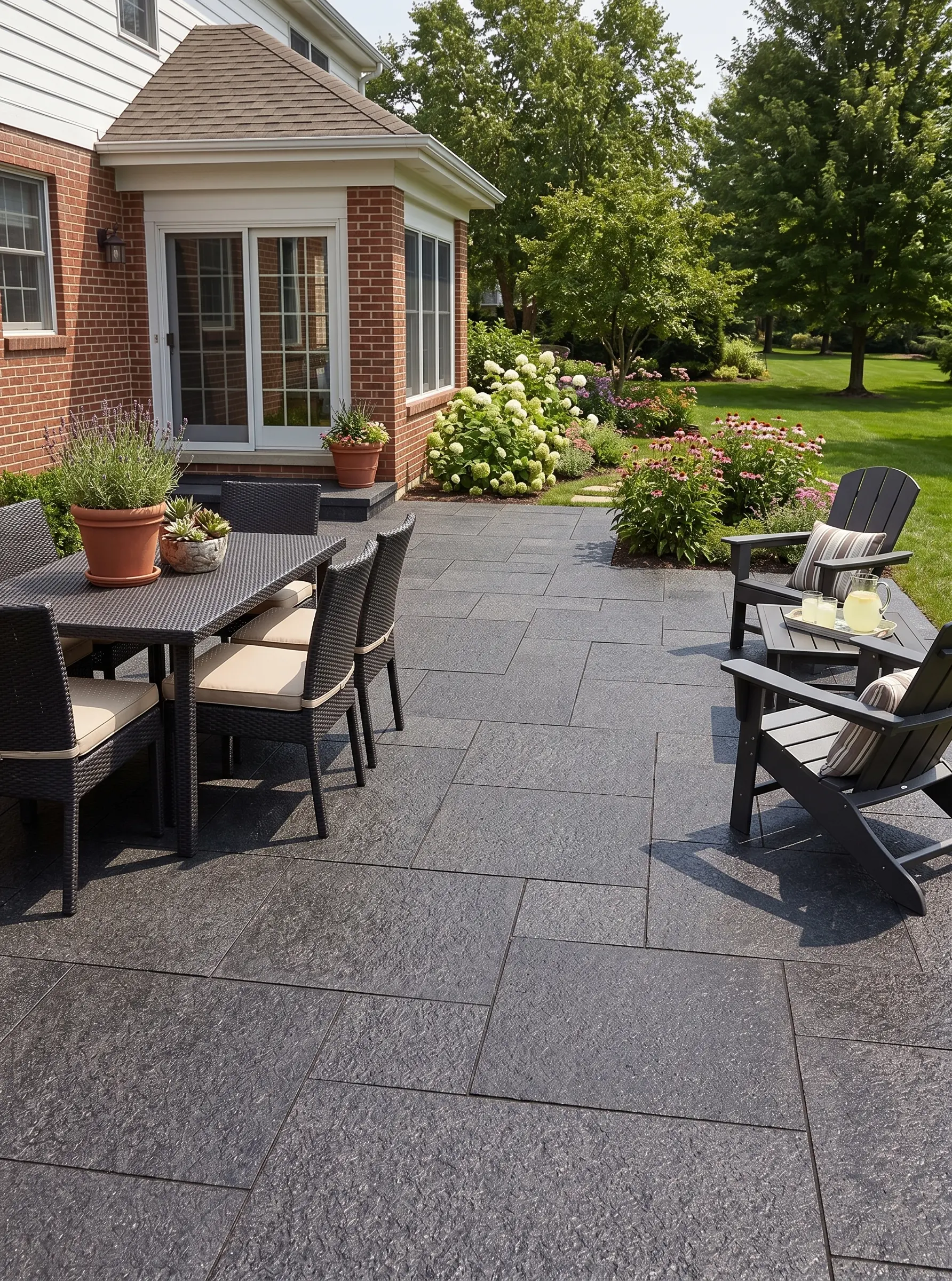
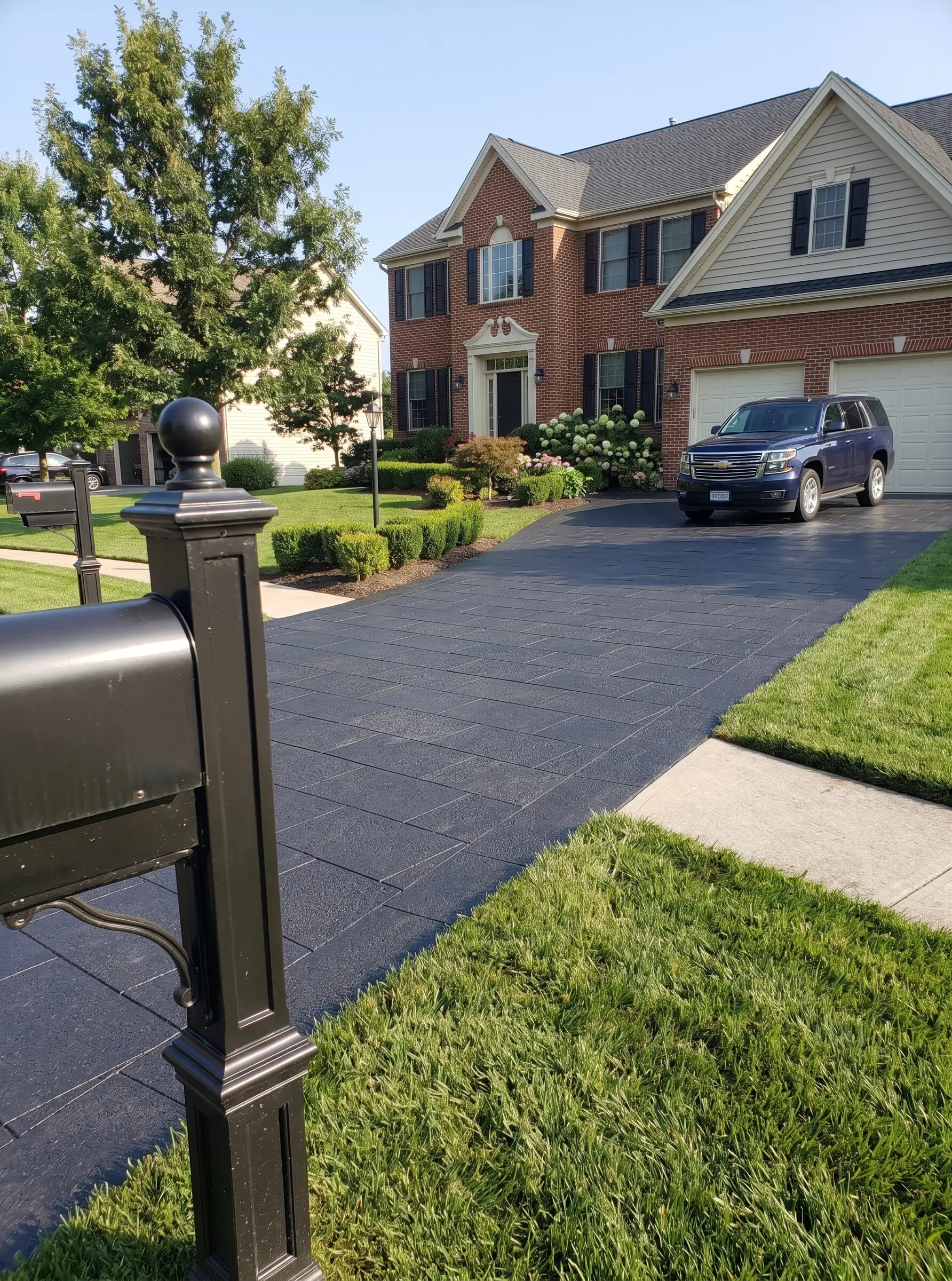
For driveways, use setts or cobbles at least 3.5 in (4 in standard) thick on a compacted base, or pavers 2 in (5 cm) or thicker mortar-bonded to a reinforced concrete slab. Basalt setts and cobbles handle vehicle loads well at those thicknesses when the base is correctly engineered. Basalt tiles and 3 cm pavers serve pedestrian paths, patios, pool decks, and terraces. For interior use, honed and polished basalt tiles produce a refined, dark surface that stays dimensionally stable in controlled environments. If you’re considering basalt for a feature interior floor or wall application, the Citadel Stone basalt selection includes format and finish options worth reviewing alongside your project drawings.
Applications Where Scoria Has a Genuine Role
Scoria isn’t a failed material — it’s a misunderstood one. Its porosity and light weight make it genuinely useful in applications where dense stone would underperform. Landscape drainage layers, green roof growing media, lightweight fill in retaining wall backfill, horticultural aggregate, and decorative mulch in garden beds all benefit from scoria’s pore structure and light bulk density.
- Drainage aggregate in landscaped beds and rain gardens — the open pore structure supports water movement and root development
- Lightweight backfill behind retaining walls, reducing lateral earth pressure compared to dense aggregate
- Green roof substrate layers, where bulk density directly affects structural load on the roof assembly
- Decorative ground cover in arid-climate garden designs where the reddish-brown colour provides visual contrast
- Filter media in some water management and biofiltration contexts
The scoria vs basalt rock decision, then, isn’t a competition with a winner — it’s a question of which material fits the role. If the role is a finished surface, a structural element, or a dimensional product, basalt is the appropriate choice every time. If the role is drainage, weight reduction, or landscape aggregate, scoria may be the right answer.
Sealing and Maintenance Requirements
Sealing basalt follows a straightforward protocol: apply a penetrating impregnator sealer suited to dense, low-absorption igneous stone, re-apply on the interval your sealer manufacturer states, and clean with a pH-neutral product. The dense matrix holds the sealer at the surface zone rather than allowing it to wick deeply, which means the seal works as intended and the stone’s surface colour and texture remain stable.
Attempting to seal scoria for a finished-surface application is a fundamentally different — and largely unsuccessful — exercise. The open pore network means sealer disappears into the stone without forming an effective barrier, and the irregular surface texture makes uniform sealer distribution impossible. This isn’t a product limitation; it’s a material physics problem. Maintenance planning for basalt is realistic and manageable. Maintenance planning for scoria as a finished surface doesn’t have a satisfying answer, which is why it shouldn’t be specified in that role.
Scoria vs Basalt Rock: Getting the Specification Decision Right
The scoria vs basalt rock comparison resolves clearly once you understand what each material’s internal structure actually permits. Basalt’s dense, fine-grained matrix opens it to the full spectrum of dimension stone applications — finished floors, wall cladding, pavers, step treads, and countertops cut to size — across indoor and outdoor environments. Scoria’s porous, vesicular structure directs it to aggregate, drainage, and lightweight fill roles where that porosity serves a purpose rather than creating a liability.
For terrain-specific projects — sloped sites, terraced gardens, hillside patios — basalt’s density and structural consistency give it a stability advantage over lighter, more porous volcanic materials. Base preparation and drainage design matter on every site, but the material itself needs to hold its position and finish quality across the drainage and movement cycles the site generates. Citadel Stone sources and cuts basalt to order at our selected quarries in the Middle East, with specifications confirmed against your project drawings before production begins. For related inspiration on format and layout options in basalt, basalt herringbone tile layouts and applications covers pattern options worth considering alongside your surface specification. Scoria’s open pore structure makes it unsuitable for finished surfaces, which is precisely why Citadel Stone focuses on solid, fine-grained basalt selected for surface uniformity and structural integrity.
Related reading: how basalt columns form · why basalt forms hexagons.