What Grade Actually Means in Natural Stone Construction
Natural stone grades for construction aren’t arbitrary marketing categories — they’re a precise shorthand for a set of measurable physical properties that determine whether a stone performs for 8 years or 40. The grading framework covers compressive strength, absorption rate, modulus of rupture, surface finish consistency, and dimensional tolerance, and every one of those variables shifts depending on whether you’re specifying a wall cladding, a structural floor slab, or an exterior paving field. Most specifiers know the grade names; far fewer understand what the underlying test data actually predicts about long-term behavior.
Understanding natural stone grades for construction requires you to look past surface finish and into the mineralogical structure. A Grade A marble slab and a Grade A limestone slab share a quality designation but behave almost nothing alike under point load or moisture cycling. That distinction is where specifications either succeed or quietly fail.
The Grading Systems You’ll Actually Encounter
Three overlapping frameworks govern how the industry classifies natural stone: ASTM dimensional stone standards, the Natural Stone Institute’s commercial grade classifications, and quarry-level internal grading that varies by country of origin. You’ll need to reconcile all three when writing a specification, because a quarry’s “Grade 1” doesn’t automatically map to ASTM first-quality, and the gap between them can mean real field problems.
ASTM standards are your most defensible reference point. NSI stone variety technical specifications provide the performance benchmarks that align with those standards across the most common construction stones. For each material category, ASTM defines minimum acceptable values for compressive strength, absorption, and flexural strength — and those minimums are the floor, not the target.
- ASTM C615 covers granite dimension stone — minimum 19,000 PSI compressive strength, maximum 0.40% absorption
- ASTM C503 governs marble — minimum 7,500 PSI compressive strength, maximum 0.20% absorption for exterior use
- ASTM C568 addresses limestone — three classes (Low, Medium, and High Density) with compressive strength ranging from 1,800 PSI to 8,000 PSI
- ASTM C629 defines slate performance — modulus of rupture minimum 9,000 PSI, absorption maximum 0.25%
- ASTM C1527 sets travertine parameters — referenced under limestone standards with fill-type and unfilled classifications treated differently
Quarry-level grading typically runs Grade 1 through Grade 3 or uses descriptors like “Select,” “Standard,” and “Commercial.” Grade 1 or Select material represents the tightest dimensional tolerances, most uniform coloration, fewest natural veining anomalies, and highest surface finish consistency. Grade 3 or Commercial still meets structural minimums but exhibits wider color variation, more natural pitting, and dimensional tolerances that require your installer to manage joint sizing in the field.
Granite Grade Comparison: Where Performance Data Diverges
Granite fabricators working at scale produce material across a surprisingly wide performance range — and the grade designation is your primary control point. Selecting granite for high-traffic construction requires you to understand the specific performance delta between first-quality and commercial material, not just accept the category name on a packing list.
First-quality granite from established granite stone fabricators typically delivers compressive strength between 20,000 and 32,000 PSI depending on mineralogy — biotite-rich granites run lower, while fine-grained grey granites frequently exceed 28,000 PSI. ASTM C615 granite dimension stone standards establish 19,000 PSI as the minimum, which means commercial-grade granite may clear the standard by a narrow margin. For exterior cladding or heavily loaded floors, the difference between 19,500 PSI and 27,000 PSI is meaningful over a 30-year service life.
- First quality (Grade 1): dimensional tolerance ±1/16 inch, consistent mineral pattern, no visible fissures exceeding 1 inch
- Standard (Grade 2): tolerance ±1/8 inch, moderate color variation acceptable, hairline fissures permitted if non-structural
- Commercial (Grade 3): tolerance ±3/16 inch, significant color range within a single order, natural pitting and mineral inclusions common
Your thickness specification matters as much as grade when granite goes into structural applications. Exterior cladding panels anchored to a curtain wall system need a minimum 3/4-inch nominal thickness in Grade 1 to maintain flexural performance through wind load cycling. Commercial-grade at the same thickness may show marginal flexural strength values that create long-term risk in facade applications where replacement access is difficult. Experienced granite stone fabricators will flag this risk during the specification review stage — it’s worth asking the question directly before locking in a grade and thickness combination.
Marble Grade Performance: Reading Between the Classification Lines
Marble slab suppliers typically present material in Grade A through Grade D classifications, and the distinction isn’t only cosmetic — it directly predicts maintenance frequency and installation complexity. Grade A marble exhibits a tight, consistent crystalline structure with minimal fissuring; Grade D carries extensive natural veining, open fissures, and structural inconsistencies that require epoxy filling and mesh backing before installation.
The absorption rate is the number to watch closely. Marble’s calcium carbonate composition makes it reactive to acidic moisture, and absorption rate determines how quickly that reaction progresses through the stone body. Grade A marble in the 0.10–0.18% absorption range seals reliably and holds a surface treatment for 18–24 months before resealing is warranted. Grade C material at 0.35–0.45% absorption will cycle moisture through the stone body faster, which accelerates spalling at joints and edge chipping in applications that see frequent wet-dry cycling — a critical consideration in regions that experience heavy rain seasons or pronounced precipitation patterns.
- Grade A: consistent veining, absorption below 0.20%, suitable for exterior use with proper sealing schedule
- Grade B: minor fissures, some epoxy filling at quarry, absorption 0.20–0.30%, appropriate for sheltered exterior or interior heavy-traffic
- Grade C: moderate fissuring, factory-filled and backed, absorption 0.30–0.40%, best limited to interior applications
- Grade D: extensive natural fissuring, heavily backed and filled, absorption above 0.40%, interior use only with limited structural loading
At Citadel Stone, we source Grade A and Grade B marble directly from Mediterranean quarries with documented quality control at the block-selection stage — not just the slab-cutting stage. Block-level rejection of material with subsurface fractures before processing is the step that most prevents grade inconsistency within a single order. Reputable marble slab suppliers will provide block-level documentation on request — if that documentation isn’t available, treat the grade designation as unverified.
Limestone Density Classes and What They Mean for Your Specification
Limestone’s three ASTM density classes — Low, Medium, and High — map more directly to application suitability than any other stone’s grading system. The density classification controls compressive strength, freeze-thaw durability, and absorption, which together determine whether a limestone specification survives 20 years or needs replacement in 10.
Low Density limestone (less than 110 lb/ft³) runs 1,800–4,000 PSI compressive strength. You’ll encounter this class in architectural cladding and interior applications where its workability and lighter weight create real structural advantages — but it has no place in exterior paving for climates that see freeze-thaw cycling or sustained heavy rainfall. Water penetration into Low Density material’s interconnected pore structure during a sustained rain event, followed by freezing, generates internal pressures that exceed the stone’s tensile capacity within a few seasons.
- Low Density limestone: compressive strength 1,800–4,000 PSI — interior cladding, decorative applications
- Medium Density limestone: compressive strength 4,000–8,000 PSI — sheltered exterior, light-traffic paving, wall stone
- High Density limestone: compressive strength above 8,000 PSI — exterior paving, driveway applications, high-traffic commercial floors
High Density limestone in the 8,000–12,000 PSI range is the only class you should specify for exterior paving that will see vehicular traffic or sustained surface water exposure. Its absorption rate below 3% limits moisture infiltration to a level that freeze-thaw cycling doesn’t exploit, and its density supports edge stability at joint interfaces over decades of thermal movement. For projects in regions with pronounced wet seasons or extended rainfall periods, the drainage base design matters as much as the stone class — even High Density limestone can fail prematurely when hydrostatic pressure builds beneath an insufficiently drained base.
Explore our natural stone construction range to review the density class documentation available across our limestone inventory before committing to a specification.
Travertine Fill Grade: Filled, Unfilled, and What the Distinction Costs You
Travertine’s grading system includes a variable most other stones don’t carry: fill status. The natural voids that form during travertine’s calcite deposition process either remain open (unfilled), receive a factory cement or epoxy fill (filled), or get a matching travertine dust-and-resin fill (premium filled). Each option has a legitimate application, but specifying the wrong fill grade for the environment creates maintenance problems that compound over time.
Unfilled travertine retains its natural texture and void pattern, which creates excellent slip resistance in wet conditions — a meaningful advantage for pool surrounds and outdoor walkways where barefoot traffic is the norm. The trade-off is that the open voids collect debris and require more aggressive cleaning to maintain. Filled travertine presents a smoother surface for interior floors and polished exterior applications, but you need to verify what the voids were filled with. Cement-filled travertine in environments that cycle between sustained wet and dry conditions — drought cycles followed by heavy seasonal rain events, for example — will show fill shrinkage and joint opening within three to five years as the fill material and the stone body respond differently to moisture changes. Epoxy or resin fills perform significantly better in those conditions.
- Unfilled: best for exterior wet zones, pool areas, rustic outdoor surfaces — natural void creates drainage micro-channels
- Cement-filled: acceptable for sheltered interior floors, minimal moisture exposure — budget-appropriate where performance demands are modest
- Epoxy/resin-filled: preferred for any application with moisture cycling, temperature swings, or high-polish finish requirements
- Honed filled: the interior standard for high-traffic commercial spaces — combines dimensional stability with slip coefficient suitable for most commercial codes
Building Stone Grades for Structural Construction Applications
Structural applications of natural stone — foundation elements, load-bearing masonry courses, retaining wall cores — demand a specification discipline that goes well beyond the Grade 1/Grade 2/Grade 3 shorthand used in decorative supply. You’re working with compressive strength, modulus of elasticity, and freeze-thaw durability data from actual test reports, not grade designations alone.
Building stone suppliers serving structural applications should be able to provide certified test reports for each quarry batch, not just general material data sheets. The performance range within a single material type is wide enough that batch-level testing matters. A high-density limestone from one quarry face may deliver 10,500 PSI compressive strength; material from an adjacent face in the same quarry might run 7,200 PSI. Both clear the ASTM C568 High Density minimum, but a 30% strength differential is consequential in a load-bearing application. USGS dimension stone production and use data confirms the variability that exists across domestic and imported stone categories — a reality that makes batch documentation non-negotiable on structural jobs.
Retaining wall applications add a drainage performance requirement on top of structural criteria. Your base course and drainage layer design need to handle the hydrostatic load that builds during extended rainfall — particularly relevant in coastal regions and flood-prone zones where drainage management directly affects structural integrity. Stone grade influences water management here too: lower-porosity grades in your facing courses reduce moisture infiltration into the wall core, while proper drainage aggregate behind the wall handles bulk water movement away from the structure.
Grade vs. Finish: Separating Two Variables That Often Get Conflated
Surface finish — honed, polished, brushed, flamed, sandblasted — is a processing variable that operates independently of stone grade. A Grade 2 limestone can receive a flawless honed finish; a Grade 1 granite can be rough-split for a rustic wall application. Conflating grade with finish creates specification errors that show up as material rejection on delivery or performance problems in service.
The finish choice affects the stone’s functional behavior in ways that matter for your specification. A polished finish on a Grade A marble reduces surface porosity by approximately 15–20% compared to a honed finish on the same material — the mechanical closing of surface pores during polishing genuinely reduces short-term water absorption. That sounds like an advantage, but polished surfaces on exterior applications lose their finish clarity within 18–24 months of UV and foot traffic exposure, then become harder to reseal evenly because the surface microstructure has partially opened again.
- Polished: maximum visual impact, reduced surface absorption, slippery when wet — interior floors, wall panels, countertops
- Honed: matte finish, moderate absorption, better slip coefficient than polished — interior and sheltered exterior floors
- Brushed/antiqued: open surface texture, higher absorption, requires sealing — interior feature walls, rustic exterior applications
- Flamed: maximum slip resistance, thermally stressed surface increases absorption — exterior paving, pool surrounds, ramp surfaces
- Bush-hammered: aggressive texture, highest slip coefficient, significant absorption — heavy-duty exterior paving, loading dock surrounds
Your sealing specification needs to match both the grade and the finish, not just the material type. A Grade B limestone with a brushed finish in a region that experiences seasonal flooding risk or heavy rainfall needs a penetrating sealer with a higher solid content — typically 40–50% — applied in two coats with a 4-hour cure window between applications, rather than the single coat specified for a polished interior Grade A application.

Water Management, Drainage, and How Grade Selection Affects Performance
The interaction between stone grade and site drainage design is one of the most underspecified dimensions of natural stone construction. Grade selection doesn’t happen in a vacuum — the absorption characteristics of your chosen stone directly determine what your drainage base needs to accomplish, and that calculation changes significantly across different precipitation environments.
On sites that experience extended heavy rain seasons, flash flooding risk, or sustained seasonal rainfall, the drainage system beneath your stone paving needs to evacuate water faster than the surface can absorb it. That requirement makes low-absorption Grade 1 material a logical choice for surface courses — not because it performs better in compression, but because it limits the volume of water that enters the stone body and creates hydrostatic pressure at the stone-base interface. High-porosity building stone grades in those same environments can absorb enough water during a sustained rain event that the weight increase alone — water is approximately 8.3 lb/gallon — measurably increases the load on your base course.
- In high-rainfall environments: specify Grade 1 or High Density stone for surface courses, minimum 8-inch compacted aggregate base with perforated drain tile at the perimeter
- In drought-cycle climates: Grade 2 material performs adequately, but specify expansion joint spacing at 12 feet rather than 15 feet to accommodate thermal movement during dry-season temperature peaks
- For sloped sites with surface runoff: maintain 1/8-inch per foot minimum grade away from structures regardless of stone grade — gravity drainage outperforms any absorption specification
- For flat installations: incorporate drainage channels between field panels every 10–12 feet, using Grade 1 channel stone with a flamed or bush-hammered finish for maximum grip in wet conditions
Citadel Stone’s technical team regularly assists specifiers in matching stone grade to site drainage conditions before orders are placed — warehouse inventory is organized by density class and absorption certificate, which makes it straightforward to pull material that meets both the structural and the water-management requirements of a specific project.
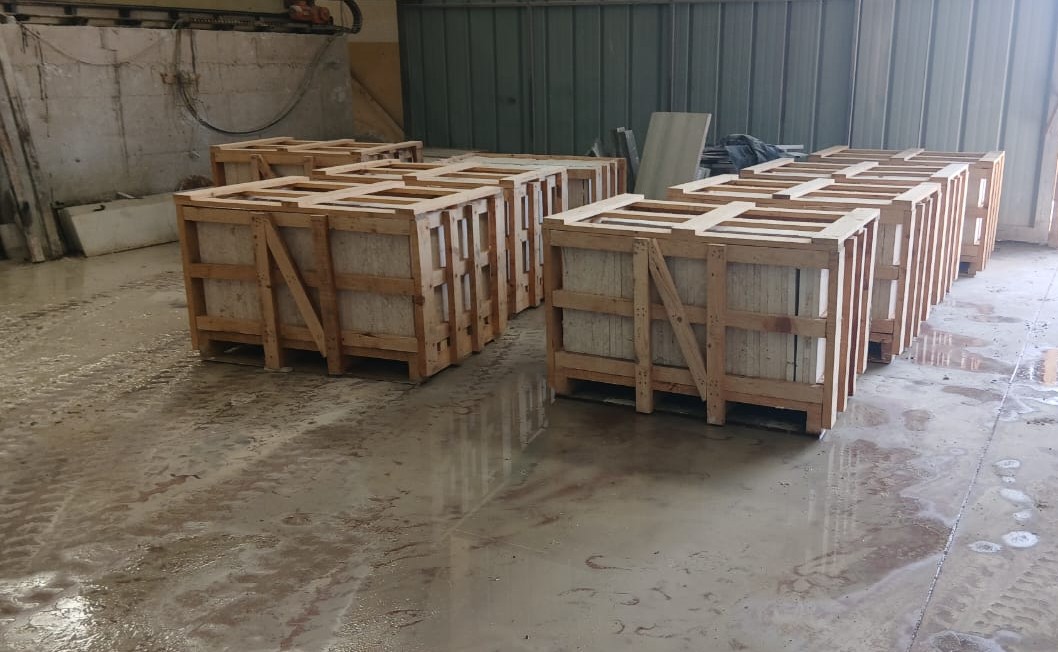
Ordering, Warehouse Logistics, and Grade Consistency Across Large Orders
Grade consistency across a large order is one of the most practically challenging aspects of natural stone construction supply. You can specify Grade 1, receive a delivery that technically passes Grade 1 tolerances, and still find that slabs from two different production runs within the same order vary enough in shade and veining pattern to create visible banding in the installed field. Managing that risk requires you to understand how your supplier controls batch consistency, not just grade designation.
Your truck delivery sequence matters more than most specifiers realize. When material arrives from the warehouse in multiple truck loads across different days, the installation crew will naturally work from whichever pallet is closest — which means material from different production batches gets installed in proximity. Specifying a clear installation sequence that interleaves pieces from different pallets within each truck load, rather than installing one pallet completely before opening the next, is the practical solution. It’s the same principle furniture installers use with wood grain — blend the batches rather than let them segregate by delivery order.
Lead times from warehouse stock for Grade 1 construction stone typically run 1–2 weeks for in-stock material. Custom orders, particularly for oversized slab formats or non-standard thicknesses required by a structural specification, extend that timeline to 8–12 weeks when material needs to be sourced from primary quarries. Building that lead time into your project schedule at the specification stage, not after the slab order is placed, prevents the common field problem of installation crews waiting on material while other trades are ready to proceed.
- Verify warehouse stock levels and batch documentation before finalizing project timelines — grade consistency certificates should accompany the material, not just the grade designation
- Request quarry batch numbers for orders exceeding 500 square feet — this allows reordering from the same production run if additional material is needed mid-project
- Coordinate truck delivery scheduling with your installation sequence to ensure proper batch blending at the installation face
- Confirm that your supplier’s warehouse stores material in climate-controlled or covered conditions — uncovered outdoor storage creates moisture cycling that can affect fill stability in travertine and surface finish in polished marble
Expert Summary: Applying Natural Stone Grades to Construction Decisions
The practical takeaway from a side-by-side comparison of natural stone grades for construction is straightforward: grade is a proxy for a set of measurable physical properties, and those properties need to match the specific demands of your application, not just clear a minimum threshold. Granite’s compressive strength advantage over limestone doesn’t matter if you’re cladding an interior wall where 7,500 PSI marble performs identically at lower cost and better visual depth. Marble’s aesthetic superiority over granite is irrelevant when the application demands freeze-thaw durability that marble’s calcium carbonate structure can’t sustain in exposed exterior conditions.
Natural stone grades for construction reward specifiers who look past the designation and into the test data — absorption rates, modulus of rupture, freeze-thaw cycle ratings, and dimensional tolerances are the numbers that predict real-world performance. Your specification should reference those numbers explicitly, with ASTM standard citations, rather than relying on grade designations alone. That approach gives you enforceable quality control at delivery and a defensible record if performance issues emerge later in the installation’s service life. For a deeper look at evaluating material quality before it reaches your job site, evaluating architectural stone quality covers the assessment framework in practical detail — a natural next step once your grade and performance criteria are set. Direct from quarries in Turkey, the Mediterranean, and beyond, Citadel Stone’s construction-grade inventory supports both high-specification and budget-conscious projects.
Related reading: types of stone for building · finding natural stone suppliers · types of stone for building houses.