The grain structure locked inside marble rock at the moment of metamorphism tells you more about long-term performance than any finish catalog ever will. A marble quarry doesn’t simply extract decorative stone — it exposes a geological record of pressure, heat, and mineral chemistry that determines how your slab will respond to loading, moisture, and thermal cycling across decades of service. Understanding what happens between the mountain face and your project site is the difference between specifying confidently and guessing.
What Is a Marble Quarry and How Does It Work?
A marble quarry is an open-cut or underground excavation site where metamorphic limestone — recrystallized under extreme heat and pressure — is systematically extracted in dimensional blocks. The operation isn’t random; experienced quarry teams read the mountain’s natural joint planes, called “bedding” or “rift” planes, to determine where the stone will cleave cleanly and where forced cuts will produce micro-fractures that compromise slab integrity. Those fractures may not be visible at the yard, but they’ll telegraph stress under load or during installation.
Diamond wire saws have largely replaced traditional channel cutting in modern quarries, allowing teams to produce consistent block dimensions — typically 6 to 10 cubic meters per block — with far less surface shock than percussive methods. The wire cuts under continuous water cooling, which matters because thermal shock from dry cutting can introduce hairline crystalline fractures near the cut face. You’ll sometimes see this show up as “tension lines” in slabs that look superficially sound but delaminate prematurely at the surface.
Block extraction is only half the picture. How the block is oriented relative to the quarry face affects vein directionality in the finished slab. Horizontal cuts produce “fleuri” or cross-cut vein patterns; vertical cuts yield “vein cut” slabs with parallel linear movement. This isn’t an aesthetic preference — it’s a structural consideration, particularly for stair treads and cantilevered countertops where flexural strength along the vein plane matters.
The Geology Behind Marble Rock
Marble rock forms when limestone or dolomite undergoes regional or contact metamorphism — meaning either large-scale tectonic burial or proximity to an igneous intrusion drives temperatures above roughly 300°C and pressures sufficient to recrystallize calcite or dolomite grains into an interlocking mosaic. That recrystallization is what gives marble its characteristic translucency and its ability to accept a high polish. It also eliminates most of the original sedimentary porosity, which is why dense white marble typically shows water absorption rates of 0.1 to 0.4% — well below the 0.75% threshold that ASTM C503 sets as the maximum for exterior building marble.
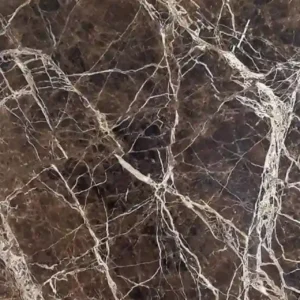
The coloration and veining you see in finished slabs trace directly back to mineral impurities present during metamorphism. Iron oxides produce reds and yellows; graphite yields grey and black tones; serpentine minerals create green veining. Carrara’s iconic grey-blue veining comes from graphite inclusions in concentrations that varied with ancient depositional cycles — which is why no two Carrara slabs are identical, and why quarry-level selection matters far more than showroom sampling. According to marble geological formation and characteristics, the specific mineral assemblage present during metamorphism is the primary determinant of the stone’s final color, hardness, and structural behavior.
Hardness across marble rock varieties ranges from roughly 3 to 4 on the Mohs scale — softer than granite (6–7) but harder than most travertines. That softness is what makes marble carvable and polishable, and also what makes it susceptible to acid etching. Understanding this geology isn’t academic; it directly informs your finish selection, sealing schedule, and appropriate use cases.
Major Quarry Regions and What They Produce
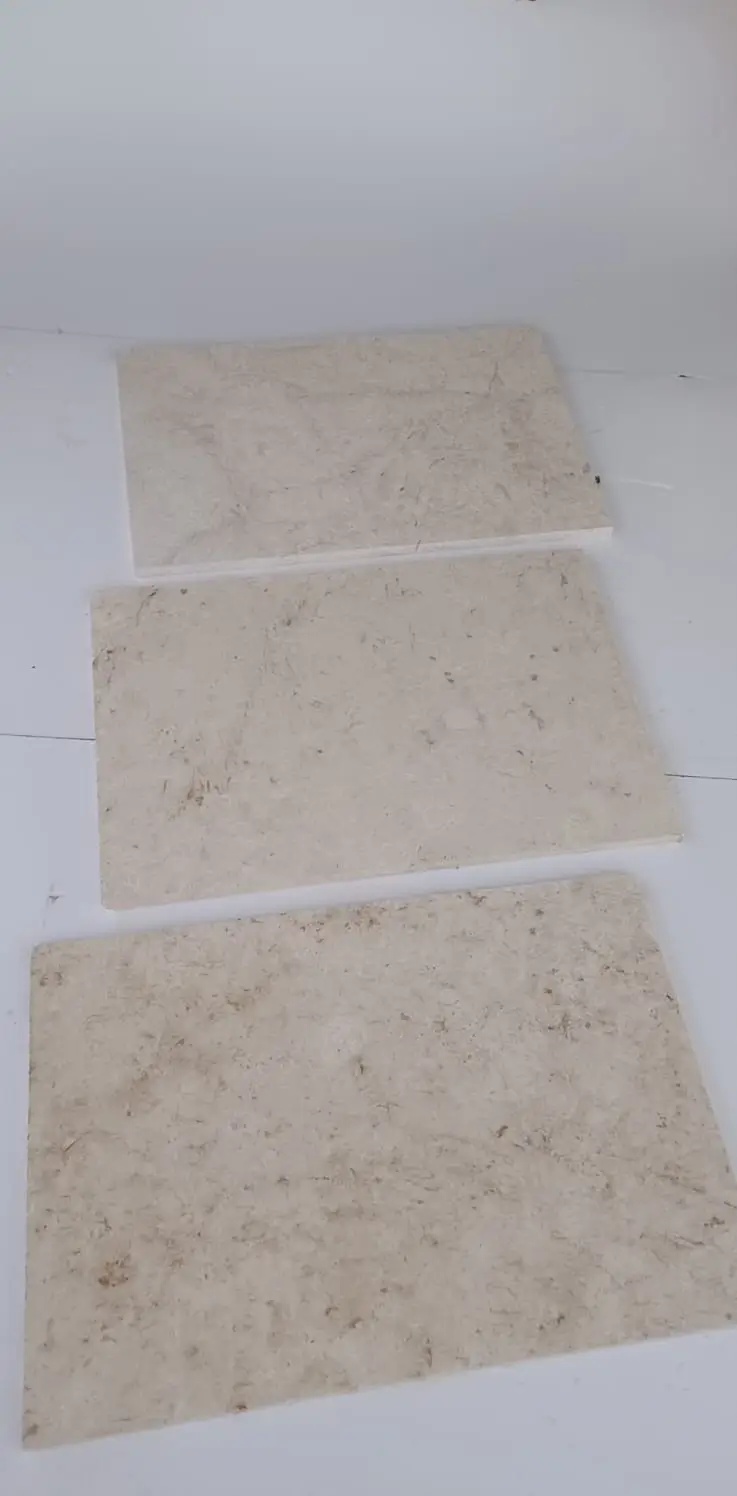
Quarry origin shapes material character in ways that specification sheets rarely capture fully. Italian Carrara quarries, operating in the Apuan Alps since Roman times, produce the calcite-dominant white marble most architects specify for interior applications — low iron, consistent crystalline structure, predictable veining. Turkish marble quarries, particularly in the Afyon and Bilecik regions, yield a broader range including beige-toned varieties with tighter grain that perform well outdoors. Middle East quarries supply distinctive cream and ivory marbles with calcite purities above 98% in select grades — material we source directly and evaluate block by block before it ships.
Greek quarries — Thassos being the most recognized — produce some of the whitest marble on earth, with near-zero mineral impurities and exceptional optical brightness. Indian quarries, concentrated in Rajasthan, supply the green, pink, and black varieties that expand the palette beyond classical white. Each origin brings its own set of structural characteristics: Italian stone tends toward larger recrystallized grain (which polishes brilliantly but can show more micro-relief with age), while Turkish varieties often exhibit a finer grain structure that maintains surface finish longer under moderate traffic.
What you won’t find communicated at the showroom level is the quarry face variation within a single named origin. Two “Carrara” slabs can have meaningfully different porosity and flexural strength depending on which bench they were extracted from. This is precisely why block-level selection — and direct quarry relationships — matter for any project requiring matched material across a large installation.
From Quarry Block to Finished Slab: The Processing Chain
Once extracted, quarry blocks travel to processing facilities where gang saws or multi-wire saws slice them into slabs — typically 18mm to 30mm finished thickness for interior applications, 30mm and above for structural or exterior use. The sawing sequence matters: the first and last slabs from each block often show more variation than the core slabs, so premium projects typically specify “book-matched interior slabs” from the block’s center portion.
Surface finishing follows sawing, and each finish has measurable performance implications:
- Polished finishes seal surface micro-pores and reduce water absorption temporarily, but scratches become highly visible and the surface loses slip resistance when wet
- Honed finishes at 400–800 grit offer a matte surface with better slip resistance — typically a dynamic coefficient of friction above 0.6 dry and 0.4 wet — making them the standard for floor applications
- Brushed or leathered textures add tactile depth and partially close surface pores while preserving the stone’s natural character
- Tumbled finishes create softened edges and a weathered look, but the tumbling process can introduce micro-chips that accelerate moisture uptake at edges
Calibration — mechanical grinding of the back face to a consistent thickness — determines how well slabs lay flat. Uncalibrated stone requires more bedding mortar to compensate for thickness variation, which affects adhesion uniformity and long-term stability. For large-format marble tile installations, specify calibrated stone to within ±1.5mm thickness tolerance.
Understanding Natural Stone Institute marble grades and technical specifications gives you a framework for evaluating slab quality at the specification stage — particularly the A, B, C, and D classification system that accounts for natural fissures, fill, and color variation.
How Marble Quarry Grading Affects Your Project
The industry’s ABCD grading system doesn’t rank marble by beauty — it classifies the degree of natural character present. Grade A marble is the most uniform, with minimal fissures, fills, or color breaks. Grade D material is the most expressive, with significant natural movement that requires full-bed installation and careful handling. Specifying Grade A for a straightforward floor and Grade D for a dramatic feature wall are both defensible choices — but confusing them, or accepting one grade when you specified another, creates real field problems.
Here’s what most specifiers miss: filler presence in lower grades isn’t just aesthetic. Polyester or epoxy fills applied at the factory can react differently from the surrounding stone under thermal cycling. In installations exposed to significant temperature swings — say, a covered outdoor terrace that sees 40°F between midday and pre-dawn — differential expansion between fill and host stone gradually loosens filler bonds over three to five years. Polished Grade D slabs in high-thermal-range environments should be sealed more aggressively and inspected annually.
Vein density also affects structural performance. Heavily veined marble rock has planes of relative weakness along the vein boundaries — particularly relevant for stair nosings and countertop overhangs. For any cantilever exceeding 12 inches in 20mm material, request flexural strength data. ASTM C503 requires a minimum flexural strength of 1,500 psi for exterior marble — but premium selections from quality quarry faces routinely exceed 2,200 psi, which changes your overhang calculations meaningfully.
Thermal Cycling, Freeze-Thaw, and Long-Term Marble Performance
Marble’s coefficient of thermal expansion runs approximately 5.5 × 10⁻⁶ per °F — higher than granite’s 4.4 × 10⁻⁶ and meaningfully higher than the concrete substrates marble typically bonds to. That gap drives a differential movement calculation you need to run for every large exterior installation. A 10-foot run of marble experiencing a 60°F day-night swing — common in continental climates where clear nights drop temperatures rapidly regardless of season — will expand and contract roughly 0.04 inches relative to a concrete substrate. Multiply that across a 30-foot terrace, and you’re looking at movement your thin-set bed cannot absorb without expansion joints every 8 to 10 feet at minimum.
Freeze-thaw exposure adds a different stress mechanism. Water trapped in micro-fissures or incompletely filled joints expands approximately 9% upon freezing, generating tensile stress that progressively widens natural fissures with each freeze-thaw cycle. Even Grade A marble with absorption below 0.3% isn’t immune when joint maintenance lapses — water migrates laterally through grout joints, not just through the stone face. The practical rule: in any region experiencing more than 20 freeze-thaw cycles per year, seal both the stone surface and the grout joints annually, and inspect joint integrity before the first hard frost of each season.
Day-night thermal cycling also affects the adhesive mortar bed. Thin-set mortars rated for exterior use typically accommodate ±0.02 inches of differential movement per linear foot before shear stress builds to bond-breaking levels. Polymer-modified mortars extend this range to roughly ±0.035 inches — a meaningful upgrade for any exterior marble installation in a thermally variable environment. Don’t let a contractor substitute standard thin-set to reduce material cost on exterior work. The failure mode — spalling tiles at year four or five — is expensive and entirely preventable at specification stage.
Sourcing Marble Rock: Supply Chain Realities
The journey from quarry block to warehouse inventory involves more variables than most project timelines account for. Block extraction, primary sawing, surface finishing, quality sorting, crating, ocean freight, customs clearance, and domestic trucking typically span 10 to 14 weeks for standard grades. Premium grades from select quarry faces — particularly book-matched sets or rare color bodies — can run 18 to 22 weeks from order confirmation to warehouse receipt.
This timeline has a critical implication: you need to confirm material availability and initiate the order before your project’s installation window opens, not when it opens. Waiting until rough framing is complete to source premium marble is the most common scheduling error in high-value residential projects. Savvy project managers lock slab bundles with a deposit 12 to 16 weeks ahead of the installation date, staging material in the warehouse until the substrate is ready.
At Citadel Stone, we evaluate marble quarry output at the processing stage — assessing block yield, surface character, and structural integrity before slabs enter our supply chain. That pre-selection process is what allows us to offer consistent material across full project quantities rather than assembling mismatched lots from secondary markets. For projects requiring large quantities or specific vein character, our team can arrange direct block reservation with selected quarries, giving you warehouse-ready material on a defined schedule. That’s a significant advantage over sourcing from domestic distributors working from available inventory rather than dedicated allocations.
Truck delivery logistics deserve attention too. Large-format marble slabs — 120″ × 60″ or larger — require specialized flatbed transport with A-frame crating. Your site access needs to accommodate a truck with a boom crane or forklift offload capability. Confirm clearance heights, surface load ratings for access drives, and staging area dimensions before scheduling delivery. A slab broken during an awkward site offload isn’t covered by material warranties, and replacement lead times restart the 12-week clock.
For more detail on how we manage the complete material journey, explore our quarry-to-slab supply process, which covers quality checkpoints from extraction through final delivery.
Specifying Marble for Your Project: Technical Decisions That Matter
Specification precision separates installations that perform for 30 years from those that require remediation at year eight. Start with end-use requirements and work backward to material parameters — not the other way around.
- For interior floors with moderate traffic, specify honed finish at 400 grit minimum, calibrated thickness ±1.5mm, Grade A or B classification, and a water absorption rate below 0.5%
- For exterior horizontal surfaces, require ASTM C503 compliance, flexural strength minimum 1,800 psi, absorption below 0.4%, and polymer-modified thin-set with movement joints at 8-foot maximum spacing
- For countertop applications, request flexural strength data if any cantilever exceeds 10 inches in 20mm material, and specify penetrating sealer application before installation — not after, when grout residue can interfere with sealer bond
- For vertical cladding, coordinate with the structural engineer on anchor system requirements; natural stone veneer panels above 30 feet typically require mechanical anchorage rather than adhesive-only systems
- For high-humidity environments like bathrooms and steam rooms, prioritize lower-absorption grades and specify epoxy grout to eliminate the grout joint as a moisture pathway
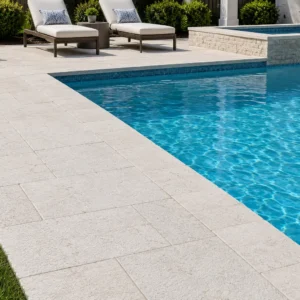
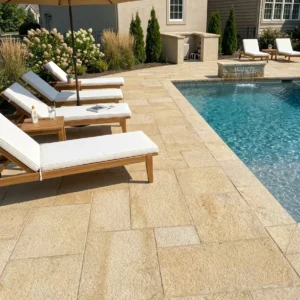
Thickness selection also depends on span. The 20mm nominal standard works well for most interior applications with full substrate support. Exterior applications with any unsupported span — pool coping edges, stair nosings — should step up to 30mm minimum. The cost differential is modest; the performance difference is substantial.
Maintenance Realities and Long-Term Performance
Marble’s maintenance requirements are predictable and manageable — provided you set accurate expectations at the outset. The material is calcium carbonate, and calcium carbonate reacts with acid. Coffee, citrus, wine, and most household cleaners with pH below 7 will etch a polished marble surface if left in contact for more than a few minutes. That’s not a defect; it’s chemistry. Honed finishes show etching less dramatically because the surface is already matte — a practical reason to spec honed for kitchen counters and high-traffic floors.
Sealing frequency depends on the stone’s absorption rate and the use environment. A dense Thassos or Calacatta marble in a low-traffic bathroom might need sealing every two to three years. A more open-structured beige variety in a commercial lobby warrants annual sealing. The water bead test tells you when resealing is due: drop water on the surface and watch. If it beads and sits for 10 minutes without absorption, the seal is holding. If it darkens the stone within 3 minutes, reseal now.
According to ASTM C503 marble building stone specification, the standard test methods for absorption, density, compressive strength, and flexural strength give you the baseline performance data to predict maintenance intervals and select appropriate sealing products. Request this test data from your supplier — any reputable source should have it on file for the specific material they’re selling.
Grout joint maintenance is the most overlooked long-term factor. Sanded grout in marble installations is generally inappropriate — the sand particles abrade polished edges over time. Specify unsanded or epoxy grout for joints under 1/8 inch. Check joint integrity annually in exterior applications, particularly after the first freeze-thaw season following installation. Cracked or spalling grout allows water infiltration that undermines both the adhesive bond and, in freeze-thaw regions, the stone edges themselves.
Final Recommendations for Marble Quarry Specification
The marble quarry is where the material’s fundamental character is fixed — everything that happens downstream in processing, finishing, and installation either honors or wastes what the geology provided. Your specification decisions need to trace back to quarry-level variables: origin, grain structure, vein density, grade classification, and dimensional tolerances. These aren’t abstract quality considerations — they’re the variables that determine whether your installation performs as designed or requires remediation within a decade.
Prioritize verified material data over showroom aesthetics. Request ASTM C503 test certificates, confirm calibration tolerances, and specify expansion joints sized for the actual thermal range your installation will experience — not the mild-condition assumptions baked into generic guidelines. In climates where diurnal temperature swings exceed 40°F or freeze-thaw cycles are a seasonal reality, those joint calculations move from nice-to-have to structurally essential. Your setting mortar selection should match the thermal exposure, with polymer-modified products as the default for any exterior horizontal application.
Plan your supply chain timeline before your installation schedule, not alongside it. Warehouse inventory for standard grades provides shorter lead times, but premium or matched material requires early commitment. Confirm truck access and offload equipment before scheduling delivery — a damaged slab on arrival resets your timeline in ways that downstream cost overruns rarely recover from. If you’re exploring how other natural stone options compare at a material level, faux marble versus real marble differences covers the performance and aesthetic trade-offs worth understanding before you finalize your specification. Marble stone at Citadel Stone is selected at the quarry face, so color and vein character stay predictable across full slab bundles.
Related reading: marble manufacturers · granite marble buying guide · What Do Granite Fabricators Do? A Full Breakdown.