An island built from its own rock
Drive anywhere on Grand Cayman and you are driving on the islands themselves. The Pleistocene Ironshore Formation along the coast and the older Bluff Formation dolostone beneath it have supplied fill, aggregate, base course and rough walling for as long as anyone has built here. That is not a story of geological poverty. It is a story of rock so hard and so irregular that it has always been better used as structure than as a finished floor, which is exactly why the two material streams on these islands have never competed. Understanding that division changes how a specification gets written and how a budget gets built.
Caymanite belongs in a setting, not underfoot
Any conversation about Cayman stone has to pause on Caymanite. It is a rare banded dolomite formed in ancient karst voids within the Bluff Formation, found only on the Cayman Brac bluff and at the East End of Grand Cayman, and it carries layered earth tones because the metallic content differs from one stratum to the next. It is cut, polished and set in gold as jewelry and keepsakes, and it is a genuine national emblem rather than a building commodity. Nobody paves with Caymanite, nobody should, and it belongs on no supplier list as a rival to anything. Mentioning it here is a matter of respect, not comparison.
What local stone does best
Island rock earns its place on every project here, usually below the visible surface and often in the parts that decide whether the visible surface survives. Specifying it locally also shortens the supply line to a few miles instead of a few hundred, which is worth real money on a barge-served island.
- Crushed aggregate and base course under terraces, drives and slabs.
- Fill and grading material for level changes and coastal build-up.
- Rough walling, capped garden walls and boundary work with real local character.
- Rubble and armor where a coastal edge has to hold against weather.
What imported dimension stone adds
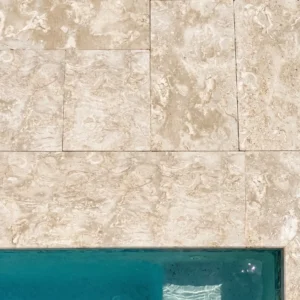
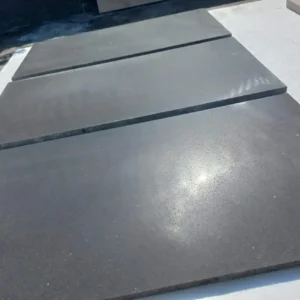
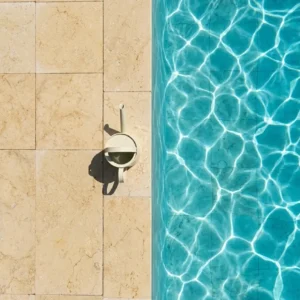
What no local operation produces is calibrated dimension paving: factory-flat, thickness-consistent, finish-controlled and supplied with documented absorption. That is the gap our calibrated limestone paving units are cut to fill, and it is a narrow, specific gap rather than a claim about superiority.
- Consistent thickness, so bedding depth stays predictable across a large terrace.
- Square, true edges that let joint widths stay tight and even.
- Repeatable finishes, so grip and glare behave the same on every unit.
- Tested absorption and density figures a specifier can actually compare.
None of that makes imported stone a better rock. It makes it a processed component, which is a different thing entirely.
Details where the two meet well
The best Cayman properties use both, and the junctions between them are where the design usually happens. Getting these details drawn early also keeps the imported order small, because you are only buying the finished surface.
- Local rubble walls capped with a calibrated coping in the same tonal family.
- Imported paving for the terrace field, island stone for the retaining structure beneath it.
- Rough local stone as planter faces framing a smooth, dressed walking surface.
- Aggregate paths reading as a soft edge where formal paving stops.
Ironshore, setbacks and where paving can sit
Ironshore is not only a material on these islands, it is also a planning reference. Coastal setback distances are measured with reference to it, so where the ironshore edge falls affects where a terrace, deck or pool surround is permitted to sit. That makes local geology part of the paving conversation long before anyone chooses a tone. Development approvals run through the Central Planning Authority under the Development and Planning Act, and the sensible sequence is to establish the setback line first and design the hard landscape inside it, rather than around a drawing you have already fallen in love with. Redrawing a terrace after the line is confirmed is expensive, slow and entirely avoidable.
Getting the tones to agree
Local rock reads warm grey to buff, weathered and irregular, with the pitted texture that gives ironshore its name. Imported pale limestone reads cleaner and far more even. Put the two side by side without thought and the contrast looks accidental; put them together deliberately and the result reads as a building that knows where it stands.
- Keep both materials inside one tonal family rather than chasing an exact match.
- Let local stone stay rough and imported stone stay smooth, so the contrast looks intended.
- Never ask new stone to imitate weathered stone; the imitation shows within a season.
- Use a shared coping or threshold detail to make the junction deliberate rather than apologetic.
Working with both, honestly
A supplier who tells you the local rock is inferior is either uninformed or hoping you are. The accurate statement is narrower and far more useful: these islands produce excellent hard rock for aggregate, fill and walling, and they do not produce calibrated dimension paving, so that one component travels in by sea and lands at George Town by barge. Everything else can be sourced within sight of the site. If you are weighing a specification, supplying stone across the islands is work we plan around local materials rather than against them. Use island stone for structure and character, and import only the finished surface you cannot cut here.