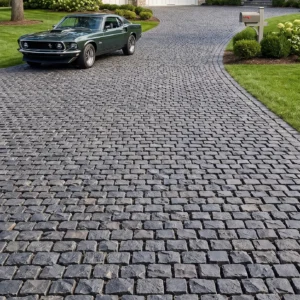
An island already made of limestone
Limestone underlies roughly two-thirds of Jamaica. That single fact ought to end the conversation about importing stone, and on most projects it very nearly does: the aggregate under your base course, the marl on the access road and the blocks in the boundary wall are all local. The question a specifier actually faces is narrower and much less romantic. Which parts of a paved surface can local supply serve outright, and which part needs a unit sawn to a controlled thickness with a documented finish behind it? Answer that honestly and the material schedule stops being an argument about national pride and becomes an ordinary procurement decision with two suppliers on it.
Who regulates quarrying, and under what law
The Mines and Geology Division, under the Ministry of Transport and Mining, supervises quarrying through the Mining Act and the Quarries Control Act. The non-metallic sector it oversees is set out explicitly, and it is worth reading in full before anyone claims the island lacks stone.
- Limestone, the material lying beneath roughly two-thirds of the island.
- Silica sand, worked commercially under the same statutory framework.
- Marble, a genuine part of the national geological inventory.
- Marl and fill, the backbone of road, yard and site construction.
- Clay, feeding block, brick and ceramic production.
So Jamaica has stone, a regulator with statutory authority, and a quarrying industry supplying the construction sector every working day of the year. Any contractor buying local material should be dealing with a properly licensed operator inside that framework, and the paperwork is straightforward to ask for.
What local quarrying supplies extremely well
Before importing anything, be clear about what already arrives by truck.
- Crushed aggregate for concrete, base course and drainage layers.
- Marl and fill for roads, yards and general site preparation.
- Block and masonry material for walls and structural work.
- Cement feedstock that keeps the domestic construction chain moving.
- Rubble and rough stone for walls, steps and landscape features with real local character.
The gap is calibration, not quality
None of that is a paving unit in the dimension-stone sense. A calibrated paver is sawn to a stated thickness within a tight tolerance, finished to a repeatable texture, sorted for shade, tested for water absorption and packed so a crew can lay a large area without shimming every third piece. That is a factory process rather than a geological one. The honest sentence is that Jamaican quarries produce the material the island is built from, while no local operation currently produces factory-flat, thickness-consistent dimension paving with documented absorption. That is precisely the narrow job calibrated limestone paving units exist to do.
Jamaican marble deserves its own line
Marble sits in the regulated non-metallic list alongside limestone and silica sand. It is part of the island’s geological inventory and part of its identity, and imported paving has no business setting itself against it. The two answer different briefs entirely. Marble is a feature material with a domestic story attached to it; a calibrated exterior paver is a working surface that has to behave identically across four hundred square feet of hotel terrace, in rain, under trolleys, for years. A designer who wants the story should use the domestic material and say so openly, and a designer who wants four hundred identical units should buy them as such. Confusing the two arguments is how projects end up disappointed with both.
A split specification that uses both sources
The strongest Jamaican schemes divide the work deliberately rather than choosing a side.
- Local aggregate and marl for base, sub-base and drainage layers.
- Local block and rubble for retaining walls, planters and boundary work.
- Imported calibrated units for the trafficked field, copings and step treads.
- Local labor and local setting sand, since bedding is where most failures actually start.
- Domestic stone features wherever the design wants character rather than repetition.
The landed-cost stack, stated honestly
Imported stone carries a cost the local product does not, and pretending otherwise helps nobody. Import duty commonly runs at 20 percent under the CARICOM Common External Tariff, General Consumption Tax adds 15 percent, an environmental levy of 0.5 percent applies, and a Standards Compliance Fee of 0.3 percent is collected by Jamaica Customs for the Bureau of Standards Jamaica, with a Customs Administrative Fee due as well. Everything is computed on the CIF value. Confirm current rates with your broker before committing a budget, since classifications and rates both move. Split specification exists precisely so that stack is only paid on the areas that genuinely need it, and so the largest volumes on the job never leave the island’s own supply chain in the first place.
How a mixed order actually runs
Two supply chains on one program need two timelines, and the Jamaica supply overview is planned around the slower of them.
- Kingston Freeport Terminal serves the capital and the south and east of the island.
- Montego Bay is normally the shorter road leg for the north-coast resort belt.
- Local materials follow the island timeline; imported units follow the sailing timeline.
- Samples travel first, so shade and finish are agreed before a container is ever packed.
Order the local material for what it does best, import only the calibrated part, and the budget lands where it actually buys performance.