Two Industries, Not One Contest
It is worth saying plainly, because plenty of imported-stone marketing gets this wrong. Saint Lucia is not short of stone. The island has an established, locally owned aggregate and quarry sector with names any contractor here will recognize, and those firms supply the material that most of a hardscape build is actually made of. The local industry is built around aggregate, armor stone, blocks and ready-mix rather than around calibrated dimension stone: gauged, cut, honed slabs and setts to a consistent thickness. That is a different industry with different plant, and it is the only place an import genuinely belongs.
Getting this framing right matters commercially as well as socially. A specifier who opens a meeting by talking down local material has lost the room before the samples come out of the box, because the people around the table have worked with those quarries for years and know exactly what they can and cannot deliver. The stronger position is simpler and truer: you are adding one layer, not replacing an industry.
Who Supplies What on the Island
The operators below are the ones a site manager already deals with, and their product lines tell you exactly which layer they own.
- Wilrock Limited, family owned, quarrying and processing at Saphyr Estate in Laborie, with screened aggregates, blocks, ready-mix, filter stone and armor stone for coastal protection.
- Concrete and Aggregates Ltd, part of the C.O. Williams group and established in 1988, a leading source of ready-mix, crushed rock and asphalt.
- Quarry Products Ltd, locally registered and owned, operating since 1986.
- RG Quarry Limited, supplying boulders and crushed aggregate.
- Shuga, Sand and Stone Limited, a Saint Lucian quarry under O.B. Sadoo Engineering Services.
The Layer Model in Practice
Think of a terrace or a driveway as a stack rather than a surface, and the buying decisions sort themselves out.
- Local crushed rock forms the sub-base and the open-graded bedding layer beneath everything.
- Local ready-mix does the slabs, the pool shell and the retaining structures.
- Local armor stone protects the coastal edge wherever the sea reaches the property.
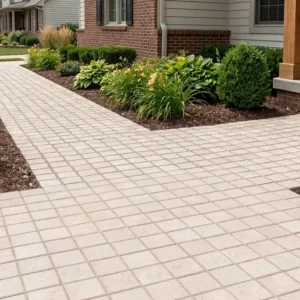
- Imported dimension stone is the last few inches that people touch, look at and photograph.
Why Calibration Is the Real Import
What you are buying from abroad is not hardness or beauty so much as consistency. Units cut to a repeatable thickness lay faster, bed thinner, hold falls more accurately and produce joints that stay even across a large area. On a site where skilled hands are in demand, that consistency is money. It is also why the wearing surface over local aggregate is worth importing while the tonnage underneath is not: freight on bulk aggregate makes no commercial sense, and the local product is already there.
Designing the Joint Between Layers
Most failures happen where two trades meet, not inside either one of them.
- Agree the bedding material and its grading before the paving is ordered, not after it lands.
- Confirm finished levels early, because a calibrated slab has far less tolerance for a rough base than a poured surface does.
- Set drainage falls and joint permeability together, since intense rainfall will find any flat spot you leave.
- Detail the edge restraint properly, as sheet flow down a slope undermines edges long before it lifts a slab.
- Keep the local supplier in the conversation, because they know the ground conditions on that side of the island.
What Tomas Still Teaches
When Hurricane Tomas hit on 30 October 2010, the lasting damage came from water rather than wind, and the numbers still shape how people build here.
- Up to 668 mm of rain fell in around 23 hours across the island.
- Most destruction came from landslides that cut roads and washed out river banks.
- Total damage and loss ran close to 43.4 percent of that year’s GDP.
- The base and drainage layers bought locally are what carry a project through that scenario.
Getting Both Halves to Site
Local aggregate arrives by truck; the imported half arrives by sea. Saint Lucia takes ocean freight directly through SLASPA’s ports, with Castries handling most container traffic from a tight ten-acre site and Vieux Fort, beside Hewanorra and the free zone, serving southern work. Castries has been congested enough that off-site container storage at Cul de Sac was introduced, so pre-arranging haulage matters. Entries go through ASYCUDA World, and while a broker is not compulsory, commercial container entries are effectively filed through one. Talk to stone logistics for Castries and Vieux Fort early so the pallets and the pour do not collide.
A Frame That Holds Up
The clean version of this argument fits in a sentence a client will repeat: the island’s quarries supply the base, the concrete and the armor stone, and the import supplies the wearing surface that sits on top of them. It respects the businesses that employ Saint Lucians, it puts freight only where freight earns its keep, and it gives the finished project a calibrated surface without pretending the ground beneath it came from anywhere else.
It also produces better buildings. The base course and the drainage layer are what carry a terrace through a wet October, and those are bought from people who understand the ground on that side of the island far better than any overseas supplier could. The imported layer then does the one job it is genuinely better at, which is arriving flat, square and consistent, pallet after pallet, so a mason can work at speed. Specify the stack, not just the stone, and both suppliers do their best work.