The wrong question and the better one
Asked to choose between limestone and basalt, most buyers want a winner. Jamaica refuses to produce one. A single property hands you several different exposures within a few hundred feet: a sun-blasted pool deck, a shaded service run, a salt-facing frontage and a sloping driveway that becomes a stream twice a year. The sensible method is to match material to exposure rather than pick a favorite and lay it from the gate to the water. That approach also spreads cost sensibly, since the expensive decision on a Jamaican property is almost never the stone itself but the area you buy it for. Walk the site at eleven in the morning and again at four in the afternoon, and the zones tend to draw themselves.
What basalt brings to a Jamaican site
Basalt is the volcanic answer, and its strengths are structural rather than decorative.
- A dense, dark stone with low water absorption and strong abrasion resistance.
- Excellent behavior under vehicles, which suits driveways, forecourts and service routes.
- A deep gray-to-charcoal tone that hides tire marks and general urban grime.
- Reliable performance in shaded, damp locations where staining shows badly on paler stone.
- A visual weight that reads as contemporary against white render and glass.
Its cost is heat. A dark surface under full Jamaican sun becomes genuinely uncomfortable for bare feet, which is a design constraint rather than a defect. Our dark basalt paving units are specified for shod traffic and wheels.
What limestone brings in return
Limestone answers the comfort and character half of the brief.
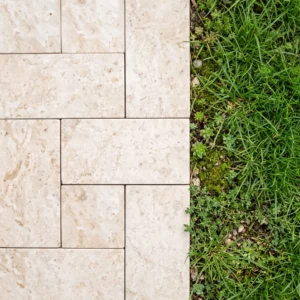
- A pale surface that reflects the middle of the day instead of storing it.
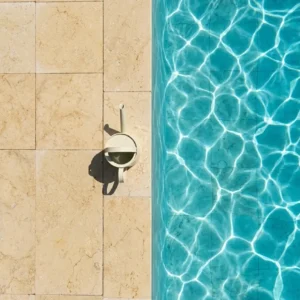
- Comfort underfoot on pool decks, terraces and any barefoot route.
- A softer, warmer character that sits well beside timber, planting and the sea.
- A wide finish choice, from bush-hammered grip through to honed calm.
- Easy visual continuity between interior tiles and exterior paving.
Its constraints are chemistry and section: it dislikes acidic cleaners, and it wants honest thickness under wheels. Specify limestone paving by exposure zone and both constraints disappear.
Zone one: the north-coast resort belt
From Montego Bay through Rose Hall to Ocho Rios and around to Negril, the drivers are barefoot comfort in strong sun and constant salt on the breeze. Pale limestone with a textured face carries the pool decks, terraces and guest routes. Basalt earns its place at the back of the property, on the vehicle apron, the loading yard and the staff paths, where feet are shod and tires are the real load. Montego Bay is usually the shorter road leg for this belt, and splitting a single order between a pale field and a dark service run costs nothing extra in freight because both arrive in the same container.
Zone two: Kingston forecourts and driveways
The capital runs an urban duty cycle that resort schedules never see. Town-house courts, apartment parking, commercial forecourts and delivery aprons take vehicles, oil, dust and daily wear.
- Basalt across the vehicle areas, in a heavy section on a properly compacted base.
- Limestone for the shaded courtyard, the entrance walk and the roof terrace.
- Setts or cobbles at the crossover, where turning loads concentrate hardest.
- Contrasting bands to mark the change from pedestrian to vehicle territory.
Zone three: hill sites and orographic rain
Rainfall stacking against the Blue Mountains puts far more water through paving on the eastern and northern slopes than a Kingston site ever handles. On sloping ground the priority shifts away from surface temperature and toward grip, drainage and the stability of the bedding layer. Split-face basalt on ramps and steps, limestone on the level terraces above them, and drainage sized for real rainfall is the pattern that keeps working season after season. Retaining structures and cut-off drains deserve the engineer’s attention before the paving schedule does, because a beautifully laid terrace above a failing slope is a short-lived thing.
Zone four: storm exposure and the code behind it
Hurricane Gilbert in 1988 remains the national benchmark, and design wind speed was lifted from 120 mph to 150 mph in its aftermath. The Building Act 2018, in operation since 15 January 2019, adopts the National Building Code of Jamaica through the Bureau of Standards Jamaica, and Beryl reminded the south coast of the same lesson in July 2024. Paving is not the structural element in a storm, but loose units, undermined bedding and blocked drainage turn a survivable event into an expensive one. Both stones perform when bedded properly, and neither performs when they are not. Ask your engineer where the water leaves the site in a hundred-year event, and specify the paving downstream of that answer rather than ahead of it.
Mixing both stones on one drawing
The strongest Jamaican schemes use both materials on purpose rather than by accident.
- Choose by exposure zone first, then reconcile the palette across the whole site.
- Keep thickness consistent per traffic class rather than per material.
- Use one stone as the field and the other for bands, borders and step treads.
- Agree shade and finish from samples of both before any container is packed.
Tell us where the sun lands, where the wheels turn and where the water goes, and the material schedule writes itself.