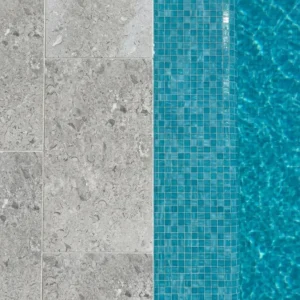
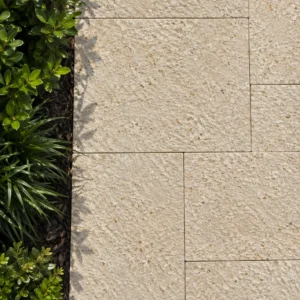
Two good stones, different jobs
Comparisons between limestone and basalt usually get framed as a contest, which is the wrong shape for the question. Both are proven exterior paving materials, both can be supplied dense and low in absorption, and both are used across the Caribbean without drama. What differs is how each behaves in a specific position: how hot it gets, how it reads in strong light, how heavy it lands at the port and how it takes traffic. Answer those four questions for each part of a property and the material allocation stops being a matter of taste and starts being a matter of record.
Start with exposure, not with taste
Walk the site and mark it up before anyone opens a sample box. A full-sun open deck is a different specification from a shaded courtyard, and a shoreline terrace is different again from a covered drive apron. Exposure on these islands means four things at once.
- Hours of direct sun on the surface across an average day.
- Distance from salt-laden air and the frequency of the freshwater rinse.
- How much water the surface handles from rain, splash or irrigation.
- What weight rolls or stands on it, from bare feet to service vehicles.
Where pale limestone wins
Pale stone is the default across most of a Cayman property for one straightforward reason: it stays walkable when the sun is at its worst. Our pale limestone paving options are specified most often for the areas below.
- Open pool decks and sun terraces where bare feet are the point.
- Large amenity decks that need to stay comfortable through the afternoon.
- Shoreline terraces where a light tone hides salt film between rinses.
- Any area where the design wants brightness and a soft, reflective surface.
In practice that covers most of the ground on a residential property, which is why pale stone tends to be the field material and everything else the accent.
Where basalt wins
Basalt is a dense volcanic stone with excellent wear resistance and a deep charcoal tone, and it earns its place in the positions where heat underfoot is not the governing issue. The basalt formats for hard use we carry suit these zones well.
- Drives, parking aprons and service yards carrying vehicle loads.
- Shaded courtyards and covered walks where surface temperature stays moderate.
- Banding, thresholds and edge details that need to contrast with pale field stone.
- Commercial forecourts where scuffing and staining must not show.
Used in those positions it is a superb material, and it gives a pale scheme the weight and definition that pale stone alone never quite achieves.
The heat trade-off nobody can design away
Dark stone gets hot at this latitude, and no finish, sealer or format fixes that. It is a property of tone and sunlight, and any supplier claiming otherwise is not being straight with you. That single fact draws the boundary line on most Cayman properties: basalt lives in shade, under cover, under wheels or as an accent, and pale limestone takes the barefoot ground. Accepting the limitation is what lets basalt be used well, because it stops the material being blamed for a placement decision that was wrong from the start. Plenty of handsome basalt has been ripped out of sun-baked decks that should never have received it.
Wind, storm and fixing method
Ivan in 2004 remains the reference point for how buildings are put together here, and the standards that followed treat wind seriously. Under the provisions that shaped the modern rebuild, design wind speeds ran from around 150 mph for the lowest risk category up to the 186 to 200 mph band for critical structures, and the Cayman Islands Building Code has been revised since. Paving is rarely wind-designed in its own right, but the fixing method matters a great deal. Mortar-set terraces and properly capped walls behave in a storm; loose-laid units on exposed elevated decks do not, whichever stone they happen to be cut from.
Weight, freight and the duty line
Both materials arrive by sea, so the commercial side deserves a place in the decision rather than a footnote at the end of it.
- Basalt is typically denser, so a given area weighs more and fills a container sooner.
- George Town works by lighterage, so pallet weight and packing discipline matter on both stones.
- Building materials landing on Grand Cayman attract a concessionary duty rate rather than the general tariff.
- Cayman Brac and Little Cayman hold a building-materials waiver running through the end of 2030.
Rates and classifications sit with Customs and Border Control, so confirm the current rate with your broker before the budget is fixed. Weight also decides how much of a scheme fits in one movement, which is worth checking before the split between the two stones is finalized.
Splitting a property between the two
The strongest Cayman schemes use both stones deliberately. Pale limestone runs the pool deck, the terraces and the barefoot ground. Basalt takes the drive, the shaded courtyard, the thresholds and the banding that gives the pale field its edge. The two tones sit well together when the split follows use rather than fashion, and the property reads as though somebody thought about the sun. Order small samples of both, leave them outdoors on site for a fortnight, and stand on each at three in the afternoon. Let exposure decide the stone, and both materials will look like the right answer.