Exposure, Not Preference
The limestone-or-basalt question is usually asked as a matter of taste and answered as a matter of exposure. On a property in Saint Vincent and the Grenadines, one boundary can enclose four different environments: open windward frontage taking salt spray, a sheltered courtyard, a barefoot pool deck, and a service yard carrying vehicles. Asking which stone is better is the wrong question entirely. Asking which stone suits each of those four zones produces an answer you can build with, and the honest answer is very often both. A mixed specification is a normal outcome on a villa scheme, and nobody looking at the finished property reads it as indecision.
Map the Site First
Walk the plot and label the zones before looking at a single sample.
- Windward frontage: salt spray, wind-driven rain, full sun and no shelter at all.
- Leeward court: sheltered and warmer, less salt, more shade thrown by the building itself.
- Pool and barefoot routes: constantly wet, constantly bare skin, comfort ranking above everything else.
- Driveway, turning area and service yard: point loads, tires, spills, shoes rather than feet.
- Covered terraces and thresholds: heavy traffic, little weather, appearance carrying the decision.
Where Limestone Earns Its Place
Across most of a villa, a dense pale limestone is the default for good reasons.
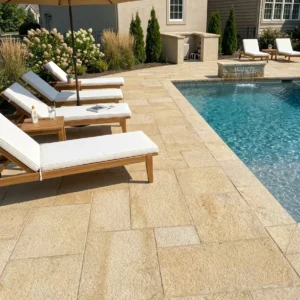
- Pale tone stays markedly cooler underfoot than a dark stone in open sun, which settles pool decks on its own.
- It takes brushed, bush-hammered and sandblasted finishes that grip well without feeling harsh to bare skin.
- A dense, low-absorption limestone washes clean after an ash fall and returns to its own color.
- It sits comfortably against white render, timber and planting, the common palette in Grenadines villa work.
None of that holds for a soft, porous limestone, so the absorption figure decides whether these advantages are real or merely advertised.
Where Basalt Earns Its Place
In the harder zones the argument shifts, and it shifts on measurable grounds.
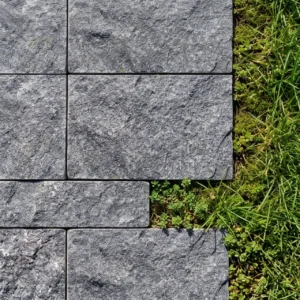
- Very high density and low absorption, a strong hand in salt-loaded windward positions.
- Excellent wear resistance under vehicles, so it holds a driveway or a turning area without fretting.
- A flamed face gives the most aggressive grip available, which is useful on ramps and service slopes.
- A dark tone hides tire marks and traffic staining that a pale stone would show for years.
Those strengths are why exposed frontage and hard-worked areas often go to dark basalt for salt zones instead of asking one material to do everything.
Heat Is the Honest Trade
Basalt’s density comes with a dark face, and a dark face under Caribbean sun gets hot. That is not a defect; it is physics, and it is the reason basalt belongs where shoes are worn while limestone belongs where feet are bare. Anyone who tells you a dark stone stays cool at midday has not stood on one in July. There is no finish, no coating and no laying method that undoes it, and the honest thing a supplier can do is say so before the order rather than after. Clients who want that look around a pool are usually better served by choosing limestone for SVG projects in a mid tone, with basalt kept for a border, a step nosing or a frame.
Driveways, Ramps and Service Yards
The main island of St Vincent is steep and volcanic, and the Grenadines have narrow roads and tight turning space. Vehicle areas take point loads from wheels, occasional oil, and the grit that comes off any working site. Specify by thickness first and by material second: a thicker unit in a dense stone, laid on a properly compacted base, with edge restraint that will not creep under turning loads. Small-format units handle slope and curve better than large slabs, and they are easier to lift and lay where a truck cannot reach the working face. This is the one zone where appearance should give way to wear, and where a dark, dense stone repays the premium several times over.
Mixing Both on One Property
A mixed specification reads as design rather than compromise when the transitions are deliberate. Decide them on the drawing, not on site with a saw in hand and half a pallet left over.
- Change material at a threshold, a level change or a planting bed, never mid-run across an open terrace.
- Keep one shared module so both stones align on the same joint lines.
- Use the darker stone as an edge, a band or a frame that ties the two together visually.
- Order both together so tone, thickness and pallet planning are settled in a single shipment.
The Decision in One Pass
Take the zone map, put comfort first where feet are bare, put density and wear first where salt and vehicles are, and let appearance decide only in the sheltered middle. Ask for small samples of both and test them on the site itself, wet and at midday. Then agree thickness and base build-up with your architect or engineer under the planning permit, and settle the destination island before crates are built, since that leg decides pallet size more than anything on the drawing does. Done in that order, the specification stops being a preference and becomes a description of the site. Exposure picks the stone; you only pick the tone.