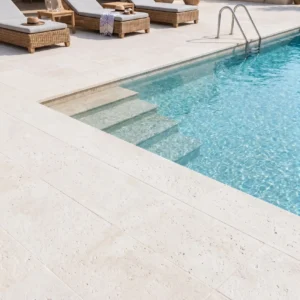
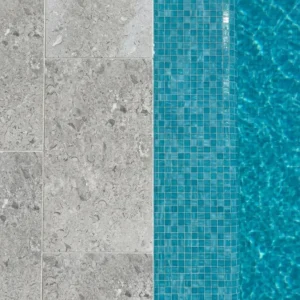
What the two figures actually mean
Absorption is the water a dry stone takes up when it is soaked, given as a share of its own dry weight. Density is the mass packed into a fixed volume. The two tend to move together, because both describe how much pore space sits between the grains. A tight limestone takes on little water and weighs more per unit; an open-textured one drinks more and weighs less. On this island, where the wettest months and the peak hurricane months are the same months, those two results describe a terrace’s next several years far better than any photograph can.
The wet season is the design case
Sint Maarten has a tropical savanna climate with roughly 1,047 mm of rain a year and a drier stretch running from January through July. The wet peak falls between September and November, which is also when hurricane risk is at its highest. That overlap changes the brief. You are not specifying for a shower that dries off by lunchtime; you are specifying for wind-driven rain striking a surface that can stay saturated for days at a time.
- Rainfall arrives concentrated into a few months rather than spread evenly across the year.
- Wind-driven water reaches joints and edges that vertical rain never touches.
- Saturated bedding drains slowly, so joint detailing carries more of the work than the slab does.
- Public surfaces in Philipsburg and along the Great Bay Boardwalk were rebuilt after Hurricane Irma made landfall on 6 September 2017.
Salt is the second load
Salt water does something plain rain does not. It travels into the pore structure, the water evaporates, and crystals grow in the space left behind, pushing outward as they form. Lower absorption gives that cycle less room to work in. As a matter of plain geography, the eastern shore around Dawn Beach and Oyster Pond meets open Atlantic weather in a way that leeward Great Bay and Simpson Bay do not. Treating them as separate exposure bands when you write the schedule is simply sensible.
Reading a test report before you order
Ask for the following, and expect straight answers.
- Absorption and bulk density results for the lot you are buying, not a brochure average.
- Whether the result is a single test or a mean, and which finish it was measured on.
- The thickness tolerance, because the bedding depth has to absorb it.
- A physical piece you can soak, dry and soak again on your own site.
We send those figures with a quote rather than after it, which is why absorption and density figures worth checking sit next to the paving formats instead of in a downloads folder. Where a result is not available for a particular lot, we say so rather than borrowing one from a similar stone.
Density, thickness and where load sits
Density is not a strength rating on its own, but it is a fair early signal of how much material is packed between the pores. It also sets handling weight, which matters the moment a crate leaves the quay for a hillside plot. What actually keeps paving intact under traffic is the combination of unit thickness, bedding and restraint rather than any single number on a page.
- A villa terrace and a public walkway carrying cruise-passenger traffic are different wear specifications.
- Cruise arrivals here passed a million passengers a year by 2018, and Front Street paving is walked accordingly.
- Thicker units spread point loads and survive being lifted and relaid.
- Crate weight decides how a delivery has to be broken down for a narrow or steep approach.
What the figures cannot fix
A low absorption result will not rescue a poor detail. Water standing at a threshold, an unrestrained edge on a fall, or joints left half filled will give trouble long before the stone itself does. The Dutch side covers roughly 34 square kilometers of hilly ground, with the Sint Maarten Hills and the Cole Bay Hills running through it, so drainage runs, falls and edge restraint deserve as much drawing time as the paving schedule. Groundworks are a permitting matter too: civil works permits from the Ministry of VROMI cover excavation and terrain alteration, and they come before a building permit.
- Set falls that clear water rather than parking it at a threshold.
- Restrain every free edge, particularly on a slope.
- Fill joints properly and maintain them, because open joints collect grit.
- Keep bedding depth consistent so units do not lip against each other.
Landing stone at Point Blanche
Stone for this market loads in the United States and discharges at Point Blanche on Great Bay, where Port St. Maarten’s Captain David Cargo Quay runs a round-the-clock multipurpose terminal for containerized and breakbulk cargo along a 540 m berth. Customs Sint Maarten describes itself on the government website as mainly a law-enforcement agency rather than primarily an import-duty collecting organization, and states that the only tax it levies is on unleaded gasoline. Turnover tax at 5% is charged on a local seller’s revenue and is expressly not levied on imports, so it is not a border charge on your consignment. Clearance formalities still apply, so keep an agent involved; routing and handling sit in our Sint Maarten stone supply overview.
Start with a sample
Small hand samples answer questions a data sheet cannot. Wet one and watch how long the color takes to return. Leave one in the sun, leave another in salt air for a week, then rinse both and look again. Then price the pallet count and draw the falls.
Figures you can check beat adjectives you cannot.