Slope Is the Saint Lucian Question
Almost every hardscape brief on this island arrives with a gradient attached. Land rises quickly from the water on both coasts, and a driveway, garden terrace or courtyard is rarely the flat rectangle that a brochure photograph assumes. Setts suit that reality better than large slabs do, because a small unit can be adjusted course by course to follow a fall instead of fighting it. Before anyone discusses tone or finish, the honest first question on a Saint Lucian site is where the water goes once the ground is already saturated, and what the paving is sitting on when it gets there.
What Tomas Taught About Water
Hurricane Tomas came ashore on 30 October 2010 as a Category 2 storm, and it remains the reference event for anyone building here. The lesson it left behind was not really about wind. Most of the destruction came from landslides that cut roads, destroyed bridges and washed away entire river banks, driven by rainfall of up to 668 mm in roughly 23 hours.
- Rainfall intensity, not gust speed, sets the design case for external paving.
- Saturated volcanic soil moves, and paving above or below a slope shares that risk.
- Total damage and loss reached about 43.4 percent of the country’s 2010 output.
- Eight lives were lost in Saint Lucia, and the landslides cut roads and destroyed bridges across the country.
Reading the Ground Before You Order
A sett order that works on paper can still fail on site if nobody walked the fall first. Spend an afternoon with a level, a tape and a hose, and record what the water actually does.
- Mark the high point, the low point and every hollow where water already stands.
- Note where sheet flow arrives from above, whether off a roof, a road or the plot next door.
- Check whether the slope below the paving is planted, freshly cut or properly retained.
- Identify the discharge point and confirm it can take a storm, not just a shower.
- Photograph the site during heavy rain, because that record beats any drawing you will be shown.
Unit Size and the Way a Fall Reads
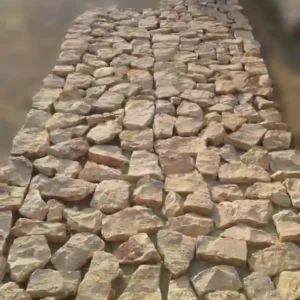
Small units win on uneven ground because each one only has to agree with the units beside it, not with the whole terrace. A large slab bridges a hollow and rocks underfoot; a sett simply beds into it. On a steep drive or a stepped garden, courses can be run across the fall so the joint lines read as level bands, which disguises minor irregularity and gives feet and tires something to bite on. Where the gradient changes, a course can be tightened or a soldier row introduced instead of cutting a wedge out of an expensive slab. Our stepped sett courses on grade are sized so a mason can hold a rhythm without constant cutting.
Bedding, Jointing and Where Water Goes
On a slope the bedding layer decides whether your paving survives a bad October. Trapped water under stone is the enemy, while water moving cleanly through the build-up is manageable.
- Use an open-graded bedding so water drains through rather than perching beneath the units.
- Keep positive falls to a defined outlet, and never let a terrace discharge over a cut bank.
- Choose a jointing approach that will not wash out under sheet flow.
- Intercept water above the paving with a channel before it ever reaches the surface.
- Build in inspection and cleaning access, because tropical debris blocks outlets quickly.
Edge Restraint on Falling Ground
Every sett field is only as strong as the line that holds it. On level ground an edge is a tidy detail; on a gradient it is structural, because the whole field wants to creep downhill and the bottom course carries that push. The lowest edge should be founded deeper than feels necessary and tied into something that will not be undermined when the soil below saturates. Where a terrace ends at a planted slope, keep the restraint back from the crest and allow a maintained strip in front of it, so the failure of one does not become the failure of both.
Windward and Leeward Slopes Differ
The two coasts do not ask for the same specification, and a supplier who treats Dennery like Marigot Bay has not been paying attention.
- Atlantic-facing ground at Dennery, Micoud and Vieux Fort takes constant wind-driven spray.
- Sheltered western sites near Castries, Marigot Bay and Soufriere see calmer air but heavier runoff off the ridges.
- Salt exposure argues for dense, low-porosity stone and a textured rather than glassy surface.
- Shaded, humid slopes grow biological film fast, so plan cleaning access from day one.
Getting Stone to a Hillside Site
Delivery is part of the design on a steep plot. Container gear needs somewhere flat to stand, and the last stretch of a hillside access track usually decides how the pallets get broken down. Port Castries sits on a ten-acre lot and has been congested enough that the ports authority added off-site container storage at Cul de Sac, so nobody should assume a same-day pull. Southern projects around Soufriere, Laborie and Vieux Fort are often better served through the Vieux Fort port instead. We plan stone supply into Castries and Vieux Fort around the access route, not the other way around. On a Saint Lucian slope the stone is the easy part, and the water beneath it is the real job.