Ground That Never Sits Flat
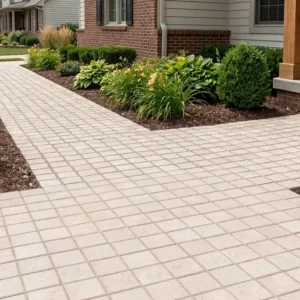
Grenada is a volcanic island and the terrain says so. Outside a few flat coastal shelves near Grand Anse or Point Salines, most plots step, tilt or roll, and the ground you want to pave is rarely the ground you were handed. Setts earn their place here for one plain reason: a small unit follows a changing surface far better than a wide slab does. A slab has to be bedded to a single plane, so any twist in the ground shows up as a rocking corner within a season or two. A sett can be tapped down to meet whatever is under it, and the joint absorbs the difference.
Reading the Fall Before You Order
Before a crate is ordered, walk the plot with a level and write down what the ground actually does. On a hillside the numbers change every few paces, and a survey taken on site beats a layout drawn in an office.
- Measure the fall across the area in both directions, not only downhill.
- Mark where water already arrives from: roofs, an access track, the plot above yours.
- Note every point where the gradient breaks sharply, since the bed wants a step there rather than a taper.
- Record the finished levels you cannot move, such as door thresholds, drain inverts and an existing retaining wall.
- Photograph the ground during heavy rain if you get the chance, because the wet season tells the truth.
Unit Size and the Grip Question
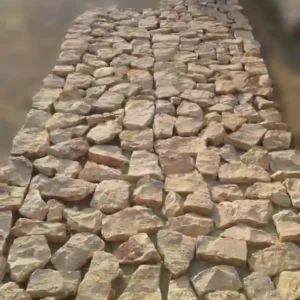
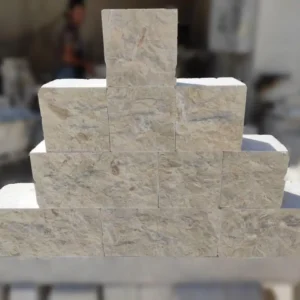
Grip on a slope comes from three things: the texture of the stone face, the number of joints crossed per stride, and the direction those joints run. Smaller units give more joint lines per foot of travel, and every joint edge is somewhere a shoe or a tire can catch. A four-inch cube often behaves better on a ramp than a larger unit of the same stone, simply because there is more edge under the foot. Split and flamed faces also hold grip far better than smooth ones once a surface is wet, which here it often is. Sizes and face options across our Grenada cobblestone sett stock are listed by format, so you can match unit size to gradient instead of guessing.
Bedding and Jointing on a Gradient
A bed that works on the flat can creep on a slope. Anything above a gentle fall wants a bound construction rather than loose sand, and the joint has to be part of the structure rather than a cosmetic fill.
- Use a bound bed wherever a loose bedding layer would migrate downhill under load.
- Keep joints filled to full depth, since a half-filled joint on a slope simply becomes a channel.
- Start laying at the bottom of the fall and work upward, so gravity closes joints rather than opening them.
- Build edge restraint in at the head of the slope before the field courses are laid, not afterward.
- Give the crew a datum line, because a drifting course is hard to correct on a gradient.
Where the Water Goes
The coastal belts see roughly sixty inches of rain a year while the central highlands can approach one hundred and fifty inches, and the heaviest months run from June through November. A paved slope becomes a channel unless you plan otherwise.
- Size falls and outlets for highland rainfall if the site sits inland or uphill, not for coastal averages.
- Break long runs with cross-falls so a single storm cannot build speed across the whole surface.
- Give the toe of the slope somewhere to discharge that is not a doorway or a plot boundary.
- Keep the sub-base draining, because a saturated base will move under setts however well they were laid.
- Follow the route water takes once it leaves the paving, since that is where damage shows first.
The Wet Season and What Grows
Seven months of rain, warmth and shade produce algae and moss, and a slick green film on a slope is a safety problem long before it is an appearance problem. Shaded courtyards and paths under tree cover need more texture than an open terrace, and a maintenance habit rather than a single treatment. Plan for periodic washing, keep leaf litter out of the joints, and avoid smooth faces anywhere feet meet a gradient. Where a site is steep and shaded we would rather send a rougher face and a smaller unit. Formats, crating and lead times sit alongside our wider notes on sourcing stone for Grenadian sites.
Landing Crates at St George’s
Stone arrives through the Port of St George’s, where the main quay runs 335 m with depth alongside of roughly 8.3 to 9.8 m and the container yard holds over 1,500 TEU. Reach stackers and terminal tractors handle the boxes, so crated stone is routine cargo. Tropical Shipping sails from the Port of Palm Beach and King Ocean runs an Eastern Caribbean service. If your site is on the Atlantic side near Grenville, plan on clearing at St George’s and trucking across, because the Grenville pier carries only about 3.0 m alongside at its head and serves small craft.
What to Send Before You Specify
Most slope questions get answered quickly when the right information arrives early.
- The steepest gradient on the paved area, and the length of that run.
- Whether the surface carries feet only, or vehicles as well.
- Shade, tree cover and aspect, since those drive the finish choice.
- The coast you are building on, because exposure on the Atlantic east differs sharply from the sheltered west.
Get the fall, the finish and the joint right, and a sett slope will still be sound after many wet seasons.