Why a Slope Here Is Never Even
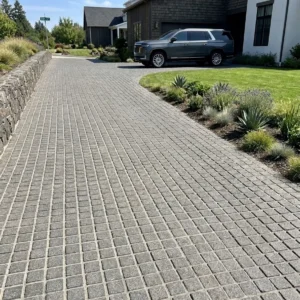
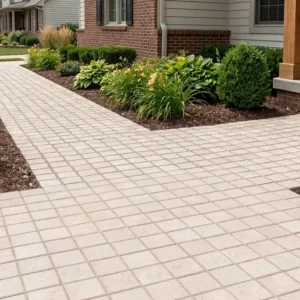
A fall on Providenciales is rarely the clean graded bank a drawing suggests. The islands sit on a soft limestone platform, and what reads as a smooth gradient is usually a shelf of rock under a thin skin of screened material. That combination punishes large units. A wide slab bridges the hollows, rocks under load and cracks at the first point that never had support beneath it. Small units behave the opposite way. A sett rests on whatever sits directly under it, and several hundred small bearings absorb a surface that one wide bearing cannot. On uneven ground the choice of format does more for the finished result than the choice of material does.
Walk the Fall Before Ordering Stone
On a sloping site the survey sets the layout, the bedding and the labor bill, in that order. Half a day with a level and a shovel is cheaper than a week of remedial work.
- Where storm water arrives from, and where it is allowed to leave the plot
- Whether the rock shelf runs continuous or breaks into soft pockets
- The steepest local gradient rather than the average across the whole run
- How close the fall passes a pool shell, a cistern or a foundation
- Where a truck and barrows can reach without crossing finished paving
Bedded and Bonded, Not Dry Laid
On an exposed slope a dry-laid bed migrates downhill, slowly for months and then all at once during a single burst of rain. Reinforced poured concrete is the structure of choice across the islands because it copes with salt and wind, and a slope is exactly where that logic should reach the paving. A concrete base with a bedding mortar keeps every sett located while the ground below settles or drains unevenly. It also allows steps and ramps to be formed within the same surface, without a change of material at the point where the gradient gets serious.
Drainage for Concentrated Rain
About 43 inches of rain reaches the islands in an average year, and it does not spread itself politely across the calendar. It arrives in heavy concentrated periods on a flat, poorly draining platform, so a slope turns into a fast sheet of water hunting for the lowest edge. Setts help, because the joint grid gives the surface texture and a predictable direction, but only when falls and outlets are designed together. We size joint, fall and unit depth as one decision when quoting our cobblestone stock for Provo.
- Run falls toward a channel or a soakaway, never toward a doorway
- Break long runs with a cross fall so sheet flow cannot build speed
- Keep joints full so water travels over the surface, not into the bed
- Give the foot of the slope more capacity than the calculation demands
Fixings and Restraint in Salt Air
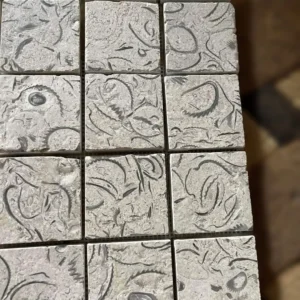
Salt is the governing exposure in the Turks and Caicos Islands, and salt-laden air corrodes standard metals quickly. Freeze-thaw resistance is worth nothing here and nobody should be selling it. Salt crystallization is the durability question that matters, which points toward dense, low-absorption stone laid with tight, well-filled joints on a slope that will be washed by spray and by every heavy shower.
- Use stainless fixings for edge restraint, channels and handrail anchors
- Avoid cast zinc alloys anywhere the surface will be washed by spray
- Specify low absorption rather than any cold-weather durability claim
- Fill joints completely so salt cannot sit and work in an open gap
Steps, Ramps and Changes of Level
Steep ground is usually easier to resolve with a short flight than with a long ramp nobody enjoys pushing a cart up. Setts suit this work because the same unit forms the tread, the riser face and the landing, and a small module lets a rise be tuned without cutting specials. Keep risers consistent, light the nosings, and choose a face texture that still reads as safe when the surface is wet and barefoot traffic is crossing it after a swim.
Getting Stone onto a Sloping Site
South Dock on Providenciales handles more than 85 percent of national port traffic, and its physical limits shape every delivery. Draft is only about 11 feet and berthing is restricted to vessels of roughly 110 TEU, so nothing arrives on a large container ship. SEACOR Island Lines and Tropical Shipping sail direct from Florida and between them carry nearly all cargo entering the country. That matters on a slope, where there is rarely a convenient flat place to stack pallets.
- Stage deliveries in lifts so the site is never blocked by its own stone
- Allow for consolidation, which can add two to three weeks at a US facility
- Price Grand Turk, South Caicos, Salt Cay and North Caicos as separate barge legs
- Remember there is no ferry between Providenciales and the Turks Islands
- Confirm truck access to an unfinished gradient before the first delivery
We plan stone supply into Providenciales with those constraints priced in rather than discovered on site.
A Workable Build Sequence
Order of operations matters more on a slope than anywhere else on a property. Cut and form the base from the top down so spoil never lands on finished work, pour and cure, then lay setts from the bottom up so each course beds against something solid. Set drainage outlets before the first stone goes down rather than after. Leave the edge restraint until the field is laid and the true line is visible, then fix it in stainless and point the perimeter last. A slope built in that order stays where you put it.