Jan Thiel is Curaçao’s resort-residential flagship: the lagoon-and-hillside district where gated communities, beach clubs and villa parks run a shared standard — European buyers, managed amenities, rental programs woven through private ownership — and where the island’s most consistent construction quality serves its most consistent expectations. The district is a specification ecosystem, and stone runs through every layer. Here is the Jan Thiel guide.
The villa-park model
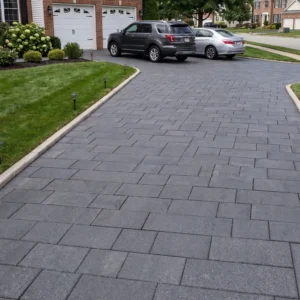
The district builds in managed communities: villa parks with architectural codes, shared infrastructure maintained by owner associations on the association-governance craft, and rental programs placing paying guests in private homes — which sets the specification bar at the landlord-grade durability plus hospitality polish. Community palettes keep streetscapes coherent; individual courts express within the code. The model rewards material discipline: batch-documented paving lets the park repair uniformly for decades.
Beach-club ground
The lagoon’s clubs are the district’s social engines — day-bed decks, swim platforms, restaurant terraces running brunch to DJ dusk — and their ground runs the cluster’s hardest hospitality duty: barefoot-honest surfaces at full-sun temperatures, salt-and-sunscreen chemistry answered by sealing programs run on club rhythm, the sand-margin transitions where deck meets beach, and capacity engineering for event nights on the downtime-is-money operations. Club standards migrate uphill: villa owners specify what the club proved.
- Specify the restaurant terrace to commercial duty, not to residential duty with a bigger area.
- Keep the service route in the toughest material, since trolleys run it all day.
- Choose a finish that survives spilled drinks and a nightly hose without staining.
- Detail furniture zones so chairs are dragged across one defined field rather than everywhere.
Hillside-lagoon geometry
The district terraces from ridge to water, and its sections run the hillside disciplines at community scale: retaining systems dressed as garden architecture, staircase streets on accessible gradients, view corridors protected by code, and drainage engineered for the island’s cloudburst season before it reaches the lagoon — water-quality stewardship the wetland-margin manners extend districtwide. The lagoon is the amenity; every uphill decision protects it.
The rental-program spec
Homes earning in rental pools face the management-company audit as their real client: turnover-proof surfaces between guest cycles, spare-tile attics for instant repairs, photography-ready finishes that carry listings, and the refurb-window disciplines when parks renew in phases. The arithmetic favors stone visibly: the villa that shows wear rents behind the villa that doesn’t, and the district’s occupancy data prices the difference annually.
Amenity-circuit craft
The district’s shared realm — boulevard walks, fitness circuits, playground courts, marina-edge promenades — runs the managed-community standard in Dutch-Caribbean dress: continuous accessible surfaces, shade infrastructure timed to the tropical day, wayfinding worked into paving bands, and maintenance operations on association calendars. The public-realm quality is the district’s brand; buyers price it into every villa transaction.
- Fix shade structures into structure rather than standing them on paving.
- Coordinate shade positions with the paving layout so posts land on planned points.
- Allow for the constant easterly, which loads any canopy in one predictable direction.
- Provide a shaded route between buildings, not only shaded destinations.
Specifying to the standard
Jan Thiel’s consistency is procurement discipline: community codes referencing material standards, association archives holding batch records, contractors prequalified on documented work, and the island supply guide serving the ecosystem’s registers — club-grade decks, landlord-grade villa courts, community-grade shared realm — with the documentation the governance layer requires. The district proves the cluster’s managed-community theorem: shared standards compound property value, and stone specified once to the code serves every owner who follows.
The second buyer: how coded communities resell
Jan Thiel’s specification ecosystem faces its true audit at resale, and the district’s pricing history reads as a verdict on governance. The second buyer purchases documentation as much as villa: the architectural code’s file proving the streetscape will hold, the association’s archives showing infrastructure maintained on calendar rather than crisis, the batch records that make the terrace’s future repairs routine, and the rental program’s books where the villa earns. Agents in the district will say it plainly — the coded communities’ premium over freestanding equivalents is the governance made liquid, and it widens with every year the standards visibly hold.
For sellers, the preparation is file assembly rather than renovation theater: the handover binder — drawings, approvals, batch numbers, the spares’ location, the maintenance log — answers the document-trail culture’s questions before the buyer’s lawyer asks them, and the physically honest villa — stone aged rather than worn, code-compliant from the curb — photographs into the listing the district’s market expects. For buyers, the due-diligence path is equally structured: read the association’s minutes for deferred-maintenance smoke, walk the shared realm as the surveyor of record — its condition is the community’s balance sheet made visible — and price the code as protection, which is what the second sale proves it to be.
The district’s lesson generalizes across the cluster’s managed communities: architectural codes are resale insurance, associations are value custodians, and stone — documented, batch-matched, calmly aging — is the governance’s most legible exhibit. The first sale buys a villa; the second sale grades the system; Jan Thiel keeps passing, which is why its second buyers keep arriving with confidence and check books in the same hand.
Family life inside the code: pets, kids and the rulebook
A coded community’s liveability shows at family scale, and Jan Thiel’s rulebook earns its keep by handling the domestic questions gracefully. The children’s layer works because the shared realm was designed for it: the amenity circuits’ car-light loops where bikes learn balance, playground courts on impact-honest surfacing inside sightline distance of the café terraces, and pool rules that manage the after-school hours without banning childhood. The pet layer runs on the same clarity: leash and clean-up codes stated and observed, the walking circuits generous enough that compliance is pleasant, and the boundary plantings chosen with dogs’ realities in mind. The rulebook’s tone matters as much as its content — codes written as shared standards rather than prohibitions keep the community’s consent, and the association that enforces evenly keeps its authority. For buying families the diligence is simple: read the rules imagining a Tuesday — school run, dog walk, bikes on the loop, supper on the terrace — and the district that makes the imagined Tuesday easy is the one whose code is working. The villa parks sell order; the families test it daily; and the ground between them, safe and looped and shaded, is where the code proves it was written for living.
What a managed community actually enforces
Resort-residential development on Curacao sits inside a public framework before it sits inside a private one. The Curacao Eilandelijk Ontwikkelingsplan separates urban from rural land, designates conservation zones for the preservation of natural, historical, cultural and landscape values, and records residential densities of around ten dwellings per hectare on plots of 500 to 1,000 square meters with future targets between ten and thirty. Community design rules then sit on top of that, and both apply to every terrace.
- Read the public designation and the private design code together rather than separately.
- Expect a prescribed palette, and use format and texture to create individuality within it.
- Submit real samples for design review, since photographs never survive a committee.
- Agree the batch and supplier at approval so a substitution never becomes a dispute.
- Allow approval time in the program, because a managed community meets on its own schedule.
Buying on evidence when a hundred units must match
Consistency across phases is the hardest thing a resort-residential scheme has to deliver, and it is won with data rather than with assurances. The Natural Stone Institute testing program covers ASTM C97 for absorption and bulk density, C170 for compressive strength, C880 for flexural strength, C1353 for abrasion resistance and ANSI A326.3 for slip. Those numbers let phase four look like phase one.
- Fix the specification against test values rather than against a sample board.
- Read abrasion resistance first for commercial terraces, which wear rather than break.
- Meet the slip benchmark in every wet zone, including restaurant terraces and pool routes.
- Record batch references per phase so future repairs draw from the right stock.
Where resort duty differs from private duty
The same terrace detail behaves differently when four hundred people cross it on a Sunday. Commercial areas inside a resort-residential scheme need heavier specification than the villas around them, and the mistake developers make most often is applying one standard across the whole estate to keep procurement simple.
- Write two specifications, one residential and one commercial, within a single visual family.
- Use thicker units and tighter joints in public areas where trolleys and crowds operate.
- Keep the visual language continuous so the estate still reads as one place.
- Hold separate spares for the commercial zones, since they will need them first.
Resort residential stone that satisfies the design review
A managed community is judged terrace by terrace, in daylight, against its neighbors. Specify to test data so phases match, split residential from commercial duty within one family, get the batch agreed at approval, and hold spares where the wear will actually happen. Our Curacao stone supply guide sets out the formats, finishes and lead times that suit this island. Consistency across ten years and four phases is what separates a resort community that ages well from one that merely opened well.