What Vetting a Stone Supply Yard Actually Reveals
Knowing how to vet a stone supply yard before placing a bulk order is the single most reliable way to close the gap between what a yard promises and what arrives on the truck — and experienced specifiers who’ve been burned by a bad supplier will confirm that operational habits predict stone quality almost as accurately as a lab test. The questions you ask upfront, the documentation you request, and the yard visit you actually make will tell you more about long-term reliability than any product brochure ever will.
Documentation and Testing Standards That Separate Serious Yards
Your first line of evaluation is paperwork, and a reputable stone supply company should produce it without hesitation. Ask specifically for ASTM test results covering compressive strength, water absorption, and abrasion resistance for any material you’re considering in bulk. For dimension stone, these are codified under standards like ASTM C503 for marble and ASTM C615 for granite — a yard that can’t reference these documents or point you to third-party lab results should raise immediate concern.
The Natural Stone Institute technical stone specifications provide an independent baseline for what credible test data should look like across stone families. Use those benchmarks when reviewing whatever documentation a yard hands you. A yard that volunteers this comparison proactively is usually one worth staying with.
Beyond compressive data, look for quarry-of-origin documentation. Single-quarry sourcing gives you color and veining consistency across pallets — critical when you’re matching requirements for a phased build or a large continuous installation.
Yard Visit Non-Negotiables Before Any Bulk Commitment
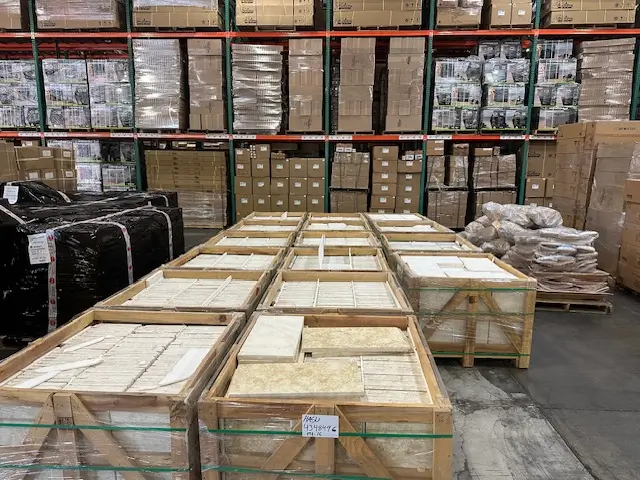
Visiting a stone supply yard before a large order isn’t optional — it’s the diagnostic step that tells you what the website won’t. Organized, clearly labeled inventory with consistent stack heights signals good stock rotation. Random piles with mixed labeling signal the opposite: you’re likely to receive stone pulled from multiple batches with inconsistent finish, tone, or thickness.
- Check whether warehouse conditions protect material from direct weather exposure — UV degradation begins before the stone even reaches your site if outdoor storage is unmanaged
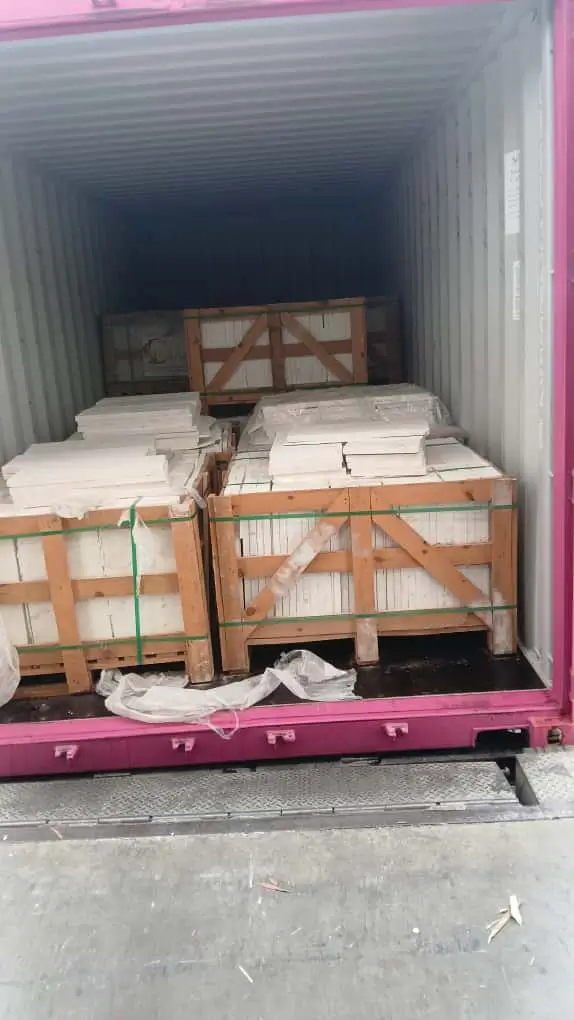
- Look at how pallets are wrapped and banded — poor wrapping leads to edge chipping during truck transport, which shifts waste percentages on your project
- Ask how long current stock has been in the warehouse — material sitting for 18-plus months in variable conditions can show surface oxidation or efflorescence before installation
- Count the variation within a single labeled pallet — pull three pieces and compare thickness with calipers; tolerances beyond 3mm in nominally consistent product indicate quality-control issues at the source
- Verify that the stone supply company maintains lot tracking — knowing which quarry run a batch came from matters for reorders
The USGS dimension stone production and use data shows substantial variation in stone production quality across quarry regions — which is exactly why verifying quarry origin at the yard level protects your specification downstream.
Inventory Depth, Lead Times, and What They Tell You
One of the most underestimated vetting criteria is whether a stone supply yard carries genuine depth of inventory — not just display samples. Ask directly: how many square feet of your target material are available in the warehouse right now, and how much is in transit? A yard that keeps 5,000 square feet on hand versus one holding 500 will behave very differently when your project scales or when a second phase requires reorder matching.
Truck delivery lead times are a direct reflection of how a yard operates. A well-stocked all stone supply operation with regional warehouse positioning typically delivers within one to two weeks of confirmed order. Yards that quote six to eight weeks on standard material are either importing directly without domestic buffer stock or managing inventory poorly — both scenarios create project scheduling risk you need to price in before committing.
At Citadel Stone, we track warehouse inventory levels continuously so that lead time quotes reflect actual stock, not optimistic estimates. That distinction matters when you’re coordinating stone delivery against a concrete pour schedule or a landscaping crew’s availability window.
Finish Consistency and UV Performance for Exposed Installations
For any project where stone will face direct sun exposure — pool surrounds, open patios, driveways without overhead cover — finish selection at the vetting stage is as important as material selection. Ask the yard whether the honed, brushed, or sandblasted finishes they offer are processed in-house or at the quarry. Quarry-finished stone delivers tighter consistency; yard-finished material can vary batch to batch depending on equipment calibration.
UV exposure is a genuine performance variable that separates experienced stone supply company buyers from first-time specifiers. Iron-rich stones like certain sandstones and some granites oxidize visibly under prolonged sun exposure — the surface tone shifts from the showroom sample within 12 to 24 months. Paler limestones and travertines tend to hold their appearance better under UV because calcium carbonate-based matrices are less reactive to photochemical breakdown than ferrous minerals.
- Request outdoor weathering samples — a serious yard keeps demonstration material that has been exposed for 12-plus months so you can assess actual color shift
- Ask whether the yard recommends a UV-stable penetrating sealer for the specific material you’re ordering, and at what interval resealing is advisable
- For honed finishes in full-sun installations, confirm that the surface has been tested for slip resistance — ANSI A326.3 static coefficient of friction values above 0.6 are the practical baseline for safe outdoor use
- Lighter finishes reflect more solar radiation than darker ones, which affects surface temperature and long-term sealer integrity in high-UV environments
Discussing UV performance with your yard contact before ordering is a reliable signal of their technical depth. A yard that can speak to sealing schedules, finish durability under sun exposure, and color retention data is an asset to your project — not just a materials vendor.
Ordering Minimums, Overage Policies, and Return Terms
Before placing a bulk order with any stone supply yard, clarity on three commercial terms directly affects your project margin: minimum order quantities, overage allowances, and return policy conditions. These aren’t administrative details — they’re risk variables that compound fast on large-scale installations.
Minimum order quantities tell you whether the yard is set up for trade buyers or retail walk-ins. A yard that requires a full-pallet minimum for natural stone pavers is typically a trade-oriented operation with consistent pricing structures. One that sells by the square foot from open stock carries risk: color and batch matching becomes unpredictable when you reorder.
- Confirm whether the yard’s stated minimum applies per SKU or per delivery — some yards require minimum truck loads regardless of material mix
- Standard industry overage recommendation sits at 10-15% for cut stone and 15-20% for irregular or tumbled formats — ask whether the yard’s pricing structure supports ordering at that buffer without a significant per-unit cost penalty
- Ask explicitly whether unused sealed product can be returned within a defined window — and get that in writing before order confirmation
- Verify whether a restocking fee applies to unopened pallets versus opened ones — the difference is material on large orders
You’ll also want to know how the yard handles short deliveries — cases where a truck arrives with fewer units than invoiced. A professional stone supply company has a documented claim process with a defined resolution window. A yard that answers this question vaguely is one that manages disputes reactively.
Supplier Communication and Technical Support as Vetting Criteria
The quality of a stone supply yard’s communication before you order is the strongest predictor of how they’ll perform when something goes wrong mid-project. Test this deliberately during the vetting process: send a detailed technical inquiry — material thickness tolerances, available lot sizes, sealing recommendations — and evaluate both the response time and the depth of the answer.
A technically capable all stone supply operation should be able to discuss installation substrate requirements, mortar and adhesive compatibility for different stone types, and joint spacing recommendations without routing you to a generic product sheet. This depth signals that their team has hands-on experience with the materials, not just sales familiarity.
Our technical team at Citadel Stone evaluates materials at the quarry and warehouse level, which means when a customer asks about thickness variation or surface treatment options, the answer comes from direct handling experience — not from re-reading a spec sheet. That distinction matters when you’re specifying for a project where field adjustments are costly. You can review our stone supply yard standards to understand how we approach material quality at every stage from sourcing to delivery.
Red Flags That Should Disqualify a Stone Supply Yard
Experience across projects makes pattern recognition fast: certain yard behaviors consistently predict supply chain failures, quality inconsistencies, or commercial disputes. Knowing how to vet a stone supply yard means knowing which behaviors to treat as disqualifying rather than negotiable.
- No quarry-of-origin documentation available — this makes reorder color matching impossible and suggests loose quality controls upstream
- Inability to provide ASTM test results for structural materials — a yard selling stone for load-bearing or high-traffic applications without lab validation is taking your risk on their behalf
- Pricing that shifts significantly between inquiry and order confirmation — this signals poor inventory management or opportunistic pricing on scarce stock
- No dedicated account contact for trade buyers — project-scale orders require a single point of accountability, not a general customer service queue
- Truck delivery windows quoted in ranges broader than 48 hours — this makes it nearly impossible to coordinate site readiness, and delays that cascade through a landscaping schedule are expensive
- Samples that don’t match delivered material within reasonable tolerance — if the display piece and the pallet look like different stone, the yard is showing you aspirational samples, not representative ones
The ASTM dimension stone quality and testing standards exist precisely because material variability in natural stone requires independent verification — a yard that sidesteps these standards leaves you without recourse when the specification isn’t met.
Pricing Structure and Value Signals Worth Understanding
Bulk stone pricing isn’t just about per-square-foot cost — it’s about total project cost once waste, delivery, and reorder risk are factored in. A yard with slightly higher unit pricing but consistent batch quality, predictable truck delivery scheduling, and a documented overage return policy frequently delivers lower total project cost than a cheaper source with erratic quality control.
Pay close attention to how a yard structures its pricing tiers. Yards that offer transparent volume breaks — say, at 500, 1,000, and 2,000 square feet — are operating with a structured trade program. Yards that negotiate case-by-case without published tiers often adjust pricing based on perceived buyer sophistication, which creates inconsistency across your project phases.
For a deeper look at what drives price differences across natural stone supply options, paving stone supply pricing factors covers the cost variables that experienced buyers account for before committing to a supplier relationship.
Final Recommendations for How to Vet a Stone Supply Yard
Vetting a stone supply yard thoroughly before bulk orders is the kind of upfront investment that pays out across every phase of a project — from delivery reliability to reorder consistency to warranty coverage. The checklist approach works best when you treat it as a dialogue rather than a questionnaire: how a yard responds to detailed questions tells you as much as the answers themselves. Prioritize documentation, visit the warehouse, test their communication responsiveness, and confirm commercial terms in writing before a single pallet ships. A yard that performs well across all those dimensions is a long-term supply relationship worth protecting. Reviewing a supplier’s return policy terms before ordering protects your project timeline, and Citadel Stone makes those terms available during the quoting process.
Related reading: How to Compare Stone Supply Companies Effectively · stone veneer supply guide.