What the Building Stone Ordering Process Actually Requires
Most project delays don’t start on-site — they start weeks earlier, when the building stone ordering process gets treated as a simple purchase rather than a coordinated logistics sequence. Getting the right material, in the right quantity, delivered to the right location inside your project window requires you to make at least six distinct decisions before a single pallet ships. Treat any of those decisions as an afterthought and you’ll feel it in your timeline. This article walks through each stage in sequence so you can move from inquiry to delivery without the back-and-forth that bogs down most first-time buyers.
Quantity Calculation Before You Call
Your quantity estimate is the foundation of the entire building stone ordering process — and it’s the step where most buyers lose money. Under-ordering creates a second shipment, which almost never matches the first batch’s color variation. Over-ordering leaves pallets sitting in a staging area that quickly becomes a liability. For rectangular or modular layouts, calculate square footage precisely, then add 10% for cuts and breakage on straight runs. Irregular layouts with curves, radius edges, or diagonal patterns need 15–20% overage because cut waste climbs sharply once you’re angling material.
Thickness matters as much as square footage. Building stone sold at 1.25 inches nominal behaves very differently in your structural spec than 2-inch material — and both may be listed under the same product family. Verify the exact thickness against your base depth and finished grade requirements before submitting your order. A 0.5-inch discrepancy across a 2,000-square-foot project will throw your drainage slope calculation off in a way that creates pooling problems within the first wet season.
- Measure your project area twice — once in plan view, once accounting for any grade changes that affect coverage
- Confirm nominal versus actual thickness with your supplier before finalizing quantity
- Factor cut waste at 10% minimum for grid layouts, 15–20% for organic or diagonal patterns
- Account for material reserved for future repairs — ordering 5% extra now is far cheaper than sourcing a matching batch three years from now
Material Selection and Design Integration
The building stone you specify isn’t just a structural decision — it’s an aesthetic one that has to hold up against the surrounding landscape for decades. Natural stone integrates with design styles very differently depending on the material’s color range, texture, and finish. A modern minimalist courtyard designed around clean horizontal lines typically calls for large-format, honed-finish material in a tightly controlled color palette — silver-grey limestone or basalt slab in 24×24 or larger. Traditional colonial settings almost always read better with tumbled or hand-chiseled finishes in warm buff or honey tones that soften the formality without losing character.
Large stone landscaping choices also reflect the surrounding planting design in ways that aren’t always obvious at the selection stage. In xeriscaping contexts where drought-tolerant grasses and succulents dominate, the stone should provide textural contrast — rough-faced or sandblasted finishes that echo natural rock outcroppings rather than smooth polished surfaces that look out of place in a naturalistic setting. Landscape boulders used as accent elements need to be drawn from the same geological family as your field stone or paving to create visual continuity. A project that mixes warm sandstone boulders with cool bluestone paving creates a tension that never resolves, no matter how skilled the landscaping.
- Match stone finish to the architectural vocabulary of the surrounding structure — honed for contemporary, tumbled or chiseled for traditional
- Select boulders and field stone from the same geological color family as your primary paving material
- Consider how the stone reads at distance versus up close — rougher textures need to perform at both scales
- Confirm that your chosen finish is available in the slab size your design requires before committing
Reading Product Specifications Correctly
Natural stone specifications are not standardized across suppliers in the way manufactured materials are, and that gap creates costly misunderstandings. According to Natural Stone Institute stone variety technical data, physical properties including absorption rate, modulus of rupture, and compressive strength vary significantly even within the same stone type depending on the specific quarry seam and finishing method. A limestone product listed as “light grey honed” from one source may perform very differently in freeze-thaw conditions than the same nominal description from another quarry bed.
Your specification review should always check four data points: compressive strength (PSI), water absorption percentage, finish type, and slab thickness tolerance. Compressive strength above 8,000 PSI is a baseline for exterior paving applications — anything below that in a high-traffic or vehicular context is a risk. Water absorption below 3% is desirable for exterior use in regions with significant rainfall or temperature cycling. Finish tolerance matters for modular layouts — a nominal 24×24 tile with a ±0.08-inch calibration tolerance creates joint inconsistency that becomes visible at scale across a large project.
- Request the full technical data sheet, not just the product description, before ordering
- Verify compressive strength against your load requirements — decorative applications and driveway applications use different thresholds
- Confirm slab calibration tolerance for modular formats to avoid joint inconsistency issues at scale
- Check absorption rate if your application involves freeze-thaw cycling or direct water exposure
Lead Times and Warehouse Stock
Understanding warehouse inventory cycles is where many buyers get into trouble. Stock levels for natural stone fluctuate in ways that don’t follow a predictable pattern — a popular material can sell out of a specific lot number in a matter of days when multiple large projects converge on the same timeline. Your first call to a supplier should always include a stock verification for the exact lot you want, not just a general availability check. Lot consistency matters for natural stone because color variation between quarry batches is real and unavoidable.
Citadel Stone maintains a national warehouse network that typically supports lead times in the 1–2 week range for stocked materials, compared to the 6–10 week import cycle you’d face sourcing direct from overseas. That difference is significant when your project has a concrete pour date or a landscaping installation window that can’t shift. For large stone landscaping projects requiring landscape boulders, lead times can extend depending on size class and weight — pieces above 500 lbs often require specific truck configurations that need advance scheduling with the delivery team.
- Confirm lot number availability at the time of ordering, not just general product availability
- Ask whether your full quantity ships from a single warehouse location to ensure lot consistency
- Factor in truck access constraints at your delivery address — narrow gates or limited turning radius directly affect scheduling
- For phased projects, request that your full quantity be held and shipped in staged lots from the same warehouse batch
How Building Stone Quantity Formats Work
The building stone ordering process uses several quantity formats — square footage, tonnage, and piece count — and suppliers don’t always present them the same way. Square footage is the most intuitive starting point, but you’ll often need to convert to tonnage or pallet count for shipping and cost calculations. A rough conversion for standard 1.25-inch limestone or travertine paving is approximately 13–15 square feet per 100 lbs, though this varies with specific gravity by material type. Granite runs heavier — closer to 12 square feet per 100 lbs at the same thickness — which affects both material cost and truck payload per delivery.
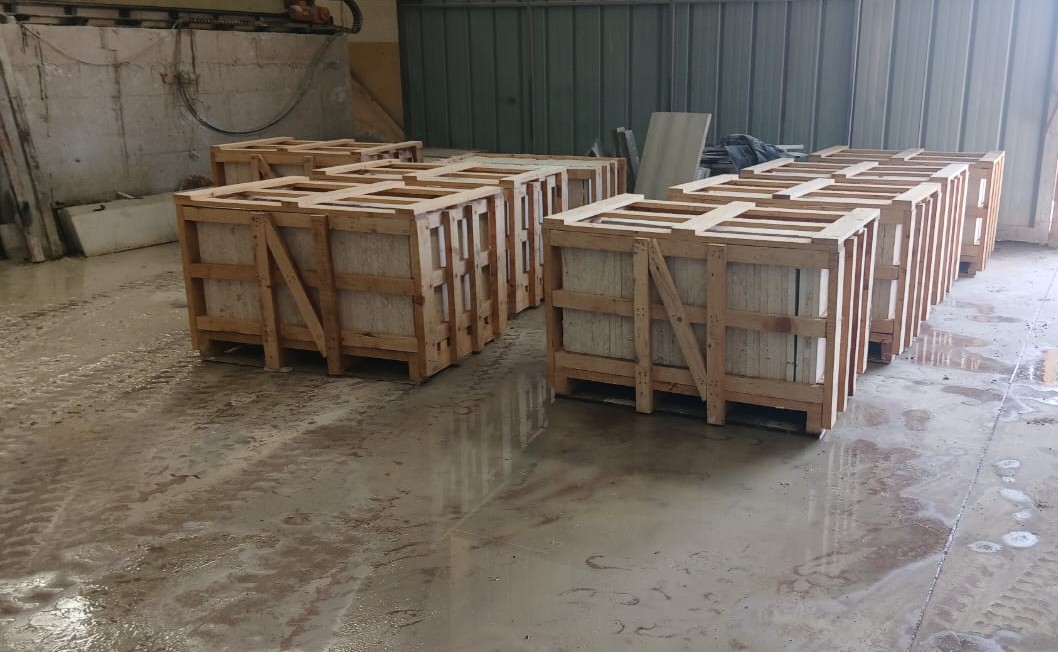
Pallet configurations matter more than most buyers realize. USGS dimension stone production data confirms that natural stone is typically shipped in standard pallet sizes optimized for freight efficiency, not for exact quantity matching. That means you’ll almost always receive slightly more or slightly less than a round number — and your order should account for this rather than expecting exact piece counts. Ask your supplier what the standard pallet configuration is for your chosen material and calculate your order in pallet increments rather than exact square footage to minimize partial pallets that inflate per-unit shipping cost.
- Convert your square footage to tonnage or pallet count before comparing supplier quotes — unit prices mean nothing without a common unit
- Request the pallet configuration for your specific material so you can order in efficient increments
- Factor truck payload capacity into your delivery plan — a standard flatbed carries 40,000–48,000 lbs, which sets your maximum per-delivery quantity
- Confirm whether your quoted price is per square foot, per ton, or per pallet — the format varies by supplier
Delivery and Site Preparation Requirements
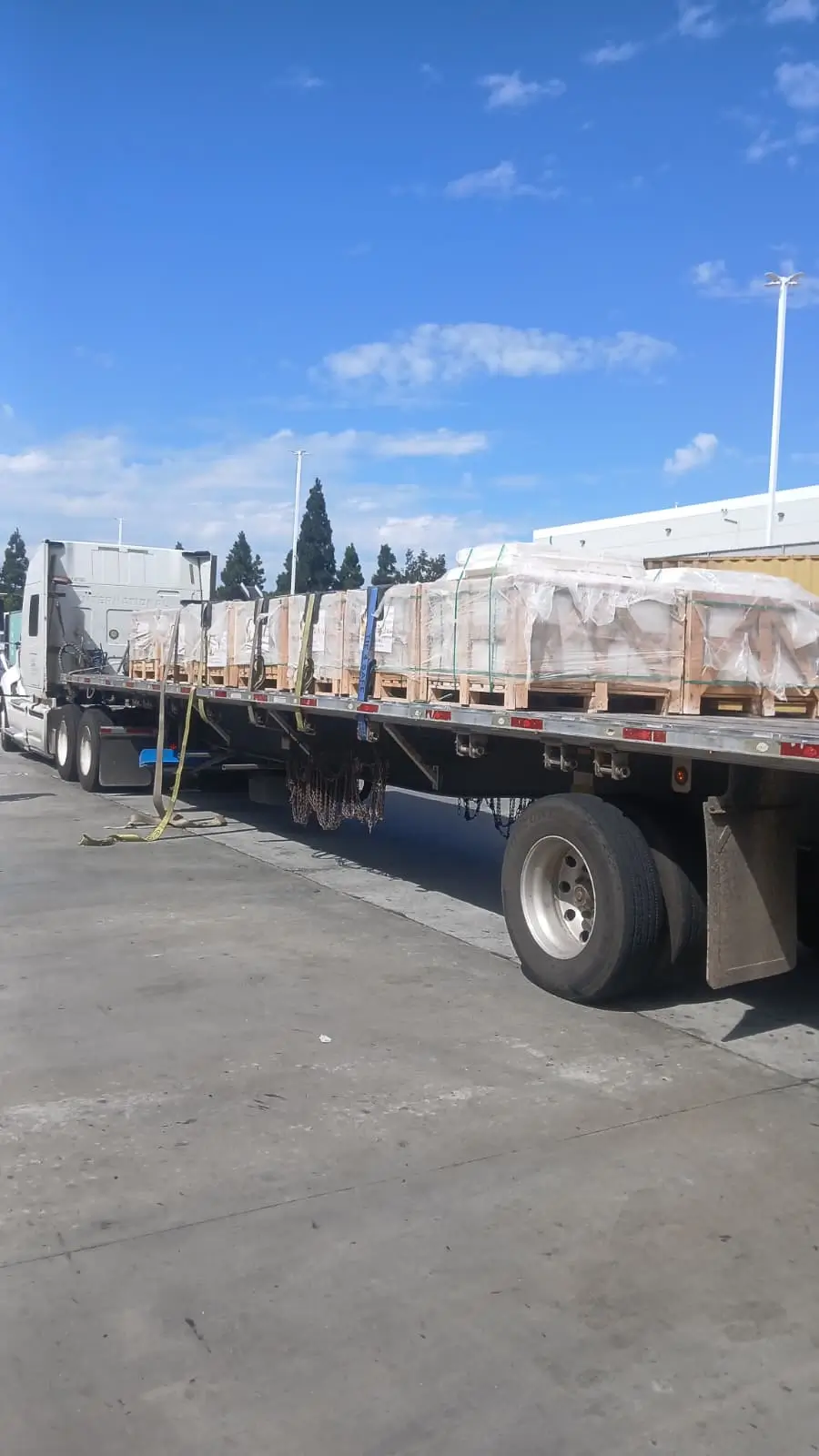
Your delivery logistics plan needs to be developed at the same time as your material order, not after it ships. Truck access is the most commonly underestimated constraint in the building stone ordering process. A standard flatbed carrying palletized stone requires at least 14 feet of vertical clearance and 50–60 feet of straight approach for safe offloading with a forklift or pallet jack. Residential sites with overhead utility lines, mature tree canopies, or narrow driveways frequently fail these requirements — and the truck driver is not obligated to proceed beyond what’s safe.
The ASLA natural stone landscape guidance consistently emphasizes that site preparation directly determines installation performance — and that logic extends to delivery staging. Your receiving area needs to be on firm, level ground capable of bearing the combined weight of the stone and the moving equipment. Soft ground or steep grades near the delivery point create both safety issues and pallet damage risk. Coordinate your truck delivery window with your installation team so material moves from pallet to installation position the same day where possible — leaving palletized stone sitting on unprepared ground for extended periods creates settlement issues that complicate handling.
- Walk your delivery route before the truck arrives — measure clearances, identify soft spots, and confirm turning radius is adequate
- Designate a firm, level staging area with enough room for a forklift to maneuver safely
- Schedule delivery within your installation window so material isn’t sitting exposed on pallets for more than 48–72 hours
- Confirm with your supplier whether delivery includes curbside drop or site placement — these are different service levels with different cost structures
Inspecting Your Order on Arrival
The moment your pallets arrive is your last opportunity to catch problems before they become your problem. Natural stone ships with expected variation — color range within a batch is normal and should be anticipated — but edge chipping, face scratches from improper stacking, and dimensional inconsistency are defects that need to be documented before the truck leaves. Your delivery acceptance inspection should be systematic, not casual. Pull and inspect pieces from at least three different positions on each pallet — top, middle, and near the base — because damage patterns aren’t always uniform across a pallet stack.
Check each pallet count against your order documentation. It’s not uncommon for a partial pallet to ship undercount, particularly on orders that required breaking a standard pallet configuration to meet your specified quantity. Document any discrepancies with photographs and note them on the delivery receipt before the truck departs. At Citadel Stone, our team pre-sorts and palletizes orders with inspection notes so you know the batch reference and any noted variation ranges before you open the first wrap — which makes your site inspection significantly faster and more targeted. For any questions during or after delivery, the Citadel Stone ordering support desk can reference your specific lot documentation and resolve discrepancies directly.
- Inspect pieces from multiple positions on each pallet — not just the top layer
- Document any chips, face damage, or dimensional irregularities with photos before signing the delivery receipt
- Verify piece count against your order and note any shortfall on the paperwork while the truck is still on-site
- Check color consistency across pallets — if your order shipped from multiple warehouse locations, variation between pallets may be higher than within a single lot
Sourcing Landscape Boulders Through the Same Process
Landscape boulders follow a parallel but distinct ordering process from cut stone — and conflating the two creates timeline and logistics problems. Boulders are sold by weight class (typically in 100–500 lb, 500–1,000 lb, and 1,000+ lb tiers) rather than by area, and the delivery equipment required scales with piece weight in ways that directly affect site access requirements. A project spec calling for large stone landscaping accents in the 800–1,200 lb range needs a truck equipped with a boom crane or a crane on-site to offload safely. Standard forklift delivery isn’t an option at that weight class, and most residential driveways aren’t rated for the ground pressure a fully loaded crane truck exerts.
Color and geological sourcing for landscape boulders for sale should align with your primary paving material as closely as possible. According to the Natural Stone Institute, mixing stone types from different geological families in the same landscape creates visual tension that’s difficult to resolve with planting alone. Order boulder samples — even small reference pieces — before committing to a full quantity, because boulder color description is inherently subjective and what reads as “warm grey” in a quarry photograph often arrives with significantly more brown or green undertones in natural light. Your building stone ordering process for boulders should include a sample approval step that cut stone orders often skip.
- Specify boulder weight class, not just approximate size — weight determines both equipment and delivery cost
- Request sample pieces or high-resolution batch photography before finalizing a large boulder order
- Confirm delivery equipment with your supplier before scheduling — the wrong truck for the weight class creates on-site delays that are difficult to resolve same-day
- Match boulder geological family to your primary paving material for visual cohesion across the finished landscape
Parting Guidance on the Building Stone Ordering Process
The building stone ordering process rewards preparation at every stage — and punishes improvisation in equal measure. Your quantity calculation sets the cost baseline, your specification review sets the performance baseline, and your delivery logistics plan determines whether all of that preparation actually translates into a smooth installation. Most problems that surface on-site trace back to a decision made — or skipped — during the ordering phase, not during installation itself. Treat each step as a distinct checkpoint rather than a formality, and the downstream work becomes significantly more predictable.
As you finalize material decisions, it’s worth understanding how cost structures work across different stone categories and project scales. For a detailed look at what drives price variation in natural stone projects, hardscape stone material pricing breaks down the cost factors that most buyers encounter when comparing quotes. Sourced direct from quarries in Turkey, the Mediterranean, and beyond, building stone for sale at Citadel Stone arrives palletized and pre-sorted.
Related reading: stone house building · building stone homes · Natural Stone Wall Ideas for Homes and Gardens.