

The surface texture is where the honed basalt vs polished concrete decision actually gets made — and most specifiers settle it before they fully understand what each material does under load cycles and seasonal movement. Honed basalt carries a closed, matte surface that reads dark and even across the slab; polished concrete is an in-situ system whose final appearance depends entirely on aggregate quality, grinding depth, and the concrete mix’s original water-to-cement ratio. Those are fundamentally different performance variables, not just aesthetic ones.
What Each Surface Actually Is
Honed basalt is a dense volcanic stone ground to a consistent flat finish — the honing process removes saw marks and closes the surface to a low-sheen matte. It is a manufactured slab or tile cut from quarried stone, dimensionally consistent and tested as a discrete unit. Polished concrete, on the other hand, is a finish applied to a poured-in-place or precast concrete substrate using progressively finer diamond tooling, then sealed or densified. The two products share a visual language — dark, reflective to semi-matte, modern — but they are fabricated and perform through entirely different mechanisms.
Understanding that distinction upfront saves you from specifying one material in a context that suits the other. Your slab thickness, base system, joint layout, and long-term maintenance program all flow from which of these two systems you choose — and the choice should be driven by performance criteria before aesthetics enter the conversation.
Structural Basis and Dimensional Consistency
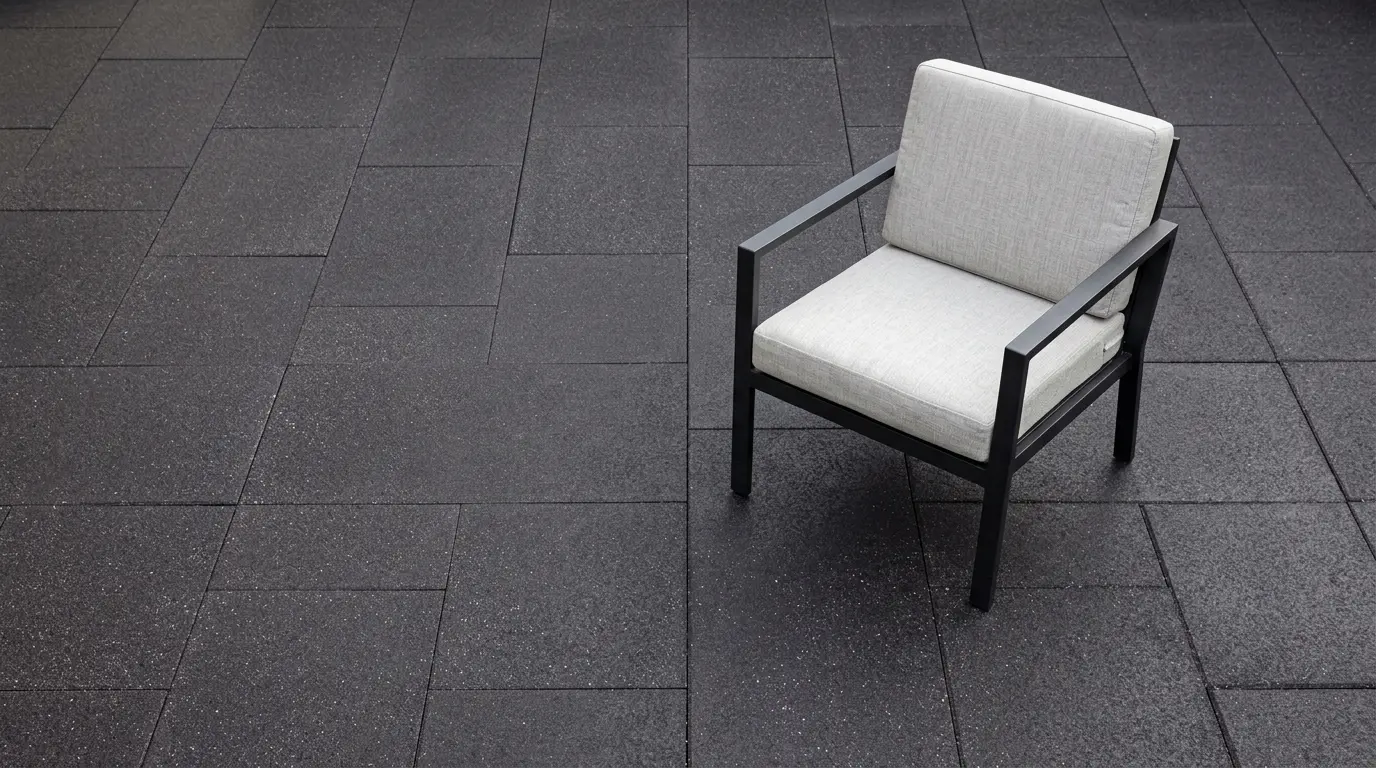
Basalt is an igneous volcanic rock with a fine crystalline grain structure that forms under rapid cooling. That grain structure gives it a high, consistent density with low absorption — both properties that translate directly into dimensional stability once it is cut and honed. Each unit arrives at site as a finished piece, cut to a specified thickness and dimension, so your layout grid is locked in before a single piece touches the substrate.
- Honed basalt tiles and slabs are quarried, cut and finished as discrete units — dimensional tolerances are set at the fabrication stage
- Each unit’s physical properties can be verified against an ASTM test report — absorption, density and flexural strength are testable per named methods; request the test report from your supplier before specifying
- Polished concrete’s structural performance depends on the parent slab — mix design, curing, reinforcement and base compaction all influence the final result
- Concrete’s surface finish is achieved on site, so any inconsistency in the parent slab shows through grinding — aggregate pop-out, surface voids and bleed-water lines become visible under polishing
- Honed basalt’s properties are consistent across the batch; polished concrete’s outcome varies with site conditions, crew skill and ambient temperature during pour and cure
According to USGS volcanic rock composition data, basalt is one of the most abundant fine-grained igneous rocks on earth, characterized by its dense silicate mineral matrix — the same matrix that makes it a reliable specification for high-traffic interior floors. That density is not just a geological footnote; it is the property your loading calculations depend on.
Surface Finish and What Honing Does to Basalt
The honing process on basalt involves progressively finer diamond abrasives run across the sawn face until the surface is flat and closed. The result is a low-sheen matte that does not reflect a full image — distinct from a polished finish, which would carry a mirror-reflective sheen and is reserved for dry indoor surfaces only. Honing closes the surface pores without filling them with a coating, so the stone’s natural colour depth reads through without the distraction of glare.
Your choice of grit at the honing stage changes the surface appreciably. A coarser hone leaves a slightly more open texture that takes edge light differently from a tight, fine-grit surface. For most interior floor applications — living spaces, kitchens, hallways — a Honed 60 Grit or Honed 120 Grit finish gives you the closed, even surface that reads well under both ambient and directional lighting. The 120 grit is the tighter of the two and sits closer to a low-sheen than the 60, which carries a slightly warmer, more matte character.
Polished concrete achieves its sheen through a different sequence: the slab is ground flat, densified with a lithium or sodium silicate chemical hardener that reacts with free lime in the concrete, then polished with progressively finer heads up to the desired gloss level. The densifier stage is critical — without it, the surface dusts under foot traffic. That chemical step has no equivalent in natural stone finishing; Natural Stone Institute igneous stone specifications cover finishing protocols for stone that differ fundamentally from the concrete densification process.
How Thermal Cycling Affects Each Material
Temperature range — the swing between overnight lows and daytime highs across seasons — is the performance variable that differentiates these two materials more than almost any other factor. Both basalt and concrete expand and contract with temperature, but their coefficients of thermal expansion differ, and that difference drives your joint spacing calculation.
Concrete has a higher coefficient of thermal expansion than dense igneous stone. In an environment with significant day-to-night or seasonal temperature swings, a polished concrete floor moves more per degree than a basalt floor of comparable area. For interior floors with climate control, that movement is small enough to manage with standard expansion joints. For spaces that cycle widely — unheated buildings, covered but open-sided structures, or any space that sees significant seasonal temperature variation — the cumulative movement across a large concrete slab area requires more frequent expansion joint placement than you would specify for basalt.
- Basalt’s thermal expansion coefficient is lower than concrete’s — your joint spacing for basalt can be wider for the same temperature range and slab dimension
- Polished concrete’s joints must account for both thermal movement and shrinkage — shrinkage cracking is a concrete-specific failure mode with no equivalent in stone
- In freeze-thaw environments, the concern for basalt is not the stone itself but the grout joint and setting bed — water infiltration into joints that freezes and expands damages the joint and can displace tiles over repeated cycles
- Polished concrete in freeze-thaw zones is vulnerable at the surface — spalling and delamination occur where surface moisture penetrates and freezes before the densifier has fully saturated the matrix
- Your joint design should use a movement-accommodating sealant and a grout specified for the thermal range of the installation — not a standard cement-based grout where seasonal cycling is significant
The practical implication is that your expansion joint layout is a thermal engineering decision, not a layout grid preference. For basalt, calculate from the stone’s coefficient and your site’s temperature range; for polished concrete, add the shrinkage allowance on top of thermal movement, and your joint frequency increases.
Absorption, Sealing, and Long-Term Maintenance
Basalt’s low absorption rate means liquid sits on the surface longer before any potential infiltration — that characteristic makes spill management on a basalt kitchen floor or living space floor straightforward. That said, sealing honed basalt on the interval your sealer manufacturer states is the maintenance step that keeps it performing well over decades. The sealer sits in the surface pores rather than forming a film, so it does not change the stone’s matte appearance but it slows staining at the surface.
Polished concrete’s maintenance profile is different in a specific way that surprises many owners: the densified surface is more resistant to liquid infiltration than raw concrete, but it can scratch and etch under maintenance products with incorrect pH, and the sheen level will dull over time under foot traffic. Re-polishing restores the sheen, but it requires diamond tooling, site protection, and a crew — it is a contractor task, not a homeowner task. Basalt maintenance stays at the cleaning and re-sealing level throughout its service life.
For honed basalt and polished concrete floors specified in kitchens, the sealing question is straightforward: both need a sealer compatible with the surface and the use. Where they diverge is that basalt’s sealing program is well-documented by stone sealant manufacturers with product-specific recoat intervals, while polished concrete’s maintenance may require periodic re-densification or guard application depending on the original system specified.
Colour, Light, and Visual Character
Basalt reads dark — typically in the blue-black to charcoal-grey range — with a quiet, even matte surface that does not compete with other materials in a room. That visual restraint is exactly what makes it a strong floor choice in spaces with warm timber joinery, white walls, or natural light from multiple directions. The stone does not generate glare, and its colour holds consistently across pieces when you are sourcing a consistent batch.
Polished concrete sits in a different colour family depending on the aggregate and cement used. Grey aggregate concrete polished to a high gloss gives a reflective, cool surface; seeded aggregate in terracotta, granite chip or river pebble changes the visual entirely. The design range in polished concrete is wider than basalt’s, but that range requires upfront aggregate specification and comes with more site-variable risk. You are committing to a floor finish before you see the final result.
Basalt’s colour consistency is one of its genuine advantages: you select from a tested batch, and the variation is within the natural range of the stone. Honed Basalt from Citadel Stone’s selected Middle East quarries shows the characteristic blue-black coloration that makes it a strong specification anchor in contemporary interiors — and because the material is cut to order, your batch stays consistent from the first tile to the last.
Where Each Material Performs Best
Your application context should drive material selection more than visual preference. Both materials suit dry indoor applications, but they do it differently and they have different failure modes when pushed beyond their ideal context.
- Honed basalt performs well in interior floors, wall cladding, kitchen countertops cut from slab, and fireplace surrounds — the stone’s density and closed surface work for all of these in dry indoor conditions
- Polished concrete performs well in large-format open-plan floors, industrial-aesthetic commercial interiors, and spaces where the in-situ pour eliminates the need to manage individual tile joints
- Basalt’s individual unit format gives you repairability — a damaged tile can be removed and replaced without disturbing adjacent pieces, provided the setting bed is intact
- Polished concrete’s monolithic character means a local repair — a crack repair or patch — will always show at the surface sheen level unless the entire panel is re-polished
- For spaces with underfloor heating, basalt’s thermal mass means it takes longer to reach temperature but holds that temperature longer — relevant to your heating system sizing
- Polished concrete conducts heat differently through the slab depth; your heating engineer needs the concrete mix specification, not just the surface finish, to size the system correctly
The comparison is not a simple winner — it is a routing exercise. Basalt’s format suits tile-based installation systems; polished concrete suits poured slabs. Your structural floor type, substrate condition, and project program all influence which system is actually buildable in your context.
Installation Logistics and Project Timing
Polished concrete’s timeline is governed by the concrete cure cycle — the slab must reach sufficient strength before grinding begins, and grinding must be completed before densification, which must be completed before the final polish passes. That sequence takes weeks, not days, and any deviation from it shows in the final surface. Your project program needs to accommodate the full cure and finishing sequence without compression.
Basalt installation follows a tile-setting program: substrate preparation, mortar bed or adhesive system, tile placement, grouting, and sealing. Lead times are quoted with the order, and your access logistics and offloading arrangements are confirmed before delivery is scheduled. The material arrives ready to set — there is no site cure period before work can proceed. For projects with tight program windows, that difference in sequence is a practical advantage.
Citadel Stone cuts honed basalt to order from stock held at our selected quarries, so your specified dimensions and finish are produced against a confirmed order. That means your layout grid is determined before fabrication, not after — which is the right order of operations for any well-run stone installation.
Cost and Whole-Life Value
Material unit cost comparisons between honed basalt vs polished concrete are rarely straightforward. Polished concrete’s material cost is low, but the finished-floor cost includes grinding equipment, diamond tooling wear, densifier, labour over multiple grinding passes, and sealer — and if the slab has surface defects, additional passes add time and cost. Basalt’s material cost is higher per square foot, but the installation system is well-understood and the maintenance program is lower in contractor-intervention cost over the service life.
The Natural Stone Institute’s stone variety data frames natural stone’s whole-life value against synthetic and processed alternatives: stone’s service life in a properly maintained installation extends across decades, which means the annualised cost of a basalt floor — spread across its service life — compares favourably against surfaces that require periodic mechanical restoration. That is a specifier argument worth making to clients who lead with unit cost.
Your whole-life cost calculation should include sealing intervals, the cost of any contractor maintenance visits for polished concrete, and the value of repairability. A single replacement tile in a basalt floor is a tradesperson-level task; a polish restoration in a concrete floor is a specialist contractor task with mobilisation cost attached.
Parting Guidance
The honed basalt vs polished concrete decision comes down to format, substrate, and program — not aesthetics alone. Basalt gives you a manufactured unit with testable, documented properties, a tile installation sequence, and a maintenance program that stays at the owner level throughout its service life. Polished concrete gives you a monolithic finish with wide design range, but a site-variable outcome, a longer program, and contractor-level maintenance when the surface needs restoration. Both are strong in the right context; neither is the universal answer.
Your specification should start with the structural floor type and substrate condition, move to program and maintenance requirements, and then confirm aesthetics. For interior living spaces, kitchens and hallways where a matte dark surface is the design intent, honed basalt is consistently the lower-risk specification — the performance is documented, the installation system is established, and the material ages predictably. Beyond basalt’s matte finish, other textures in the same stone family serve different applications: how a flamed texture changes basalt’s surface is worth reviewing if your project includes outdoor or wet-area components alongside the interior floor. Honed basalt from Citadel Stone brings a soft matte depth to living spaces and kitchens, sourced from our selected Middle East quarries.
Related reading: honed stone finish · honed granite.