

The flamed basalt tile finish does something that most surface treatments cannot replicate — it exposes the raw crystalline structure of the stone while tightening the pores against moisture ingress, producing a surface that reads both ancient and precise. Most specifiers choose the flamed basalt tile finish for its bold visual texture, but the mechanical result of the flame process matters just as much: you’re left with a surface that has undergone intense thermal stress during production, which means the stone you receive has already cycled through conditions far more extreme than any outdoor installation will deliver. Understanding that trade-off informs every sizing, fixing, and maintenance decision that follows.
What the Flame Process Does to Basalt
A high-temperature torch passes rapidly across the sawn face of the basalt slab, and because different minerals in the stone expand at different rates, the surface micro-fractures and spalls away in a controlled burst. The result is a coarse, undulating texture with peaks and hollows across the face. The depth of that relief depends on the stone’s mineral composition and the speed of the torch pass — denser, more uniform basalt produces a tighter relief, while material with larger crystal variation produces a more pronounced texture. At our selected quarries in the Middle East, where the basalt is sourced from ancient lava flows with a notably uniform fine-grained structure, the flamed surface comes out with a consistent matte character that holds its appearance across large installed areas.
The flame also drives off some surface moisture and seals the very top layer of pores, which is why flamed basalt tile finish performs well in exposed outdoor conditions. Below that sealed micro-skin, the stone retains its natural porosity, so a quality penetrating sealer still needs to go on — but you’re starting from a more stable baseline than a sawn face would give you. According to USGS basalt volcanic rock properties and composition, basalt’s dense igneous structure and low silica-to-iron ratio give it inherent mechanical toughness that other common paving stones, such as limestone or concrete, do not match at equivalent thickness.
Colour Range and Visual Character
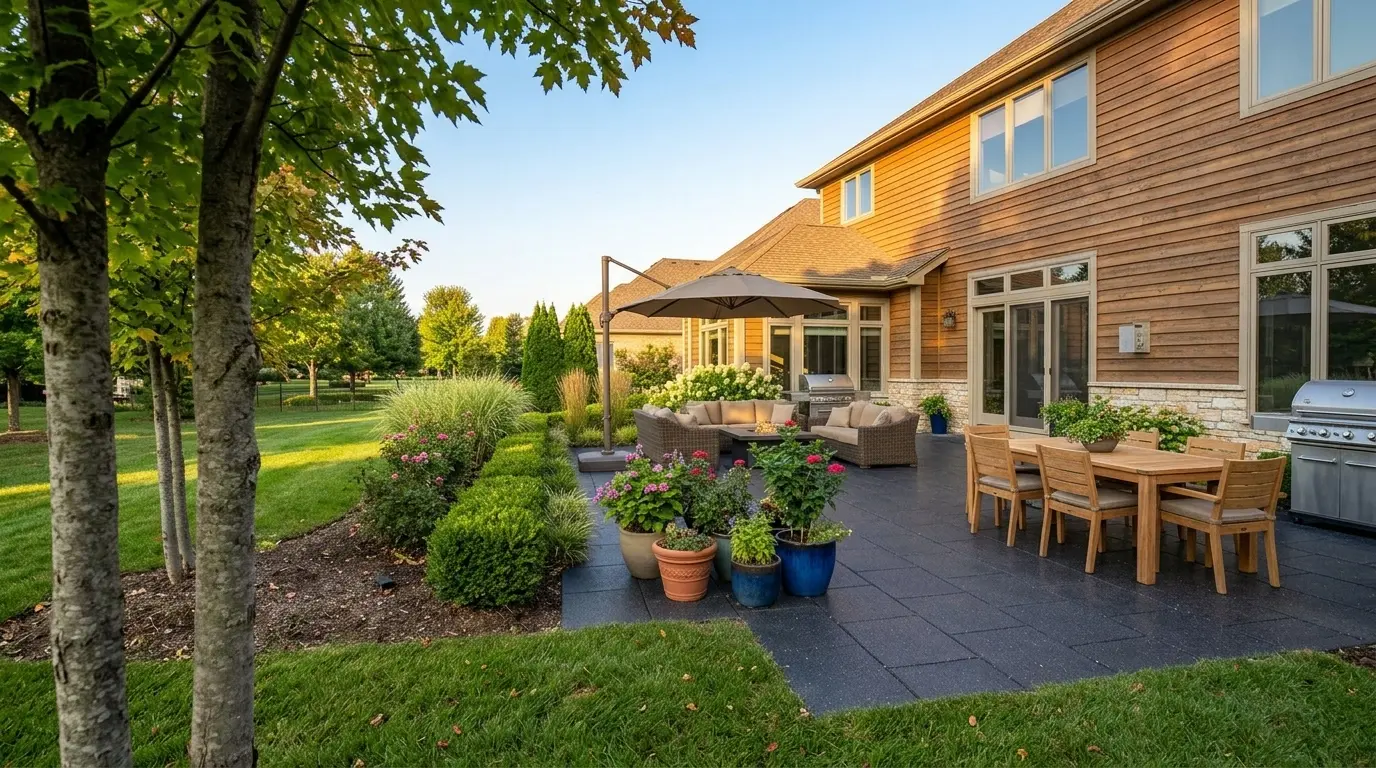
Basalt reads near-black when freshly cut, but the flaming process adds a dimension that a honed or polished surface hides entirely. The thermal exposure pulls out subtle grey, blue-grey, and occasionally rust-brown undertones in the surface minerals, and those tones shift with lighting angle. Indoors under artificial light, a flamed basalt tile finish will often read as deep charcoal with a slightly uneven texture that gives large-format installations a handcrafted quality. Outdoors in full sun, the same tile reads darker but with more surface variation than a comparable honed piece.
One aspect that surprises many project designers: the colour contrast between flamed and honed surfaces of the same basalt is significant enough that mixing them — a honed field tile with a flamed border, for example — creates a strong visual break without introducing a second stone. For reference on how to compare finish options side by side, our honed basalt tile page shows the colour differential clearly, which helps when you’re deciding on finish combinations before samples arrive on site.
Your colour decision should also account for how the stone reads when wet. Basalt darkens noticeably with moisture, more so than lighter-coloured stones. A flamed surface wet down with rain will shift from charcoal to near-black, which can be dramatic in a landscape setting but may not suit every interior design intent. Take a sample, wet it, and look at it in the actual light conditions of the installation location before finalising.
Where Flamed Basalt Tile Performs Well
The coarse open texture of the flamed finish makes it a natural candidate for high-exposure outdoor locations where a smooth surface would be unsuitable. The applications where it earns its place consistently include:
- Pool decks and surrounds — the open matte texture suits wet environments and the stone’s dark tone creates strong contrast with water
- Exterior steps and ramps exposed to rainfall or irrigation runoff
- Courtyard paving and terraces in exposed positions
- Feature walls and split-face cladding on exterior facades
- Outdoor kitchen surrounds and built-up seating areas where stone is cut to size from slab
- Covered terraces and indoor-outdoor transition zones
For pool decks and wet steps, a bush-hammered finish is also appropriate and gives a slightly different surface character — more mechanically uniform than flamed, with a pitted rather than spalled texture. For outdoor paths and courtyards, a Brushed 16 Grit or Brushed 36 Grit finish both work well alongside the flamed option, depending on the aesthetic direction. The flamed basalt tile finish delivers the coarsest natural matte texture in the basalt range, which is why it suits the most demanding outdoor positions.
Polished finishes belong on dry indoor surfaces only — interior floors, wall cladding, countertops, vanity tops, and fireplace surrounds.
Thickness, Format, and Sizing for Your Application
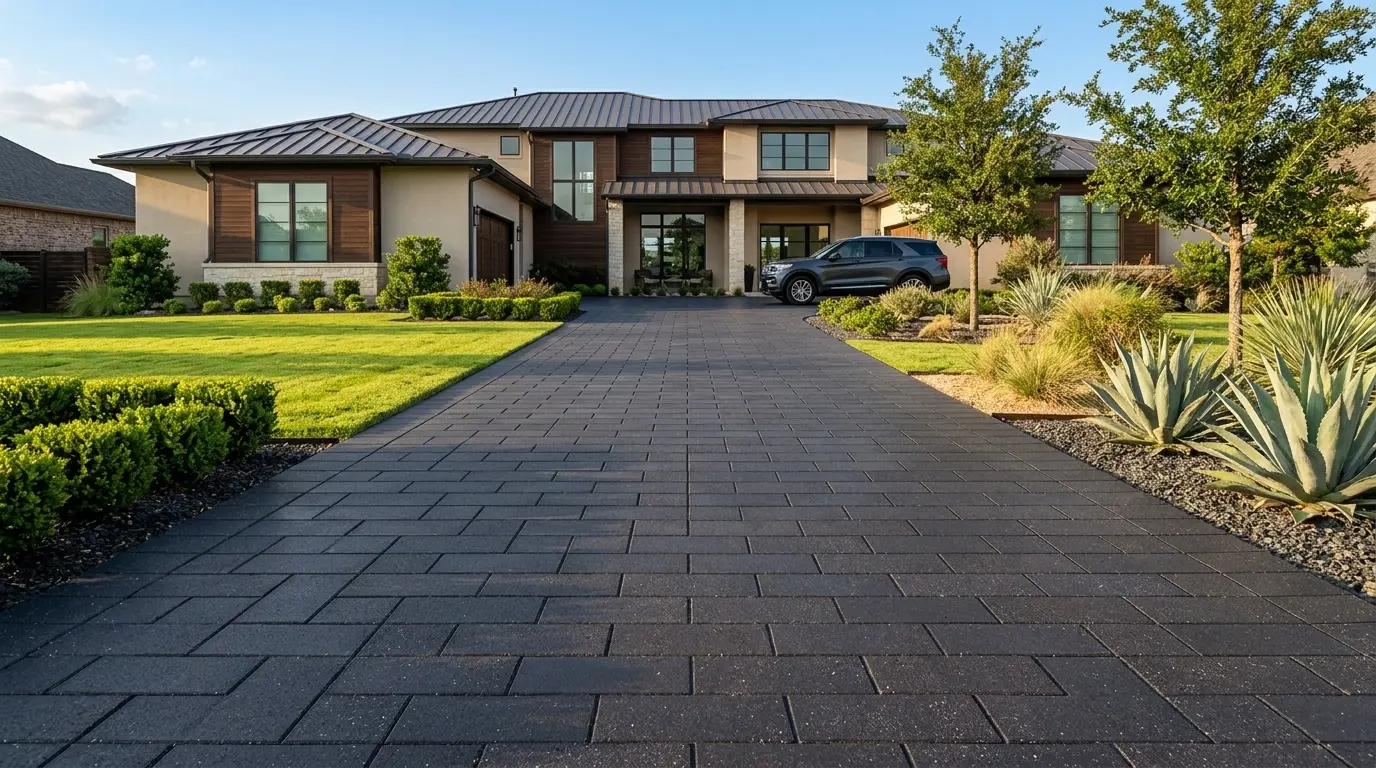
Flamed basalt tile finish is available in tile, paver, slab, and cladding formats, and the right thickness depends entirely on the load and installation type. For pedestrian patios and terraces, 30 mm (approximately 1¼ in) pavers mortar-bedded to a prepared concrete sub-base handle typical residential foot traffic without issue. For driveways or any vehicle-load area, the specification changes: use setts or cobbles at least 3.5 in (4 in standard) thick on a compacted base, or pavers 2 in (5 cm) or thicker mortar-bonded to a reinforced concrete slab. Never use a 30 mm tile or paver in a vehicle area, and never specify a driveway thickness without also specifying the base construction.
Format choice affects grout joint width and installation rhythm. Large-format flamed basalt tile — 600 x 600 mm and up — creates a more contemporary reading with fewer joints, but it demands a very flat sub-base because the coarse-textured surface makes lippage harder to correct after installation. Smaller formats (300 x 300 mm or 400 x 400 mm) tolerate modest sub-base variation better and suit more traditional installation patterns. For cladding applications, thinner panels at 20 mm are standard, fixed mechanically or on a suitable adhesive to a sound substrate.
Your format and thickness decisions should be confirmed with the project engineer where point loads, cantilevers, or structural spans are involved. The Natural Stone Institute igneous stone paving technical standards are a useful reference for specifiers working through thickness-to-span relationships on engineered outdoor decks.
Base Preparation and Bedding for Flamed Basalt
The material will perform only as well as the base beneath it. Flamed basalt tile, like any dense igneous paver, does not flex — it transfers load directly to the bedding and sub-base. Any settlement in the base translates immediately to movement at the joint or, in worst cases, to a cracked tile. Your base preparation checklist for pedestrian applications should include:
- Compacted granular sub-base at the correct depth for the anticipated load
- A concrete slab or compacted road-base layer appropriate to the project specification
- Consistent bedding mortar or adhesive at the recommended thickness for the tile format selected
- Adequate drainage fall built into the slab — basalt does not absorb standing water and pooling at the surface accelerates joint deterioration
- Expansion joints at intervals calculated from the thermal movement of the stone and the substrate — never specified from a generic rule of thumb
Thermal movement in basalt is lower than in many other paving stones, but the coefficient still needs to be taken from a test report and used in the joint-spacing calculation, not estimated. Request the thermal expansion data from your supplier at the specification stage.
Installation in Wind-Exposed and Storm-Prone Locations
Cladding applications of flamed basalt tile face a different mechanical brief than floor paving. Wind loads on vertical stone panels — particularly on upper storeys or exposed facades — create suction and positive pressure cycling that the fixing system must handle, not the stone itself. The stone’s density and thickness are assets here, but the fixing specification governs performance. Mechanical fixings rated for the site’s design wind speed are the standard for exterior cladding; adhesive-only systems on exposed facades are not recommended for basalt panels above a certain height, and that threshold is a structural engineer’s call, not a material specification.
For horizontal paving in storm-exposed locations, joint integrity matters more than most specifiers anticipate. Wind-driven rain forces water horizontally into joints at pressures that far exceed standing rainfall. Fully filled joints — using a suitable joint mortar or resin grout rather than open sand — resist this better and also prevent the fine debris and seed material that wind delivers from establishing in the joint. Edge restraints in exposed courtyard or terrace installations need to be mechanically anchored, not just mortar-bedded, because the same storm events that drive rain into joints also create pressure differentials that can work edge pavers loose over years of cycling. The basalt volcanic rock formation and construction properties reference confirms the material’s mechanical toughness, but the fixing and restraint system is where storm durability is actually built in.
Hail impact is worth considering for thin cladding panels in severe-weather regions. Basalt’s dense igneous structure gives it better impact resistance than softer sedimentary stones such as limestone or slate, but a very thin panel (15 mm or less) on an adhesive fixing will absorb impact energy differently than a mechanically fixed 20 mm panel. Specify panel thickness and fixing method together, accounting for both wind load and impact requirements for the climate zone.
Sealing, Maintenance, and Long-Term Care
Flamed basalt tile finish has a coarser, more open surface micro-profile than honed or polished basalt, which means it has a larger effective surface area for a sealer to penetrate. That’s an advantage — a quality penetrating impregnating sealer bonds into the stone structure rather than sitting on top of it, and the open texture gives it more contact surface. The practical result is that a properly sealed flamed surface resists staining better than a polished surface with a surface-coat sealer that can be scratched off.
Apply a penetrating impregnating sealer before the installation is put into service, following the sealer manufacturer’s stated surface preparation requirements. The interval between resealing depends on the sealer product and the exposure conditions of the installation — your sealer manufacturer’s data sheet specifies the maintenance interval, and that schedule is the one to follow. For high-traffic exterior locations, an annual check and reseal on the manufacturer’s recommended cycle keeps the protection layer intact. Cleaning is straightforward: a pH-neutral stone cleaner, not acidic or alkaline products that attack the stone’s mineral structure.
One detail that comes up consistently in exterior installations: the coarse texture of the flamed finish traps airborne grit and organic debris more readily than a smooth surface. A periodic dry sweep followed by a rinse keeps the surface from developing a ground-in grey cast from embedded dust. In locations with overhanging trees, more frequent attention to debris clearing prevents tannin staining, which is far easier to prevent than to reverse.
Comparing Flamed Basalt Tile with Other Finishes and Materials
The flamed basalt tile finish occupies a specific niche in the natural stone spectrum. Against other finishes on the same stone, it delivers a coarser texture than brushed, honed, or polished surfaces, and a more consistent texture than split face. Against other materials in comparable outdoor applications:
- Versus granite in a flamed finish: both are dense igneous stones with similar mechanical toughness, but basalt reads darker and more uniform because its crystal structure is finer; granite in a flamed finish tends to show more mineral variation in colour
- Versus slate: slate is metamorphic, lighter, and layers in a way that makes it prone to delamination in some climates; basalt does not delaminate and handles freeze-thaw cycling better in most cases
- Versus concrete pavers: concrete can be manufactured in almost any colour and texture, but it is more porous and more susceptible to surface degradation over decades of exposure than dense volcanic basalt
- Versus limestone in an exterior position: limestone is a sedimentary stone with higher absorption rates and more sensitivity to acid rain and cleaning chemicals; basalt’s igneous origin gives it notably lower absorption and better chemical resistance
The case for flamed basalt in demanding outdoor locations comes down to a combination of density, low absorption, and the specific surface character the flame process delivers — a texture that reads natural rather than manufactured, in a stone that earns decades of service life in exposed positions.
Ordering, Specification, and Delivery Planning
Citadel Stone stocks flamed basalt tile at our selected quarries and cuts to order, which means your format, thickness, and edge detail are specified at the order stage rather than selected from pre-cut inventory. That process rewards early specification — having the layout drawing and format confirmed before the order is placed avoids material waste and keeps the cutting schedule aligned with your project programme.
Lead times are quoted with the order and depend on format complexity and quantity. Your project’s site access constraints and offloading arrangements should be confirmed before the delivery date is scheduled — basalt is dense, and pallets of material arrive at significant weight per unit. Plan the offloading point and any cranage or forklift requirements in advance. Delivery to your site is arranged and managed by Citadel Stone and confirmed with the order; ask for the lead time when you submit your specification.
For test report data — absorption, flexural strength, compressive performance — request the documentation at the specification stage. Those figures come from actual test certificates on the material, not from published ranges, and they belong in your project specification file. The ASTM test methods covering dimension stone properties are the appropriate reference frame for any technical claims you need to verify.
Getting Your Flamed Basalt Tile Specification Right
The specification decisions for a flamed basalt tile finish project follow a clear sequence. Start with the application: identify the surface type, the load category, and the exposure conditions. Use those three inputs to determine the finish (flamed is appropriate for exposed outdoor paving, pool decks, feature walls, and exterior steps; polished stays for dry indoor surfaces only), the format, and the thickness. Get a sample of the flamed basalt in the size closest to your specified format, wet it in the actual installation light, and confirm the colour reads the way the design intent requires. Request the test report at the specification stage rather than after the order — absorption and flexural data belong in the specification file, not as an afterthought.
For your base and fixing specification, work from the project engineer’s requirements for the load type, and confirm expansion joint spacing from the thermal coefficient on the test report. In storm-exposed cladding applications, have the fixing system reviewed against the site’s design wind load before finalising. Plan your access and offloading logistics early so that delivery scheduling aligns with the programme. Your outdoor stone project may also grow to include complementary hardscape elements built from the same material family — basalt garden benches and seat walls are one natural extension when the primary paving or cladding specification is already set in basalt, and they draw from the same material sourcing logic. Citadel Stone cuts flamed basalt tile to order at our selected quarries in the Middle East, with the finish and format chosen to suit each application.
Related reading: Honed Stone Finish: Polished vs Honed vs Flamed · Honed Granite vs Basalt: Which Floor Holds Up?.