Four Districts and One Guide
Historic-district work in the US Virgin Islands is not a matter of taste. The Department of Planning and Natural Resources, through the State Historic Preservation Office and the Virgin Islands Historic Preservation Commission, issues an updated Historic Districts Guide covering Charlotte Amalie, Christiansted, Frederiksted and Cruz Bay. It addresses signage, paint colors, architectural materials, masonry and wood repair, landscaping, new additions and the legal approval process. A supplier who does not know that document exists is not much help on this kind of job.
Who Approves What
Two separate conversations run in parallel on a historic-district project, and confusing them costs weeks.
- The Historic Preservation Commission must approve construction inside a designated district.
- The State Historic Preservation Office sits within DPNR, with the role delegated to the Commissioner.
- The Division of Permits handles the building permit under the 2021 International Building and Residential Codes.
- Coastal Zone Management runs a separate DPNR review where the site sits on the shore.
New construction inside a district is expected to follow architectural guidelines that maintain the Danish colonial character of these towns, so the material argument has to be made rather than assumed.
What the Surrounding Fabric Is Made Of
It is worth being precise here, because the honest answer is more useful than a flattering one. The historic character of Charlotte Amalie and Christiansted is carried by their buildings, by masonry walls, Danish colonial frontages and fortifications, rather than by a documented tradition of stone-paved streets. The Charlotte Amalie Historic District covers 165.3 acres and the Christiansted Historic District covers 135.9 acres, and both were listed on the National Register of Historic Places in 1976. When new paving goes into a setting like that, it is a new element introduced beside old masonry, and it should be presented to the commission on those terms rather than dressed up as the restoration of something that was there before. The territory also holds Christiansted National Historic Site, Salt River Bay National Historical Park and Ecological Preserve, Virgin Islands National Park on St. John, and Fort Christian, so a site can sit close to federal designations as well as territorial ones.
Local Building Stone and Its Place
St. Thomas has its own building stone. The Louisenhoj Formation produces a bluish volcaniclastic rock, named for exposures in roadcuts north of Charlotte Amalie, and Louisenhoj bluestone is valued locally in facades. It is a wall material rather than a paving line, and it belongs to the island’s own building history. Imported paving is not a substitute for it and should never be positioned as one. A new surface laid at the foot of such a wall is there to sit quietly beneath it.
Specifying New Stone Beside Old Walls
Most of the craft in this work is restraint, and most of the arguments are settled by the wall behind the paving.
- Take the tone reference from that wall, not from a catalog photograph.
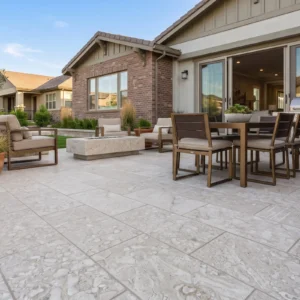
- Keep unit sizes modest so the surface does not overpower a small courtyard or entry.
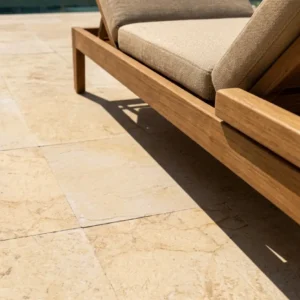
- Choose a finish that reads as worked rather than polished, since sheen is what makes new stone look new.
- Detail the junction where paving meets an old wall base so nothing traps water against the masonry.
- Keep the specification documented, because the commission is reviewing materials as closely as layout.
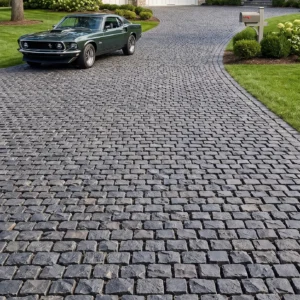
Projects using hand-finished setts for district work should have physical samples in hand well before the submission date.
Finish, Tone and the Review Conversation
Reviews go better when the applicant brings material rather than images. A photograph cannot show how a face scatters light, or how a tone shifts when the stone is wet, and both are exactly what a commission is judging. Bring a sample, the data sheet and a laying drawing to the same meeting, and allow real time for it, because a sample that arrives after the hearing is worth nothing at all. Our stone supply outline for the territory sets out how samples travel and what documentation accompanies an order.
Coastal and Flood Overlays
These are Danish-founded port towns, and a site close to the shore can pick up a Coastal Zone Management review on top of the historic one. CZM is a separate DPNR division and runs its own process on its own timetable, which is worth establishing before a submission date is agreed rather than after. The DPNR Division of Permits also administers floodplain management and the National Flood Insurance program, and post-2017 reconstruction is among the categories of current work that carry those conditions.
- Establish early whether the site falls inside a coastal zone review area.
- Ask which approvals must be sequenced and which can run alongside each other.
- Keep material data sheets in the application file rather than in a separate folder.
- Build sample lead time into the schedule before a submission date is agreed.
A Workable Sequence
The projects that go smoothly are the ones that treat approval as a design input rather than an obstacle at the end.
- Confirm the district and read the current Historic Districts Guide before anything is drawn.
- Agree the material palette with the design team, then order samples.
- Submit with data sheets, dimensions and a laying drawing attached.
- Hold the order until the review outcome is known, and build that wait into the program.
Send us the district, the wall you are working against and the review date, and we will have samples with you in time.