A Capital Rebuilt More Than Once
Road Town is not a museum piece. It is a working harbor town on Tortola that has been added to, knocked about and put back together many times, most recently after Hurricane Irma crossed the Territory on 6 September 2017. Around 85 percent of the housing stock was damaged or destroyed, and much of what stands today is repair rather than replacement. Heritage work in the Virgin Islands therefore rarely means restoring a frozen streetscape. It means adding carefully to a place that has always been practical about materials. Where old walls, steps and yards have lasted, they tend to be low, heavy and well drained, which is a useful hint for anything laid beside them now.
What Heritage Means in Practice Here
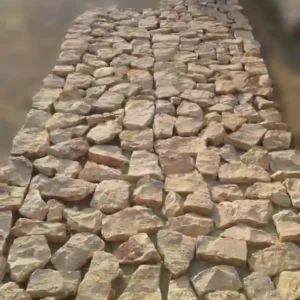
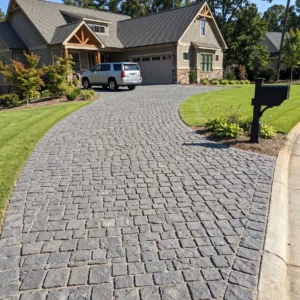
On most island properties the historic fabric is modest and local: a stone boundary wall, a set of worn steps, a threshold, the yard around an old timber house. Paving that respects it does not try to outshine it. Setts suit that job because their scale is domestic. Laid in short courses with a hand-dressed face, traditional cobble units we carry sit quietly beside old walls instead of competing with them, and they weather rather than wear out.
Before any layout is drawn, record what is already on the ground.
- The height and coursing of any existing wall the new paving will meet.
- Levels at every threshold, since older buildings rarely sit square to their yard.
- The line surface water takes in heavy rain, which an old yard usually settled long ago.
- Any stonework worth lifting, cleaning and relaying rather than replacing outright.
The Granite That Trains the Local Eye
Anyone specifying stone in the Virgin Islands should spend an hour at The Baths on Virgin Gorda first. The name is short for batholiths, and the place is a protected national park of about seven acres where enormous granite boulders form passages and sheltered pools. That granite formed roughly 45 million years ago when magma intruded into older rock, then cooled, cracked into blocks and was rounded by weathering as softer material eroded away. It is not a resource and should never be treated as one. It is, however, the reference every local eye carries: pale warm tones, rounded rather than sharp edges, matte surfaces, generous scale. Understanding that landscape is the difference between paving that belongs on Virgin Gorda and paving that could have been dropped anywhere in the world.
Texture Instead of Polish
Historic settings ask for surfaces that look worked rather than machined. That is a finish decision as much as a material one, and it is worth reviewing texture choices for heritage work before quantities are agreed.
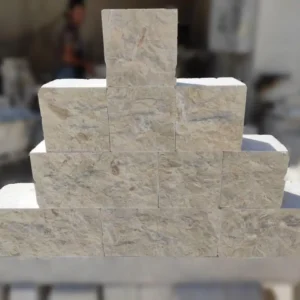
- Hand-dressed or split faces read as older work and hide small level differences.
- Bush-hammered surfaces hold grip on sloping yards without looking industrial.
- Honed faces suit sheltered interior thresholds where glare would be unwelcome.
- Gloss finishes look wrong beside weathered stone and turn slick in a downpour.
Matching Old Work Without Copying It
Direct imitation usually fails, and old and new stone will never be identical anyway. The better approach is to match a few properties exactly and let the rest differ honestly.
- Match the unit scale, since module size is what the eye reads first.
- Match the joint width and the joint color, which age a surface faster than the stone does.
- Match tonal temperature rather than exact color, because new stone will settle over time.
- Leave a legible junction between old and new work rather than blurring the two together.
The Paperwork Behind Sensitive Work
Development is governed by the Physical Planning Act, 2004, applications are still processed in accordance with the Land Development Control Guidelines of 1972, and the Town and Country Planning Department reviews each submission and visits the site before the Planning Authority decides. A locally registered architect or surveyor must file the application. For sensitive settings that is an advantage rather than an obstacle, because the professional who knows the neighborhood is inside the process from the first day. Allow time for that review in the build schedule, since the departmental review, the site visit and the decision are separate steps and none of them is instant.
Small Quantities and Repairs
Heritage jobs rarely need a full container. They need the right hundred square feet, and often a reserve held back for future repairs.
- Order a modest overage from the same production run so replacements match years later.
- Keep the reserve dry and shaded, because setts stored under plastic can stain.
- Consolidate small orders with a larger shipment where timing allows.
- Record the format, depth and finish in the owner maintenance file.
Working With What Is Already There
Imported stone is not a substitute for the island material culture and should never be sold as one. It is a wearing surface laid by local crews over base material bought through the island’s own builders’ merchants, alongside walls built long before anyone shipped a crate here. Specified with restraint, it lets an old yard keep its character while finally shedding water properly and taking modern loads. Local crews know which corners take water and which walls have moved over the years, so their advice on falls and bedding is usually worth more than anything a distant drawing can offer. Good heritage paving is the work nobody notices until they try to imagine the place without it.