Climb into the cordillera and Puerto Rico cools into its oldest luxury: coffee country — the mountain municipalities around Jayuya, Adjuntas and Yauco where nineteenth-century haciendas built an export empire in the shade, and where a modern revival is renewing the estates as working farms, agrotourism destinations and mountain retreats. The highlands are the island’s other heritage, and their stone craft blends estate conservation with working-farm honesty at altitude. Here is coffee country’s guide.
The hacienda inheritance
The estates’ fabric is a working-heritage register this library knows well: great houses with deep verandas over the valleys, the estate-hospitality instincts translated to mountain Spanish, and the processing architecture — the glacis drying floors, the beneficiado’s levels and channels, the machinery rooms — as the industrial half conservation must honor. Renewal runs the settled manners: original masonry conserved breathing, the read-before-build discipline applied to terraced slopes three coffee generations engineered, and new work matched to fabric the clouds have been washing for a century.
The glacis: the drying floor’s mountain form
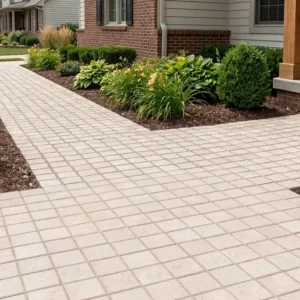
Coffee’s signature stone is the glacis — the great sunning floor where parchment coffee dries in raked rows — and its craft mirrors the drying-floor canon at estate scale: smooth, dense surfaces that release the crop cleanly, subtle falls that shed the mountain’s sudden showers without carrying beans, raised edges, and the sweeping discipline the harvest enforces. Revival estates restore their glacis first — the floor is the farm’s proof and its best photograph — and agrotourism found its stage ready-made: the raking demonstration, golden at four o’clock, is coffee country’s signature image.
- Dense, low-absorption units where drying is slow for months at a time
- Wide joints that can be raked and refilled rather than sealed shut
- Thresholds detailed for mud and boots, not for a coastal terrace
- Edge restraint on every step, since slopes push surfaces downhill
Altitude specification
The mountains write their own sheet: cooler temperatures that make fireplaces real equipment, cloud-drift humidity on the cloud-belt grip rules, mountain roads that govern delivery on the switchback realities, and rain that arrives hard on slopes the terraces were built to hold. Ground craft follows: textured surfaces on every outdoor level, drainage worked with the old terrace logic rather than against it, retaining renewed at engineering honesty, and the staged-build patience of estates renewed one good harvest at a time.
The agrotourism turn
The revival’s economics run on visitors: estate tours ending at the tasting room, the visitor-circuit craft in coffee dress — safe paths through working levels, viewing ground at the glacis edge, working areas legible without interruption — farm-stay quarters on the family-hospitality model, and the mountain-lunch terraces whose views do half the marketing. The register stays working-first: visitors come for the real farm, and the infrastructure’s job is serving the harvest and the tour without either compromising the other.
- Service routes surfaced to the same standard as the guest routes
- Covered and open sections given one continuous texture
- Drainage taken clear of the seating area before it reaches the slope
- Furniture points set out before the paving pattern is fixed
Storm and the mountain farm
María devastated coffee country — the canopy, the crop and the estates together — and the replanted decade carries the resilience curriculum at farm scale: shade systems re-established with wind lessons applied, processing buildings hardened, access roads on the feeder-road seriousness because a slide still takes the season, and the energy-independence layer running strongest where the grid was always weakest. The mountains rebuilt patient and stronger; the estates’ stone — glacis, terraces, channels — was, as everywhere, the layer that held.
Specifying the highlands
Coffee country’s kit blends the registers: conservation-matched estate fabric, working-grade processing ground, cloud-belt textures, terrace-honest drainage and visitor-duty circuits — delivered up mountain roads that reward the consolidated-planning habit even on a domestic lane. The island supply page serves the highlands in their own rhythm: harvest-calendared, estate-matched, unhurried. The clouds still wash the mountains; the haciendas are waking; and their stone — a century seasoned — is ready for the next hundred harvests.
The Panorámica: living on the ridge road
The island’s spine carries a road built for the view: the Ruta Panorámica, threading the cordillera’s ridgelines from one end of Puerto Rico to the other through the coffee municipalities, the highest peaks and mountain towns most coastal residents have never visited. The route is the highlands’ tourism artery and its property spine both — lookout restaurants, mountain inns, weekend cabins and the estates behind them all string along its gradients — and building on it means accepting the ridge’s particular terms.
The terms are mostly about access and weather. Delivery arrives by the road’s standards, not the project’s: switchbacks and narrow shoulders set vehicle sizes, the consolidation habit pays for itself twice on a mountain route, and the last leg from road to site frequently transfers to smaller wheels. Cloud sits on the ridge for days at a time, which the highlands’ altitude specification answers with texture and drainage — and which owners come to treat as the address’s luxury rather than its inconvenience, since the mountains deliver cool nights the coast cannot buy at any price. Roadside premises add the lookout economy’s craft: parking that works on a gradient, terraces aimed at the valley rather than the tarmac, and surfaces that take weekend crowds arriving in cloud and leaving in sun.
The register the route rewards is modest. The Panorámica’s charm is that it feels undiscovered a half hour from towns of a hundred thousand people, and the properties that keep that feeling — low, green-framed, quiet at night — are the ones the road’s regulars remember fondly. Build for the cloud, respect the gradient, and let the view do the advertising it has been doing since the road was cut.
A working landscape, not a backdrop
The mountains are still farmed, and that context sets the tone for anything built in them. The 2022 Puerto Rico Census of Agriculture counts 7,602 farms working 494,481 cuerdas, close to 22 percent of all land on the island, at an average of 65 cuerdas each, with coffee among the products showing the largest sales increases since 2018. A hacienda terrace sits inside that economy rather than beside it, which is why the finishes that succeed here read as agricultural rather than resort.
- Materials that look correct next to working buildings, not against them
- Surfaces that tolerate farm vehicles as well as guests
- Details that can be repaired by the people who already maintain the estate
- A palette that ages into the landscape instead of fighting it
Grip on a slope that is usually wet
The cloud belt keeps these terraces damp for long stretches, and a wet slope is where slip resistance stops being theoretical. The work behind frictional testing of natural stone walking surfaces sets out the ANSI A326.3 wet test method and a dynamic coefficient of friction of at least 0.42 for level interior floors that will be walked on wet. A sloping exterior terrace in permanent humidity is a harder case than that, and the sensible response is to test the delivered finish and specify above the minimum.
- Wet-tested finishes on every route between buildings
- Grip specified higher on slopes and steps than on level ground
- One texture maintained across covered and uncovered sections
- Cleaning method agreed, since growth changes friction faster than wear
Terracing is the old answer and still the right one
Estate builders here solved the slope problem centuries ago by cutting it into level working platforms with drainage between them. That logic still holds. A modern terrace that fights the contour needs retaining, waterproofing and repair. One that follows the contour needs a good set of steps and somewhere for water to go.
- Level platforms linked by generous steps rather than long ramps
- Cut and fill balanced on site to reduce imported material
- Drainage designed between platforms, not around the perimeter
- Retaining kept low and repeated instead of tall and singular
Choosing hacienda terrace stone in coffee country
The mountain brief rewards honesty: dense stone, open joints, tested grip, level platforms and repairs the estate can make itself. Our Puerto Rico stone supply guide sets out the formats, finishes and lead times that suit this island. Up here the ground is still a working surface first and a view second.