Three Kinds of Wet
Most slip advice imagines an occasional puddle. A Caribbean pool deck is wetter than that, and wet in different ways. There is chlorinated splash from the pool, fresh water from rinse showers and hoses, and rain that can arrive with real force. Each leaves a different film behind it. Sunscreen and body oils add a fourth layer that quietly reduces grip on any smooth surface, and shaded corners add a fifth in the form of biological growth. A finish that copes with all of that is a specification decision, and it is made long before anyone is standing on the deck with wet feet.
Finishes Ranked by Wet Grip
Texture, not tone, is what your feet read. In rough order from most secure to least on a wet horizontal surface:
- Bush-hammered, which leaves a consistent peened texture with real depth across the whole face.
- Sandblasted, giving an even micro-texture that stays predictable when it is soaked.
- Flamed, where thermal treatment opens the surface into a coarse, open face.
- Tumbled, softer to look at and to touch, with rounded arrises that suit older properties.
- Honed and polished, both of which belong indoors and become genuinely risky around water.
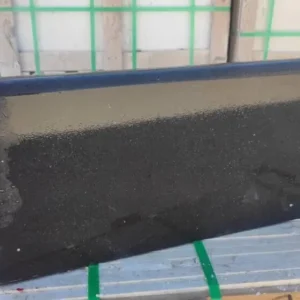
Comparing flamed, tumbled and bush-hammered surfaces side by side is the fastest way to settle an argument about grip.
Where Slips Actually Happen
They cluster, and they cluster in predictable places rather than across the middle of an open deck.
- The step out of the pool and the first coping row, where feet are wettest and least careful.
- Shower and rinse zones, which stay damp long after the rest of the deck has dried.
- Steps and level changes, where a slip becomes a fall instead of a stumble.
- Shaded corners that never fully dry and slowly build a biological film.
Texture Versus Comfort
There is a limit to how aggressive a surface should be where people walk barefoot or sit down. A very coarse flamed face can be uncomfortable for children and for anyone kneeling at the pool edge. The usual answer is zoning: a more textured finish on copings, treads, ramps and rinse areas, and a slightly gentler face across the open lounging deck. That is easier to specify than it sounds, since the same stone can normally be supplied in more than one finish on the same order, in matched thicknesses so the bedding stays consistent.
Zoning also lets you spend where the risk sits. A coping run and a set of treads are a small share of the total area but carry most of the exposure, so a heavier textured finish there costs very little across the job. Spreading that same finish across an entire lounging deck buys far less safety and takes away comfort for everyone lying on it, which is rarely a trade a client thanks you for later.
Drainage Does Half the Work
No finish saves a deck that ponds. Saint Lucian rainfall can be intense, and Hurricane Tomas remains the reference: up to 668 mm in roughly 23 hours in October 2010, with the worst damage coming from water and landslides rather than wind. On a pool terrace that means positive falls away from the water, joint detailing that lets water move, channels sized for a downpour and not a drizzle, and an edge that will not be undermined by sheet flow off the slope above. Grip and drainage are one problem with two halves, and solving only the first is how good stone gets blamed for a bad detail.
Shade makes the second half harder. A corner that never sees direct sun holds water for hours after the rest of the deck has dried, and that is exactly where film establishes and grip quietly disappears. If the layout puts a walking route through such a corner, either open it up to sun and air or accept that it needs washing on a schedule rather than when someone notices.
Keeping Grip Over Time
Texture wears, and film builds. A deck that felt secure in its first season can lose grip quietly over a few years, so choose textured limestone paving for pool decks with enough depth in the finish that it still performs once the sharpest surface has worn in.
- Wash regularly, particularly in shade, to keep the biological layer from establishing.
- Avoid film-forming sealers outdoors, since a coating can undo the texture you paid for.
- Check the rinse and shower zones first, because they stay damp longest.
- Keep drainage channels and outlets clear, as tropical debris blocks them quickly.
- Reassess grip after a few seasons rather than assuming the first year still applies.
Sampling and Supply
Do the test that matters: wet a small hand sample, tip it slightly, and stand on it with a bare foot. Do it in the shade and in the sun, because a hot surface changes how people walk. Once the finish is agreed, the rest is scheduling. Stone comes in by sea through Castries or Vieux Fort, entries run through ASYCUDA World, and landed cost should allow for VAT at 12.5 percent, the 6 percent service charge and the 2.5 percent Health and Citizen Security Levy. Confirm your tariff line with the customs duty calculator rather than assuming a rate. Choose the finish with wet feet and the deck will look after itself for years.