Wet stone is a different material
Dry, almost any paving feels secure. Add a film of water, a bare foot and a child in a hurry, and the same surface can behave completely differently. Around a pool this stops being an aesthetic question. The useful way to think about it is that grip comes from contact between skin and stone, and water breaks that contact by floating the foot on a thin film. Everything that helps, from surface texture to falls to how often the deck gets rinsed, works by getting that film out of the way faster. None of it is exotic engineering, and none of it costs much when it is decided at the drawing stage rather than discovered after the first season of use.
What actually creates grip
Texture depth is the main lever. A face with open, consistent relief gives water somewhere to go and gives skin something to bear against, while a closed, polished face leaves the film sitting on top. Consistency matters as much as depth, because a deck that grips in one area and not another teaches nobody anything useful until somebody slips. Four factors decide how a surround performs in practice:
- The depth and openness of the finished face
- How consistently that face runs across the whole field
- The falls that move water off before it can pool
- What sits on the surface: salt residue, sunscreen, cleaning film
Faces worth considering around water
Different finishing methods leave different surface profiles, and each has a personality in daily use:
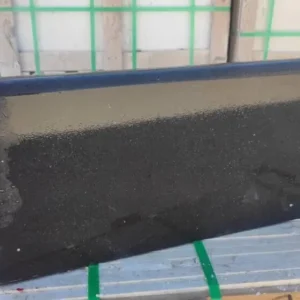
- Bush-hammered faces, with deep and even relief for the wettest zones
- Brushed faces, textured but gentle enough for constant barefoot traffic
- Sandblasted faces, uniformly open and easy to clean down
- Honed faces, better kept for covered or dry areas than for the water’s edge
You can compare the faces we cut side by side before choosing, and it is worth doing that with a wet sample rather than a dry one.
Coping and the edge detail
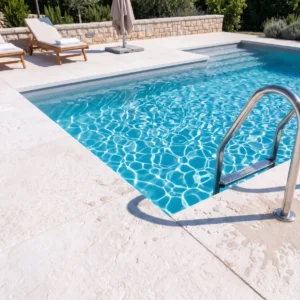
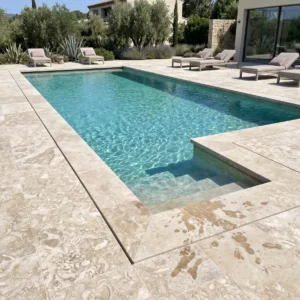
The coping takes the most punishment and the most bare feet. It is worth specifying separately from the field: a rounded or eased edge that is comfortable to sit on and pull out over, texture on the top face rather than a polished profile, and a joint detail that will not open up under constant wetting. Where the coping meets the deck, keep the finish change deliberate rather than accidental, so a bather feels the transition and reads it as information. Order the coping in the same material and finish family as the field, and order it in the same lot, so the two do not weather along slightly different paths.
Salt, chlorine and the rinse routine
Aruba decks carry two chemistries at once: pool water from the inside and airborne salt from the trade winds outside. Both leave residue as water evaporates in dry air, and residue is what makes a textured surface feel slick and look dull.
- Rinse with fresh water often, particularly on the windward side of a building
- Keep cleaning products mild and test them on a spare unit first
- Avoid film-forming sealers on wet-traffic areas unless slip performance is stated
- Deal with sunscreen and body oils early, before they build into a layer
Falls and drainage where water is scarce
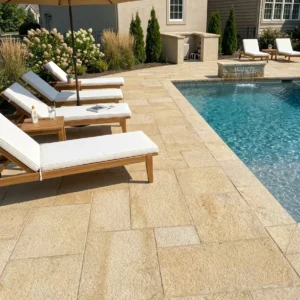
Getting water off the surface is the cheapest grip improvement available, and it costs nothing at the drawing stage. Set consistent falls away from the pool, avoid dead flat panels where a puddle can sit, and make sure the joints and channels can actually carry what a washdown produces. On an arid island fresh water is worth respecting, so plan the rinse to be short and effective rather than lavish, and specify a deck that dries quickly once the wind reaches it. Detail around limestone paving around Aruba pool decks should show the falls, not leave them to the installer.
Test it wet, with bare feet
Every claim in this article can be checked in five minutes with a sample, a bucket and a foot. Wet the piece, tilt it slightly, and stand on it; then do the same with the alternative face you are considering. Do it outdoors, in daylight, so you can also see how each finish handles glare when it is holding water. Run the test in the order that matters:
- Dry first, to set a baseline for how the face feels
- Wet with fresh water, tilted, with a bare foot
- Wet again after the piece has dried with salt residue on it
- Finally with a little sunscreen on the surface, which is the real condition
Resort decks and renovation cycles
The resort corridor along Palm Beach and Eagle Beach, plus the timeshare renovation work that runs on cycle, puts pool decks under far heavier traffic than a private villa deck carries. Specify for the busiest hour rather than the average one: deeper texture in the main circulation routes, a consistent face across the whole field so nobody meets a surprise, and a maintenance routine written down and handed over to the team who will actually run it. Renovation work has one further advantage worth planning around. Aruba sits outside the main Atlantic hurricane track, so there is no storm season closing the window, and a deck replacement can be phased into whichever weeks suit occupancy rather than whichever weeks suit the weather. The face you choose at the water’s edge is a safety decision before it is a design one.