The Wettest Months Are the Storm Months
Sint Maarten has a tropical savanna climate with a drier stretch from January to July and annual rainfall of around 1,047 millimeters. The wettest period runs from September to November, and it coincides with peak hurricane risk. That overlap is the whole design problem in one sentence. The rain that tests your falls and your drainage arrives at the same time as the wind and surge that test your restraint and your joints. A paving detail that copes with a gentle shower in March tells you very little about how it behaves in October. It is worth writing the specification for the harder month and letting the easy months look after themselves.
Two Coasts, Two Exposure Classes
It is worth treating the island as more than one exposure environment. The Atlantic-facing eastern shore around Dawn Beach and Oyster Pond takes weather that the leeward bays at Great Bay and Simpson Bay do not, and salt-laden wind is a different loading from occasional spray. This is reasoning from geography rather than a published exposure map, so treat it as a starting point and confirm the conditions on your own plot. As a rough sorting exercise before a site walk:
- Open Atlantic frontage takes wind-driven salt as a constant load.
- Leeward bay frontage sees spray in weather rather than every day.
- Hillside plots take wind exposure without the same direct salt.
- Enclosed inland courtyards deal in shade, damp and slow drying.
A frontage facing open water and a courtyard three streets inland deserve different answers on density, finish and joint material.
What Irma Left in the Specification
Hurricane Irma made landfall on 6 September 2017 as a Category 5 storm, and reports indicate around 70 percent of the infrastructure on the Dutch side was destroyed. Philipsburg and the Boardwalk along Great Bay Beach were rebuilt afterwards. Anyone specifying a surface here is writing for readers who lived through that, so the useful posture is practical rather than dramatic. The lesson worth carrying into a paving detail is not about the stone surviving wind; it is about what happens when water moves fast across a surface and takes the bedding with it.
The Joint Fails Before the Stone Does
In a scouring event the unit itself is rarely the weak link. The failure runs through everything around it:
- Bedding that washes out from beneath an edge and leaves a rocking unit.
- Joints filled with material that a fast sheet of water can lift and carry away.
- Edge restraint that was never designed for uplift at the perimeter.
- Falls that send water along a joint line instead of across it.
- Drainage sized for average rainfall rather than the wettest month of the year.
Fixing those five at design stage is cheaper than any upgrade to the stone itself, and far cheaper than lifting and relaying a surface afterwards.
Salt, Density and Absorption
Near the water, the specification points in one direction: low absorption, high density and resistance to salt crystallization within the pore structure. Salt is patient. It arrives in spray and in wind-blown mist, crystallizes as the surface dries, and works at the stone from the inside over years rather than weeks. Ask for absorption figures rather than adjectives, and treat stone chosen by shoreline aspect as the norm rather than applying one specification from the coast road to the hillside behind it. Four checks are worth making before a lot is confirmed:
- Water absorption stated as a figure, not as a descriptive word.
- Density quoted alongside it, since the two travel together.
- How the finish reads once salt has dried on the surface.
- Joint material rated for the same exposure as the stone itself.
Finish, Grip and Wind-Driven Rain
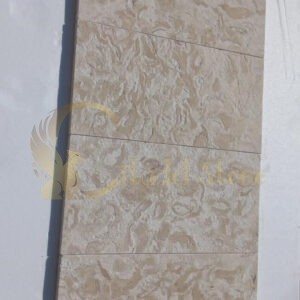
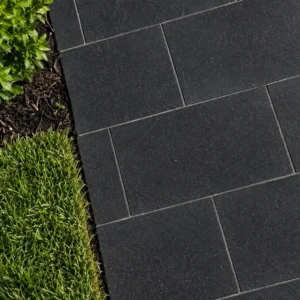
Wet grip is a year-round requirement and a storm-season one. A finish that reads well dry can become slick under a sheet of rain, and around pools and public walkways that matters more than tone. Textured faces also hide the dusting of salt and grit that coastal wind deposits, so they stay looking clean between washdowns. Comparing faces that keep grip in rain side by side, with a wet sample under your own hand, beats reading finish names on a list.
Permits Before You Dig
Groundworks are not a free action here. Civil works permits from the Ministry of VROMI are required for activity that alters terrestrial, coastal or marine terrain, including excavation, and those permits are prerequisites for a building permit, the bouwvergunning issued through the Department of Permits. Approved permits are published biweekly in the National Gazette with a six-week objection window. Excavating a sub-base for a coastal terrace can fall inside that regime, so put the permit path on the program before the stone is ordered rather than after.
Plan the Reinstatement Now
- Hold back a small reserve of paving from the same lot for repairs.
- Record crate marks and finish names in the operations file, not just on the invoice.
- Keep a written note of the bedding and joint materials actually used.
- Photograph the finished surface while it is clean and complete.
A reinstatement pack costs almost nothing while the job is running and is close to impossible to assemble afterwards. Detail the water first, keep a reserve on the shelf, and storm season becomes a maintenance question rather than a rebuild.