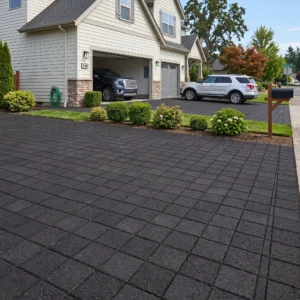
The yard price is the smallest question
Ask what paving costs on Curacao and a square-foot rate for the stone is the easiest answer to give. That number is real, and it is also the smallest part of what leaves your bank account. Between the yard and a finished terrace sit freight, insurance, a customs event, terminal handling, a truck, a base course, bedding material, edge restraint and the crew that lays it. A quote that stops at the stone is not wrong so much as incomplete.
None of that is a reason to distrust a square-foot rate. It is a reason to ask what the rate covers, where it stops, and who owns each line beyond it. The way to get this right is to write the list out before you ask anyone for a price, then make every quotation answer the same list.
The lines behind a delivered number
Build the budget as separate lines and you can argue with each one individually.
- Goods: the stone, priced by format, thickness and finish.
- Freight and insurance to Willemstad, which together give the CIF value customs works from.
- Duty and turnover tax, at rates confirmed against your declared classification.
- Terminal handling, any staging in the free zone, and the road leg to site.
- Ground works: sub-base, bedding, jointing, edge restraint and labor.
What the stone line covers
Format drives price harder than a headline rate suggests. Thickness, face size, finish and sorting all move the number, and two quotations both headed limestone pavers can sit a long way apart simply because they describe different products. Start from the stone line on your budget and make sure the specification behind it is written down: working depth by duty band, face dimension, finish, and how the units are sorted and crated. Sorting matters more than it sounds, because a batch with a wide tolerance on thickness costs the crew time on every unit they set, and that time lands in the labor line rather than the stone line.
Freight and the CIF line
Curacao receives ocean freight directly, and the container terminal at Willemstad runs 24-hour service. That is a structural advantage for a heavy product, because handling events are where stone gets damaged and where cost accumulates. It does not make freight free.
- Stone reaches a container’s weight limit long before it fills the volume.
- Working depth changes how much finished area one box actually carries.
- Crating and pallet build affect both damage rates and handling cost.
- Every extra handling event is another chance to chip an edge.
Ask for the finished area one container carries at your specified working depth, then size each phase to that figure. It turns freight from a lump sum into a rate per square foot you can compare against every other line on the sheet.
Duty, tax and numbers we will not invent
Customs value is built on the goods plus costs such as freight and insurance. Beyond that, the honest position is straightforward. The duty rate applying to your stone depends on the HS heading it is declared under, and we will not publish a turnover tax figure for imports because the available published guidance does not agree with itself. The general OB rate is 6% and there is a 9% band for a listed set of luxury goods that does not include paving. Confirm the rate for your HS code with your customs agent, in writing, before you commit.
Site costs nobody quotes
The stone is the visible layer. The invisible ones are supplied and priced locally, and they belong in your budget from the first draft.
- Sub-base build-up, typically from a graded base coarse product.
- Bedding and jointing sand.
- Edge restraint and any concrete haunching.
- Setting out, cutting waste and the crew, which is a stratemaker rate rather than a stone rate.
- Drainage: outlets, channels and the fall the site actually needs.
Curacao supplies these layers from its own quarried material, including graded base coarse, presieved sand, aggregate and armor boulders, while the imported unit is the wearing course laid on top. Two different product categories in one build-up. Get the local lines quoted before you fix the format, because a heavier unit can shift the sub-base build-up as well as the freight.
Where money is actually saved
Savings on a stone job come from sequencing and specification, not from shaving the rate.
- Order thickness by duty band instead of applying the heaviest depth everywhere.
- Size each container to a phase your crew can lay, so stock is not standing on site.
- Use the free zone for staging when the start date is uncertain, and price that storage honestly.
- Agree the HS classification early so the duty line is a number rather than a range.
- Buy the sample before the container, not after it lands.
What does not save money is thinning the specification in the wheel tracks. That saving is borrowed from the repair budget, and it comes back with the cost of lifting and relaying attached to it.
Getting a real number
A delivered figure is only as good as the schedule behind it, so the fastest route to a defensible budget is to put the takeoff in front of someone and let each line be priced separately. When you are ready, send us your Curacao takeoff and we will price the goods and the ocean freight, then tell you plainly which lines belong to your agent rather than to us. A delivered price you can defend is built from lines you can each check, not from one number somebody rounded.