Why Decomposed Granite Driveway Problems Start Below the Surface
Decomposed granite driveway problems rarely originate at the surface — the real failure point is almost always the base preparation and compaction underneath. Most installers focus on the top two inches of material and miss what’s happening in the six to eight inches below it. Poor compaction allows the fine granite particles to migrate downward under vehicle loads, creating a surface that looks fine on day one but develops ruts, soft spots, and washouts within the first season.
The particle size distribution in decomposed granite — typically a blend of coarse grit, fine sand, and clay fines — behaves predictably when properly compacted to 95% Proctor density, but becomes highly unstable when that threshold isn’t met. You’ll notice the difference immediately after the first heavy vehicle passes across an under-compacted section: the surface displaces laterally rather than bearing the load vertically.
The Most Common Decomposed Granite Driveway Problems
Understanding the full range of decomposed granite driveway problems helps you diagnose what you’re dealing with before committing to a repair approach. Some issues are cosmetic; others signal structural failure that no surface fix will resolve.
- Rutting and tracking under tire loads, particularly in the wheel paths where vehicles turn or brake
- Surface erosion and washout after heavy rainfall events, leaving channels and exposed subbase material
- Dust generation in dry conditions, which creates a nuisance and accelerates surface loss
- Weed infiltration through the surface layer, especially in unstabilized installations
- Color fading and mineral segregation as fine particles blow or wash away, leaving behind coarser aggregate
- Edge migration where the material spreads beyond its intended boundary, thinning the center of the driveway
- Compaction rebound in areas with expansive clay subgrades, causing surface heaving after wet seasons
The Natural Stone Institute granite durability specifications provide useful baseline data on granite mineral composition — relevant here because not all decomposed granite products contain the same feldspar-to-quartz ratios, and that affects how quickly the material breaks down under traffic and weathering.
How Water Management Turns Minor Issues Into Major Failures
Drainage design is where most decomposed granite driveway problems accelerate from manageable to costly. Decomposed granite is inherently permeable in a freshly installed state, but that permeability drops sharply as fine particles compact and migrate to fill void spaces. Once that happens, surface water has nowhere to go and begins to pond, then sheet-flow, then erode.
Your driveway’s cross-slope — typically a 2% minimum pitch away from structures — determines whether rainfall exits the surface cleanly or lingers long enough to saturate the base. In regions that experience intense seasonal rainfall, monsoon patterns, or heavy storm-season downpours, even a correctly installed decomposed granite surface can fail if the surrounding grade doesn’t actively redirect water. The saturation cycle weakens binder cohesion and makes the material behave more like loose aggregate than a compacted surface.
Installing perimeter drainage channels or French drains alongside a decomposed granite driveway isn’t optional in high-precipitation environments — it’s structural. Position your outlet points at the low end of each drainage plane and size them to handle your site’s peak flow rate, not just average rainfall. A 4-inch perforated pipe bedded in clean angular gravel will handle most residential applications, but larger commercial driveways or sites with concentrated uphill runoff need engineered calculations.
When Stabilizer Fails: What Really Happens
Polymer stabilizers are marketed as the solution to loose, dusty decomposed granite surfaces — and they work well when applied correctly. The failure mode isn’t in the product itself; it’s in the application window. Stabilizer needs to be mixed uniformly with the DG material before final compaction, not sprayed on top afterward. Post-application surface spraying creates a thin crust that shatters under wheel loads within weeks.
Stabilizer performance also degrades when the material gets wet before it has fully cured. The cure window varies by product formulation and ambient temperature, but count on a minimum of 24 to 48 hours of dry conditions after installation. If your project falls during a rainy season or in a climate with significant dew formation overnight, schedule accordingly. A stabilizer that fails prematurely leaves you with a surface that’s worse than unstabilized DG — the broken polymer crust prevents natural recompaction and creates irregular hard patches.
According to ASTM C615 granite dimension stone quality standards, the mineral hardness and crystalline structure of granite aggregate directly influences how well binders adhere to particle surfaces — a factor worth understanding when selecting your stabilizer product.
Base Preparation: The Fix That Actually Holds
Repairing surface erosion and rutting without addressing the base is a short-term fix that you’ll repeat annually. The durable solution starts by pulling up the existing material, evaluating the subgrade condition, and rebuilding from the bottom up.
- Excavate to a minimum depth of 4 inches for pedestrian areas, 6 to 8 inches for vehicles under 10,000 lbs, and 10 to 12 inches for heavier trucks or RVs
- Proof-roll the subgrade with a loaded truck or vibratory roller to identify soft spots before adding base material
- Install a non-woven geotextile fabric over the subgrade in areas with expansive clay or organic soils — this prevents base contamination without restricting drainage
- Use 3/4-inch crushed angular aggregate for your base layer, not rounded gravel, which provides inferior interlock
- Compact each 3-inch lift to 95% Proctor density before adding the next layer — never try to compact a full 8-inch base in one pass
- Apply decomposed granite in a single 2 to 3-inch compacted layer over the prepared base
For projects where truck deliveries are involved, confirm your driveway edge conditions before the first load arrives. Heavy delivery trucks impose point loads at the edge of the surface that exceed what most residential DG installations are designed for, and edge failure is one of the first signs of a base that wasn’t built to specification.
Edge Containment and Border Materials
Edge migration is one of the most consistent decomposed granite driveway problems in residential applications, yet it’s among the easiest to prevent with the right containment strategy. Without a rigid border, vehicle tire pressure at the edge pushes material outward, and foot traffic along the sides accelerates the loss. Over time, the center thins while the edges become buried in displaced material.
Effective containment options include steel edging, concrete mow curb, natural stone edging, or pressure-treated timber — each with different cost and aesthetic implications. For a granite driveway where visual coherence matters, natural stone border materials complement the surface without disrupting the character of the installation. At Citadel Stone, we often see clients pair their decomposed granite surface with a granite cobble or sett border that provides both containment and a finished edge detail.
Install your edging material before placing decomposed granite, not after. Edging inserted into an existing DG surface disrupts compaction and creates a seam that water exploits immediately. The border should be set into compacted aggregate base at the same depth as your base layer, so it moves with the structure rather than independently.
Weed Infiltration and Long-Term Surface Maintenance
Weeds in a decomposed granite driveway indicate one of two things: either the installation lacks a weed barrier beneath the DG layer, or the weed barrier has failed at seams or edges. Both are fixable, but the fix for each is different. Chemical control alone won’t resolve a missing or failed barrier — herbicide only addresses the symptom, not the infiltration pathway.
- Install a 4 to 6-oz non-woven polypropylene geotextile under all decomposed granite surfaces — woven fabrics allow fine particles to migrate through the weave over time
- Overlap seams a minimum of 12 inches and pin them every 18 inches to prevent separation under material weight
- Use a pre-emergent herbicide in late winter or early spring as a maintenance measure — this suppresses seed germination without damaging the DG surface
- Spot-treat established weeds with a contact herbicide before they set seed, as DG’s open texture makes it easy for windborne seeds to germinate
- Inspect barrier integrity at edges and penetrations (drainage pipes, utility sleeves) annually, as these are the most common failure points
When to Consider a Different Granite Driveway Material
Some situations call for a different material entirely rather than a better installation of decomposed granite. High-traffic commercial entrances, steep driveways with grade changes over 5%, and locations subject to regular heavy vehicle access are genuinely poor candidates for loose-fill DG, regardless of stabilizer quality or base preparation.
For those applications, explore our granite driveway materials — solid granite pavers and cobblestones that deliver the aesthetic of natural granite without the maintenance demands of a loose surface. Granite pavers compacted into a sand-set or mortared base handle vehicle loads that would destroy a DG surface in a season, and they provide a defined, drainable joint pattern that manages surface water more predictably.
The decision point is usually load frequency and slope. A private residential driveway with two to four vehicle passes per day on flat grade is a reasonable DG application when built correctly. A property with frequent truck deliveries, significant grade, or a homeowner who expects a low-maintenance surface for ten-plus years is better served by solid granite pavers from the outset.
Ordering, Quantities, and Project Planning
Getting your material quantities right before ordering avoids the two most common project delays: running short mid-installation and ordering excess that sits exposed to weather. For decomposed granite, calculate your compacted depth at 3 inches, then apply a 25% swell factor for the loose material in the truck before compaction. A 1,000-square-foot driveway at 3 inches compacted depth requires approximately 10 to 11 tons of material to account for that compaction factor.
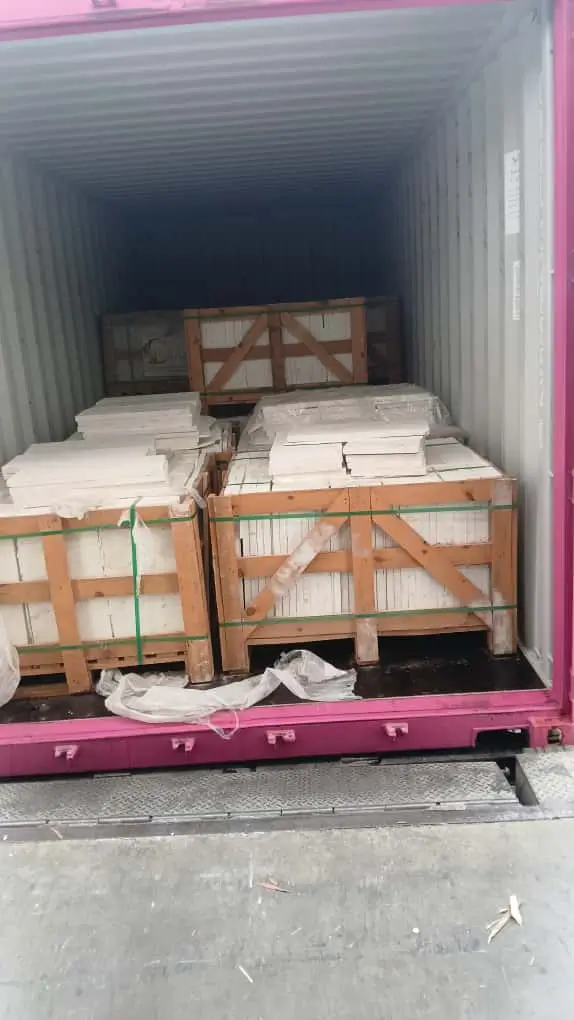
Citadel Stone maintains warehouse inventory of granite materials with typical lead times of one to two weeks for standard orders — significantly faster than the six-to-eight-week import cycle that custom or specialty stone often requires. Confirm your warehouse stock availability early, particularly if your project window falls during peak landscaping season when DG and granite aggregate demand runs high. Coordinating your delivery schedule with your site preparation timeline prevents the common problem of material sitting on a driveway for weeks before installation begins, which can create compaction and contamination issues before the first pass of the plate compactor.
According to USGS granite production and construction use statistics, granite remains one of the most widely produced and consumed dimension stone materials in the country — which means supply chains are generally robust, but regional demand spikes can still affect availability for large-volume orders.
Before You Specify Decomposed Granite Driveway Materials
Decomposed granite driveway problems are almost always predictable and preventable — the patterns repeat across thousands of installations because the same base preparation shortcuts get taken, the same drainage details get skipped, and the same application expectations get applied to the wrong site conditions. Your best outcome comes from matching the material to the actual use case before committing to an installation, not from trying to engineer around a poor material-site fit after the fact.
Evaluate your subgrade, your drainage plane, your load frequency, and your maintenance tolerance honestly before specifying DG for any driveway application. For projects where the site conditions or use profile exceeds what loose-fill granite can reliably handle, solid granite pavers deliver comparable aesthetics with substantially better performance under demanding conditions. For additional context on selecting the right granite product for your outdoor project, choosing landscaping granite for outdoor use covers the key material and application considerations worth reviewing. Switching from loose-fill to solid granite sourced through Citadel Stone is a common resolution when decomposed surfaces repeatedly fail under heavy vehicle loads or rain.
Related reading: Decomposed Granite vs Solid Granite: Which Wins? · black granite stone outdoor use.