Heat Is the First Comfort Problem
Anyone who has crossed a dark tiled terrace on Providenciales at two in the afternoon already knows the issue. The Turks and Caicos Islands sit on a low limestone platform with strong sun, thin natural shade and no elevation to hide behind. Interiors take the same load through sliding doors and open plans, and a floor that soaks up heat keeps releasing it long after the sun has moved off the glass. Comfort here is not a decorating detail that can be fixed later with rugs. It decides whether a living room works barefoot at four o’clock, whether the children sit on the floor, and how hard the cooling has to run through September.
Why Pale Stone Reads Cooler
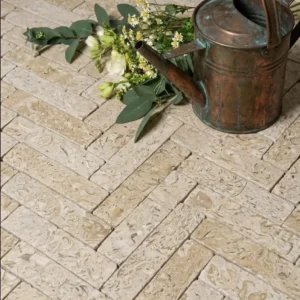
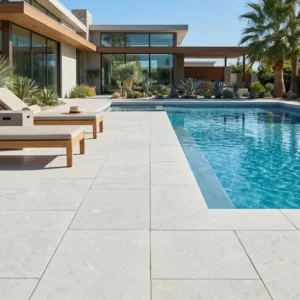
Light stone reflects more of what lands on it, so the surface temperature climbs more slowly than a dark tile in the same room under the same glass. Density matters as well. A tight, low-absorption limestone handles heat and moisture differently from a porous stone that has taken up water, and it dries faster after a squall crosses the island. None of this replaces shade or airflow, but it changes the starting point of the whole room. On Provo the gap between a chalky pale floor and a dark one is something you feel through the sole of your foot within three or four steps, and it does not go away at sunset.
What to Check Before You Buy
Tone is the headline, but the specification underneath does the real work. Ask for the same four things every time, and ask before the container is booked rather than after the pallets are sitting at South Dock waiting on a decision nobody can reverse.
- Water absorption, given as a tested figure rather than a marketing adjective.
- Density and thickness suited to the room, since interior floors and open terraces are not the same order.
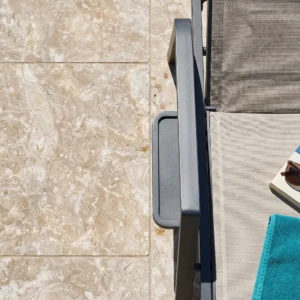
- Surface finish, because texture changes both grip underfoot and how warm the stone feels.
- Batch tone range, so a second pallet does not land two shades away from the first.
- Edge condition, since a clean calibrated edge lets you hold a tighter joint indoors.
Rooms That Gain the Most
Not every room needs the coolest floor in the house, so spend the budget where feet actually land and where the sun sits longest. Our tile stock for island villas is sorted by format and finish, which makes it straightforward to put the calmest, palest material in the rooms that punish a wrong choice.
- Open living rooms with west-facing glass, which hold afternoon heat longest.
- Covered verandas where people cross between wet and dry all day long.
- Pool surrounds and the first strip of interior floor behind the doors.
- Bedrooms, where the floor is the first surface touched each morning.
- Stair landings and hallways linking cooled rooms to open ones.
Shade, Airflow and the Bed Beneath
Stone is only one part of a comfort system. Deep overhangs, cross ventilation and planting do more for a room than any tile can, and the bed under the tile matters just as much as the tile itself. A floor bonded to a reinforced concrete slab behaves differently from one laid over a ventilated void. Reinforced poured concrete is the structure generally recommended across these islands for durability in salt air, so most interior stone here sits directly on mass. Mass is steady rather than quick to change, which works in your favor when the building is shaded and against you when it is not.
Salt Air Changes the Durability Question
Freezing weather never arrives, so the cold-climate durability arguments printed on most stone literature are simply irrelevant here. The exposure that governs is salt, which travels well inland on the breeze and works on stone and metal alike.
- Salt crystallization inside a porous stone, which argues for dense, low-absorption material.
- Corrosion of fixings, so stainless is the sensible choice and cast zinc alloys are avoided.
- About 43 inches of rain a year, arriving in short heavy bursts that demand real drainage.
- Storm exposure, with building codes strengthened after Hurricane Ike in 2008 and tested again by Irma in 2017.
Getting the Stone to the Islands
Delivery shapes the schedule more than most buyers expect, and the water around Provo is shallow. South Dock handles more than 85 percent of national port traffic, and it is the distribution point for everything that goes on to the outer islands. If you want to understand how we ship into Provo before you fix a build schedule, read the constraints early rather than late.
- Draft at South Dock is only about 11 feet, and berthing suits vessels of roughly 110 TEU.
- Cargo comes direct from Florida rather than through a regional relay port.
- Consolidation at a freight forwarder can add two to three weeks before goods reach Provo.
- Grand Turk, South Caicos, Salt Cay and North and Middle Caicos are separate barge legs.
Planning Your Order
Because block, good aggregate and lumber all arrive by sea anyway, the step up from imported concrete to imported natural stone is smaller in the Turks and Caicos Islands than in almost any other market. That is the honest argument for stone here. You are not adding an import to a locally supplied build, you are choosing a better version of an import you were always going to make. Order samples early, look at them on site in real island light at the hour the room is worst, and confirm quantities with a sensible waste allowance before the booking closes. A floor you can walk on barefoot at four in the afternoon is worth specifying properly.