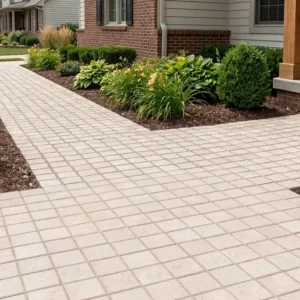
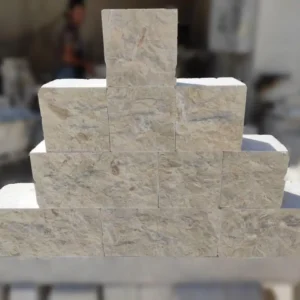
Sett paving has three costs, not one
Most budgets we see for Jamaica carry a single line for stone and nothing else that reflects reality. A sett project actually has three separate costs, and they move independently of one another: the price of the stone, the cost of landing it on the island, and the cost of laying it. Get any one of them wrong and the job stalls, either at the port or halfway across the yard with a crew standing idle. The reassuring part is that all three are predictable, provided you work them out in the right order rather than discovering them one at a time.
The landing stack at Jamaica Customs
Everything arriving into Jamaica is assessed on CIF value, which means freight and insurance sit inside the taxable base rather than outside it. The usual components are these.
- Import duty, commonly around 20 percent for many goods under the CARICOM common external tariff
- General Consumption Tax at 15 percent
- An environmental levy of 0.5 percent
- A standards compliance fee of 0.3 percent, collected by Jamaica Customs for the Bureau of Standards Jamaica
- A customs administrative fee on the entry itself
Rates and tariff classifications change, so confirm the current figures with your broker before you quote a client a number. The sequence matters as much as the rates: because the calculation runs on CIF, a cheaper stone shipped badly can land dearer than a better stone shipped well.
Freight, and how you fill the box
Stone is heavy, so a container reaches its weight limit long before it runs out of room. That single fact drives most of the freight economics on an island order. Deeper setts for vehicular areas mean fewer square feet per shipment; shallower units for pedestrian paths mean more. Kingston serves the capital and the south, while Montego Bay is the sensible entry for the north-coast resort belt, and picking the wrong one quietly adds an inland haul nobody costed. Fix the entry port at design stage, not at booking.
Labor is usually the biggest line
Setts are laid by hand, one piece at a time. That is the entire appeal of the surface and also the whole cost problem. Against large-format slabs, a sett field takes considerably more crew hours per square foot, and the finished quality tracks the skill of the person laying it more closely than any other paving type.
- Budget crew time by pattern, since radial and fan work runs slower than straight coursing
- Allow for setting out, which is real work and is routinely left out of estimates
- Price jointing and compaction as their own lines rather than folding them into a rate
- Assume a slower first week while the crew finds a rhythm with the material
- Keep the same crew across phases if you want later coursing to match the first
Quantities drive that labor line directly, so settle areas and formats first. Our cobblestone formats and coverage detail turns a yard area into pallets before you price a crew against it.
Phasing a job around shipments and seasons
Phasing is the most useful cost tool available on an island project and the most consistently underused. Rather than one enormous order and one enormous mobilization, split the work into stages that each match a shipment and a season.
- Start with areas that carry vehicles, since they set the levels everything else ties into
- Group phases so each fills a container efficiently instead of half-filling two
- Keep heavy laying out of the wettest weeks on a site that drains poorly
- Order the whole job from one production run where consistency across phases matters
- Hold spare stone from the first phase so later repairs still match
Currency, quoting and the exchange question
The Jamaican dollar floats, so a job priced in local currency months before the stone arrives carries genuine exposure. Import contracts are commonly handled in US dollars for that reason, with the local budget rebased when the entry is filed and the duty calculated. It is worth agreeing in writing with your client which party carries any movement between quotation and clearance. That single paragraph prevents more arguments than any other clause in a stone contract.
Where the money actually gets wasted
The waste on Jamaican sett projects is boringly consistent from job to job.
- Ordering short and paying a second clearance cycle for one top-up pallet
- Buying uncalibrated stone and paying a crew to shim every piece by hand
- Skipping the base and rebuilding the whole yard within three years
- Mobilizing a crew before the container has actually cleared
- Changing the pattern after the setting out has started
None of those are stone problems; they are sequencing problems. For a staged figure instead of one lump sum, request a project quote with your areas, formats and target dates and we will price it phase by phase.
What we can and cannot promise
We would rather be straight about the boundaries. Samples are small, sent so you can check color, texture and finish in your own light, and we do not send free pallets. Prices move with freight and with duty classification, so any figure we give is tied to a scope and a date. Nor do we pretend imported stone displaces local material: Jamaican quarries, supervised by the Mines and Geology Division under the Mining Act and the Quarries Control Act, supply the aggregate, marl and base course this work sits on, with marble on the same non-metallic list. Our contribution is the calibrated dimension setts nobody produces here. Tell us the phases and the dates and we will build the shipping plan around your crew.