Bulk natural stone orders reward buyers who treat procurement as a specification exercise, not a shopping transaction. The difference between a smooth delivery and a costly project delay usually traces back to decisions made weeks before the first pallet ships — material grade confirmation, quantity tolerancing, drainage compatibility, and warehouse lead time alignment. Get those variables locked in early, and the rest of the process follows a predictable path. Underestimate any one of them, and you’ll be managing substitutions on a live project schedule.
Quantity Calculation and Tolerancing for Large Orders
Your quantity estimate is the foundation of every other procurement decision, and it’s where most buyers leave themselves exposed. Natural stone is sold by the square foot, ton, or pallet depending on the product — and those conversions don’t always map cleanly onto your takeoff dimensions. Add a minimum 10% waste factor for straight-cut installations, 15% for diagonal or pattern layouts, and 20% for irregular formats like tumbled or hand-split pieces. These aren’t conservative estimates — they’re baseline figures drawn from real project completions across hundreds of installations.
Beyond waste, you need to account for natural variation within a lot. Stone from the same quarry block can shift in tone, veining density, and surface texture across a single bulk natural stone order. Request that your supplier pull all material from the same production run or quarry batch. Mixing batches mid-project creates visible inconsistencies that no amount of selective laying will fully conceal. At Citadel Stone, we verify batch consistency at the warehouse before releasing large orders, because catching a lot mismatch before dispatch is far less costly than managing it on-site.
- Add 10–20% overage to your calculated coverage area depending on cut complexity
- Request batch or lot numbers from your supplier and confirm all pallets match
- Account for breakage during transport — thinner formats (3/4″ and under) are especially vulnerable
- Verify pallet counts against your order confirmation before the truck leaves the yard
- Factor in future repair stock — order 3–5% additional material for long-term patching needs

Locking Down Material Specifications Before You Order
Submitting a purchase order with only a material name and a size is a recipe for surprises. Your specification needs to define finish, thickness tolerance, edge profile, and minimum modulus of rupture — especially for large-format pieces that will see foot traffic or vehicle loads. The Natural Stone Institute technical specifications provide baseline guidance on physical property requirements by stone type, and those benchmarks should anchor your spec sheet before you finalize pricing.
Thickness consistency matters more in bulk natural stone orders than in small runs because the variation compounds. A nominal 1.25″ paver that varies between 1.0″ and 1.5″ across a thousand-piece order creates leveling nightmares during installation. Specify your thickness tolerance in writing — a ±1/8″ tolerance is standard for most natural stone products, but tighter tolerances are achievable on calibrated material and worth the slight price premium for large commercial projects. Your installer’s labor cost will more than justify the spec upgrade.
- Define finish type explicitly: honed, polished, flamed, brushed, or tumbled — these affect both aesthetics and slip resistance
- State thickness tolerance in the purchase agreement, not verbally
- Specify edge profile: natural cleft, sawn, eased, or bullnose as required by your installation detail
- Request minimum compressive strength data from your supplier — 8,000 PSI is a reasonable floor for paving applications
- Clarify whether calibrated or non-calibrated stock is being supplied
What to Ask Stone and Marble Suppliers Before Committing
Not all stone and marble suppliers operate at the same capability level when it comes to bulk procurement. A supplier who handles retail slab sales efficiently may struggle to coordinate a 5,000-square-foot order of consistent material with a defined delivery window. The questions you ask during the quoting stage reveal operational capability faster than any marketing material will.
Ask specifically where the material is sourced and whether the supplier has a direct quarry relationship or is purchasing through an intermediary. Direct quarry relationships mean tighter control over batch consistency and faster resolution when a quality issue surfaces. Ask about warehouse stock levels for your specified material — a supplier who can confirm on-hand inventory gives your project schedule far more predictability than one who needs to import to fulfill your order. The difference is often four to six weeks of lead time.
- Request country of origin and quarry region documentation for each stone type
- Confirm whether the material is in warehouse stock or requires an import order
- Ask for references from comparable-scale bulk orders — not residential retail jobs
- Verify the supplier’s quality inspection process: do they check material before it ships?
- Confirm liability terms for material damaged in transit before you accept delivery
Stone countertop fabricators working on commercial projects face similar vetting challenges — a supplier who can demonstrate reliable batch consistency for a 200-slab fabrication job has the operational depth that bulk paving orders also require. Look for that kind of cross-category track record when evaluating a new supply relationship. Reviewing the Citadel Stone volume procurement guide gives you a structured framework for what to expect from a capable national supplier at scale.
Drainage, Water Management, and Material Selection
One of the most consequential — and most overlooked — decisions in bulk natural stone procurement is matching material porosity and base design to your site’s drainage profile. This matters regardless of geography, because water behavior varies dramatically across installation environments. Projects in areas with heavy seasonal rainfall, monsoon-style precipitation events, or significant moisture loading face very different performance demands than those in arid regions with infrequent but intense storm events.
Denser, lower-absorption stones like granite and basalt perform well in high-moisture environments precisely because they don’t absorb and release water through repeated wet-dry cycles. According to USGS dimension stone production data, granite and dense metamorphic stones consistently outperform higher-porosity sedimentary options in environments with significant precipitation variance. Higher-porosity materials like certain limestones and tumbled travertines require more deliberate base engineering — open-graded compacted aggregate, properly sloped bedding planes, and edge drainage channels — to prevent hydrostatic pressure buildup beneath the slab field.
- Specify stone absorption rate (ASTM C97) for any application where standing water is possible
- Dense igneous and metamorphic stones perform better in high-rainfall or flood-risk environments
- Porous sedimentary stones need open-graded base aggregate and deliberate slope engineering
- In freeze-thaw regions, moisture trapped in high-porosity stone accelerates spalling — specify absorption below 0.75% for outdoor applications in those climates
- Factor drainage channel placement into your quantity calculations — edge material often requires different cuts and adds 5–8% to coverage needs
Stone and marble suppliers who specialize in large hardscape projects should be able to provide absorption and porosity data sheets alongside pricing. If a supplier can’t produce ASTM C97 test data for a material you’re specifying in a drainage-sensitive application, treat that as a qualification gap worth resolving before committing to volume.
Logistics, Lead Times, and Delivery Planning
The logistics side of bulk natural stone orders deserves as much planning attention as the material specification itself. A well-specified order that arrives two weeks late, or gets delivered in pieces across three separate truck runs, can derail a project schedule as effectively as a material defect. Start the delivery conversation at the same time you start the pricing conversation — not after the purchase order is signed.
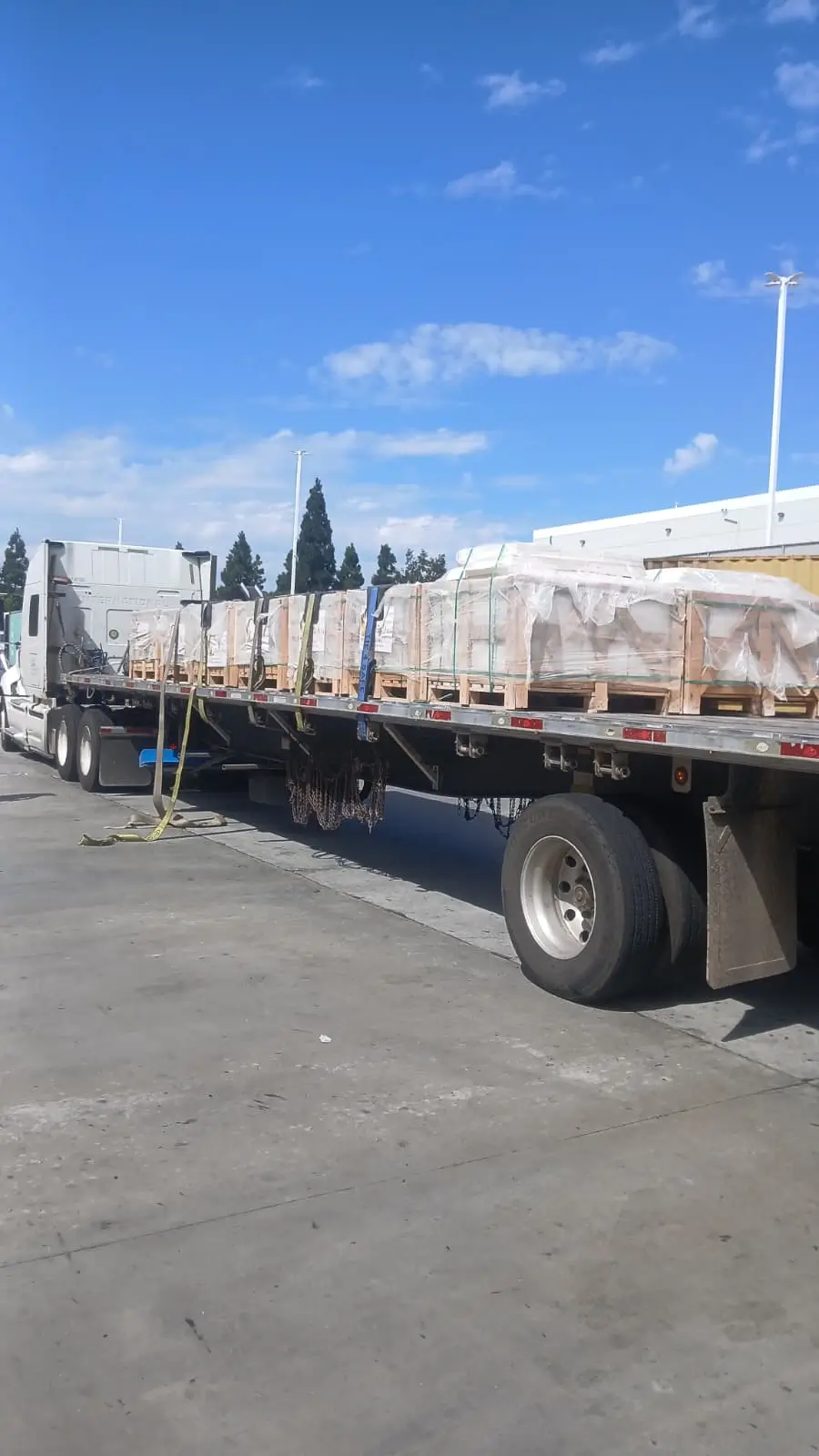
Your site’s truck access constraints directly affect delivery options. A truck carrying 20+ pallets of stone requires a clear turning radius and either a dock-height receiving area or a forklift on-site for unloading. If your project site has restricted access — overhead utilities, narrow drives, soft-ground conditions — communicate those constraints to your supplier during the quoting stage so the right equipment and delivery configuration gets planned in advance. Last-minute delivery failures on large stone orders are almost always traceable to access issues that weren’t discussed early enough.
- Confirm warehouse-to-site lead time in writing, not verbally — distinguish between in-stock and import lead times
- Specify delivery in full pallet increments to avoid partial-pallet surcharges
- Confirm unloading equipment availability on your end before the truck dispatch date
- Request a bill of lading that itemizes each pallet — this is your checklist at delivery
- Plan for phased deliveries on large projects to avoid on-site storage and weathering damage
- Confirm whether the supplier’s truck delivers to the gate or to a specified drop point on site
Base Preparation and Installation Readiness
Your bulk natural stone order can be perfectly specified, perfectly delivered, and still underperform if the base isn’t ready to receive it. Base preparation failures account for the majority of premature stone installation failures — more than material defects, more than sealing failures, more than maintenance gaps. This is worth emphasizing because it’s the one variable procurement decisions can still influence: the base specification should be confirmed before the order ships, not after.
For stone and marble suppliers working on commercial-scale projects, the base aggregate depth and compaction specification should be matched to the stone’s modulus of rupture, not simply to generic “4-inch compacted base” guidelines. A 3/4″ limestone paver with a modulus of rupture around 1,200 PSI needs a fundamentally different base than a 2″ granite slab rated at 2,800 PSI. The thinner, more fragile material needs a finer-graded, more precisely leveled setting bed to distribute point loads evenly. The Natural Stone Institute’s guidance on fabrication standards and technical certification covers load distribution considerations that apply directly to base design decisions.
- Match base depth and aggregate gradation to the stone’s modulus of rupture, not just its thickness
- Confirm that subgrade compaction reaches 95% Proctor density before laying base aggregate
- Use a concrete bedding mortar for large-format pieces over 24″ in any dimension — sand-set beds can’t support the cantilever span
- Install perimeter edge restraints before the stone field — lateral movement at edges propagates inward over time
- Leave expansion joints every 12–15 feet in all directions for exterior installations exposed to temperature cycling
Quality Inspection at Delivery: What to Check Before the Truck Leaves
The delivery inspection is your last practical opportunity to identify and document quality issues before they become contract disputes. Once the truck leaves your site and the stone is unloaded, the burden of proof for transit damage shifts — and it shifts quickly. A thorough delivery checklist takes 20–30 minutes on a standard pallet order and can save weeks of back-and-forth on defect claims.
Check the outer-facing pieces on each pallet for corner chipping and edge fractures — these are the pieces most exposed to handling stress during loading and transport. Pull random samples from mid-pallet positions to check color consistency against your approved sample. Measure five to ten pieces for thickness against your specified tolerance. Document everything with time-stamped photographs before signing the delivery receipt. Your signature on the bill of lading without noted exceptions is interpreted as acceptance of the material as delivered.
- Inspect outer-facing pieces on every pallet before signing — corner chips and edge fractures are transport damage, not field damage
- Pull mid-pallet samples to verify color consistency against your approved sample swatch
- Measure 8–10 pieces per pallet for thickness tolerance compliance
- Check for staining or moisture damage, particularly on porous sedimentary stones that were stored outdoors
- Compare pallet count and piece count against the bill of lading before the truck leaves
- Note all exceptions on the delivery receipt in writing — verbal exceptions are not enforceable
Sealing and Long-Term Maintenance Planning for Bulk Stone Projects
Sealing decisions should be made before your order ships, not after installation is complete. The sealer type, application timing, and reapplication schedule are all influenced by the stone’s absorption rate — which should already be in your specification documentation at the procurement stage. Applying the wrong sealer to a high-porosity stone or skipping the sealing stage entirely on a porous sedimentary material in a wet climate will create staining and efflorescence problems that are far more expensive to remediate than a proper initial sealing program costs.
Stone countertop fabricators advising commercial clients should distinguish between penetrating sealers and surface-film sealers. Penetrating impregnators work below the surface, don’t alter the stone’s appearance, and provide the best long-term protection for most outdoor applications. Surface-film sealers create a coating that can trap moisture beneath it in porous stones — a significant problem in environments with heavy rainfall cycles where moisture vapor drives upward through the slab. Specify penetrating sealers for all exterior applications and plan for reapplication every two to three years based on traffic and exposure.
- Apply sealer within 72 hours of installation completion — before foot traffic introduces contaminants
- Use penetrating impregnators for exterior applications — avoid surface-film sealers outdoors
- Test sealer on a sample piece from your order before committing to a full application — absorption rates vary even within a material type
- In high-precipitation environments, prioritize sealers with hydrophobic ratings above 95%
- Schedule reapplication every 24–36 months for high-traffic exterior installations
Expert Summary
Bulk natural stone orders that run smoothly share a common trait: every decision point in the procurement checklist was addressed before the order was placed, not after. Quantity tolerancing, batch consistency, material specification, base preparation alignment, and logistics planning are not sequential steps — they happen in parallel during the quoting stage, and buyers who treat them that way consistently outperform those who address them reactively. The procurement checklist isn’t bureaucratic overhead; it’s the structure that prevents the specific failure modes that derail large stone installations.
Your specification documents should travel with the order — from quote request through delivery inspection. A supplier who can respond to detailed specification questions with documented data rather than general assurances is a supplier operating at the capability level that large projects require. As you finalize your material decisions, understanding how stone grades affect both performance and pricing adds another layer of procurement precision — natural stone grades for construction projects covers that dimension in practical detail worth reviewing alongside your checklist. Sourced from our selected premium quarries across multiple continents, Citadel Stone fulfills bulk orders with lead times discussed upfront during the quoting stage.
Related reading: types of stone for building · finding natural stone suppliers · types of stone for building houses.