St. Vincent’s leeward beaches rewrite the Caribbean postcard: sand in charcoals and silvers, water deepening to indigo over dark seabeds, and coastal light that behaves like nowhere in the coral islands. For designers the black-sand coast is a gift wrapped in a challenge — every palette instinct calibrated on white beaches inverts here — and stone choices lead the recalibration. This is the dark-coast design guide, written for the chain’s most dramatic shoreline.
The inversion, understood
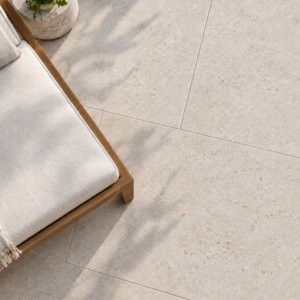
White-sand design logic runs pale-on-pale: stone disappearing into beach, blues doing the contrast. Black sand flips every relationship — pale stone now carries maximum contrast against the dark ground, reading as sculpture rather than camouflage; mid-tones that vanish on coral coasts hold their own here; and dark stone, the coral islands’ accent, risks disappearing entirely into the ambient charcoal. The design consequence is compositional power: on this coast, a pale terrace is a deliberate statement floating on darkness, and the two-stone logic plays at maximum drama — the island supplying the dark field, imports supplying the light.
- Pale stone carrying maximum contrast against dark ground, reading as sculpture rather than camouflage.
- Mid-tones that would disappear on coral sand becoming legible and useful here.
- Dark accent stone losing most of its drama, since the ground is already dark.
- Planting silhouettes reading much more strongly against a pale terrace.
- Joint color becoming visible in a way it never is on a white-sand coast.
Heat: the dark coast’s physics
Black sand takes the sun personally — midday beach crossings are a local sport — and the barefoot arithmetic tightens: pale stone’s heat-shedding advantage becomes the difference between usable and theoretical outdoor space, transitions from beach to terrace want the coolest surfaces exactly where hot sand ends, and shade strategy graduates from amenity to infrastructure. The barefoot-comfort rules apply with the volume raised: on this coast, the cool pale deck is not luxury positioning; it is thermal rescue.
Light on dark water
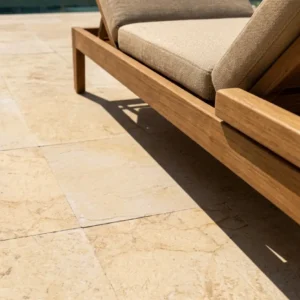
Leeward light performs differently over dark seabeds: mornings render the water pewter and silver, afternoons deepen it toward ink, sunsets burn against a coast that absorbs rather than reflects — and terraces composed for this theater make their own rules: west-facing platforms on the view-first discipline with glare a lesser enemy and depth the ally, pale stone holding the golden hour like a lamp against the dark ground, and evening lighting that plays the contrast — warm grazed limestone glowing theatrical where white-coast schemes merely glow pleasant.
The dark coast’s practical file
Volcanic sand behaves distinctly: denser than coral sand, it tracks less but grinds harder — textured surfaces sweep clean but appreciate the rinse rhythm, and entrance interception earns its keep doubly; iron-rich minerals can print wet marks on the palest stones where sand sits soaked, arguing for mid-pale tones at the immediate beach interface and reserving brilliant whites for the upper terraces; and the access-path craft runs its course with one local note — dark sand’s heat makes the path’s shaded stretches and cool-stone landings genuine mercies rather than refinements.
- Denser than coral sand, so it tracks less but grinds harder underfoot.
- Textured surfaces sweep clean but reward a regular rinse.
- Entrance interception earning its keep doubly, since the grit is abrasive.
- Iron-rich minerals capable of printing wet marks on the palest stone.
- Mid-pale tones preferred at the immediate beach interface for that reason.
Wild beauty, working coast
The leeward shore mixes registers — fishing villages hauling seines at dawn, villa terraces above the coves, the whale-watching and dive economies working the deep water close inshore — and design courtesy follows the community-manner rules: private builds that respect working beach access, compositions that join the coast’s drama rather than gating it, and the local wisdom absorbed early, because families who have read this water for generations know where the swells arrive and the sand migrates seasonally — the coast’s own site survey, available for the asking.
Owning the drama
The black-sand property done properly owns something rare: a Caribbean address that photographs like nowhere else in the sea — pale architecture on dark ground, indigo water, green mountains behind — and lives as dramatically as it looks. The stone package assembles through the chain supply guide with the inversion specified throughout: contrast as composition, heat as physics, dark-sand practicalities in the details. The coral islands sell paradise familiar; the leeward coast sells paradise nobody else has — in charcoal, silver and pale stone.
Gardens against the dark shore
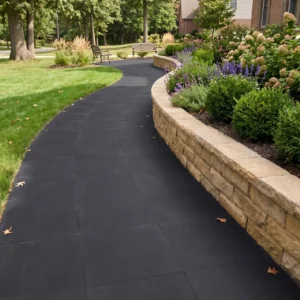
The black-sand coast writes its own planting palette, and the gardens that succeed there treat the darkness as the design’s given rather than its problem. Green reads electric against black sand — the coast’s vegetation looks twice as lush as the same species inland — so planting can be sparser than instinct suggests: sea grapes and almonds anchoring the wind line, crotons and gingers detonating their color against the dark ground, coconut verticals doing the skyline work. The stone interface follows the same inversion logic as the architecture: pale paths and terrace edges become the garden’s light-lines, drawing the eye and the evening footstep, while dark local rock walls read as the shore’s own material continued inland.
The practical file matters more here than on pale coasts. Dark sand absorbs the day’s heat and radiates it into the evening — barefoot routes want the pale, heat-shedding stone precisely where feet actually travel — and the fine volcanic grains migrate on the wind, so terraces sweep more often and joints are specified tight. Salt runs the usual windward rules. Outdoor showers and rinse points earn generous aprons because dark sand shows its tracking on every pale floor; the answer is interception, not resignation — a stone threshold and a foot-rinse where beach meets garden saves the housekeeper’s war.
The composed whole is the coast’s quiet argument: darkness below, green fire above, pale stone threading the two like light through smoke. It photographs like nowhere else in the cluster, costs no more than the conventional version, and belongs to its shore in a way imported prettiness never manages. The dark coast’s gardens do not fight the sand; they frame it — and the framing is stone.
Where the dark sand comes from
The palette question here is really a geology question, and the geology is documented. The Smithsonian Global Volcanism Program profile for Soufriere St. Vincent explains what the beaches are made of.
- A stratovolcano rising to 1,220 m on the Lesser Antilles arc, feeding the whole island with its products.
- Erupted material largely basaltic andesite, at around 55 percent silica.
- A catastrophic 1902 eruption that reworked the northern coast.
- An explosive 1979 eruption and renewed dome activity from 2020 into April 2021.
- Pyroclastic material and lava flows supplying the dark mineral sand that defines the leeward beaches.
Choosing the pale half of the palette
If dark is a given, the pale stone has to carry the whole scheme, which raises the bar on its performance as well as its color. The Natural Stone Institute records that limestone varies widely, with absorption from below one percent to above ten and dolomitic varieties generally denser, stronger and more abrasion resistant.
- Low absorption at the beach interface, where iron-bearing water can print marks.
- Higher abrasion resistance on routes that carry volcanic grit.
- Pale tones for surface temperature, which matters more here than on a reflective coast.
- Acid-sensitive material kept clear of cleaning routines that use anything sharp.
- A stated absorption figure for the delivered batch before the palette is fixed.
Detailing the transition from sand to terrace
The line between black sand and pale stone is the whole design, and it is where most schemes get untidy.
- An interception zone of mid-tone stone or gravel before the pale field begins.
- A rinse point positioned so feet and gear are cleaned before the terrace.
- Falls that carry sand-laden water away rather than across the paving.
- Edge restraint that keeps sand out of joints and joints out of the sand.
- Sweeping treated as the daily routine it will be, with the surface chosen to suit it.
Black sand beach design, one beside the other
The dark coast is not a lesser version of the white-sand postcard; it is a different composition with different rules. Pale stone becomes the figure rather than the ground, mid-tones earn their place, dark accents lose their point, and heat management becomes the practical constraint on every barefoot route. Get the interface between sand and terrace right and the contrast does all the design work for you. Where the same coast climbs into villa country, our St. Vincent building stone guide continues it. Let the pale stone be the drawing and the black sand be the paper.