

The black limestone vs black granite decision trips up more specifiers than almost any other material comparison — not because the two stones look dramatically different on a sample board, but because their performance diverges sharply once they’re in service. Compressive strength, porosity, thermal expansion coefficients, and surface hardness all pull in different directions, and the gap between a 15-year installation and a 25-year one often comes down to which material you matched to your specific loading and weather exposure conditions.
What Actually Separates These Two Materials
Limestone is a sedimentary carbonate rock formed from compressed marine organisms and calcium-rich minerals. That origin matters for performance: its crystalline structure is relatively open, with water absorption rates typically ranging from 0.5% to 3% depending on density and finish. Black granite, by contrast, is an igneous rock — it cooled slowly from magma deep underground, producing an interlocking crystalline matrix with absorption rates that frequently fall below 0.1%. That structural difference drives almost every other performance distinction you’ll encounter in the field.
Your material selection should start with those absorption numbers, not aesthetics. Black granite’s near-zero porosity means it resists staining, freeze-thaw penetration, and efflorescence almost inherently. Black limestone requires a quality penetrating sealer applied correctly — and reapplied on a 2-to-3-year cycle — to perform at the same level. Skipping that maintenance cycle is the single most common reason limestone installations look tired at year eight when they should still have 20 years left in them.
According to NSI limestone specifications, limestone’s calcium carbonate composition also makes it susceptible to acid etching — an important consideration if your project involves exposure to fertilisers, cleaning chemicals, or acid rain in industrialised areas.
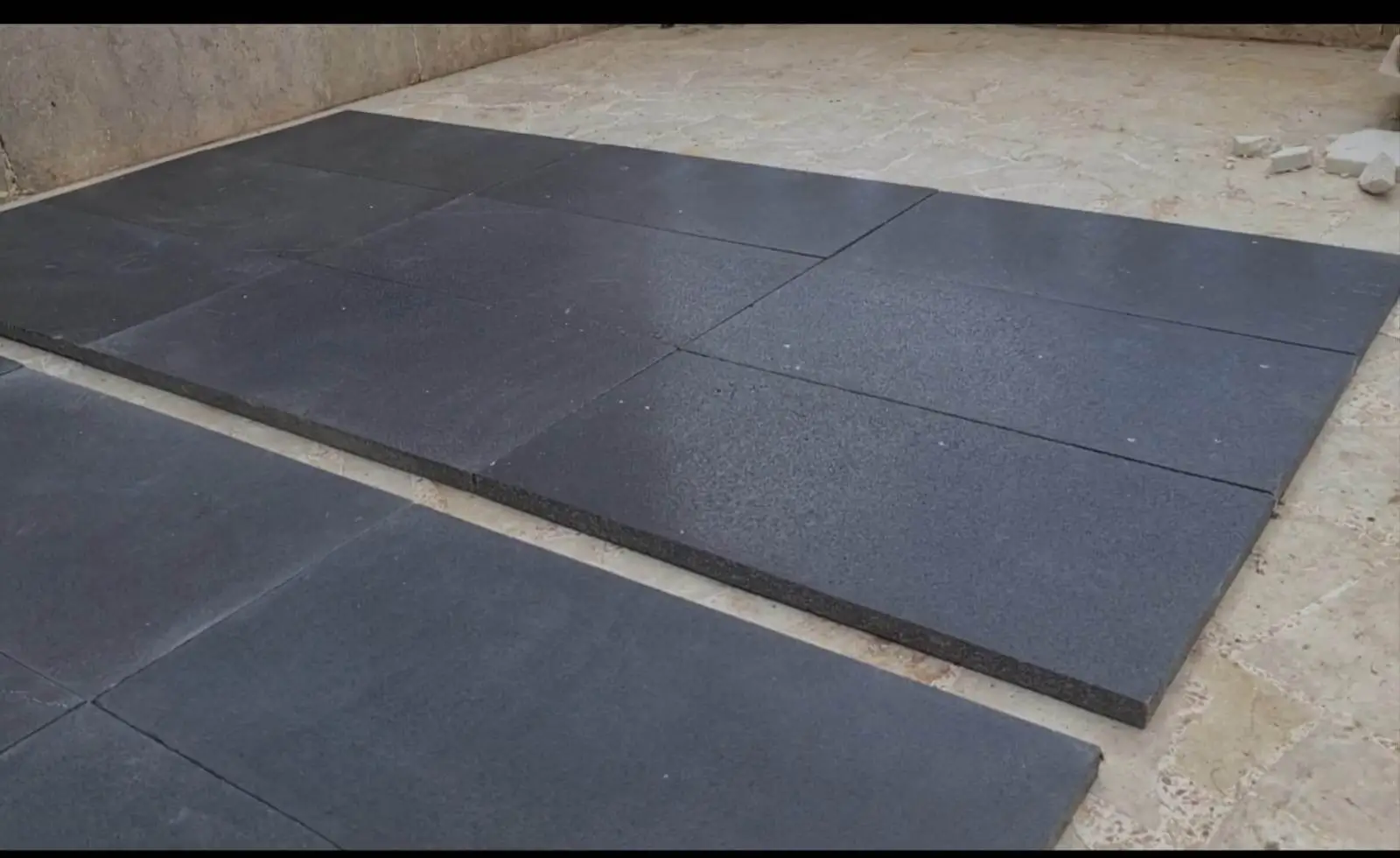
Hardness, Surface Durability, and What That Means in Practice
Granite sits at 6–7 on the Mohs hardness scale. Limestone typically ranges from 3–4. That two-to-three-point difference translates directly to scratch resistance, abrasion wear rates, and long-term finish retention. On a heavily trafficked driveway or commercial entrance plaza, black granite will maintain a consistent surface appearance for decades under foot and vehicular loading. Limestone will show wear lines in high-traffic corridors within 5–8 years unless you specify a honed finish that hides minor scratching better than polished or leathered alternatives.
The hardness gap becomes even more relevant when you consider impact resistance during storm events. Hail strikes, wind-driven debris, and the point-load impact of branches or equipment during severe weather events register differently on each material. Granite’s interlocked crystalline structure dissipates impact energy efficiently — chipping is rare unless the stone has been cut to a very thin profile. Limestone can fracture at the edges under sharp impact, particularly on thinner 20mm pavers. For exposed installations where hail is a seasonal reality, specifying black limestone at a minimum 30mm thickness substantially reduces that vulnerability.
- Granite Mohs hardness: 6–7 — resists scratching from sand, grit, and vehicular traffic
- Limestone Mohs hardness: 3–4 — requires honed or brushed finish for high-traffic use
- Granite impact resistance: excellent at standard paver thicknesses (20mm+)
- Limestone impact resistance: adequate at 30mm+, marginal at 20mm in exposed storm-risk settings
- Both materials require proper edge restraint detailing to prevent lateral movement under wind-driven hydraulic pressure
Colour Consistency: Black Granite vs Black Limestone Side by Side
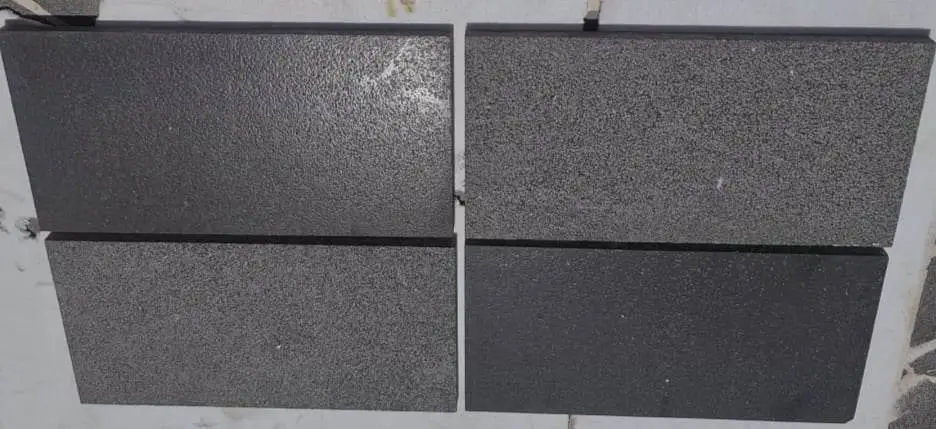
Here’s what many specifiers miss when comparing samples: black granite is remarkably consistent in tone across an entire batch, while black limestone carries natural variation — subtle fossil impressions, tonal shifts between grey-black and deep charcoal, and occasional lighter veining. Neither characteristic is a defect. They’re structural properties that should inform your design intent, not afterthoughts discovered on delivery day.
For projects demanding a uniform, contemporary aesthetic — think commercial lobbies, feature walls, or minimalist outdoor kitchens — black granite delivers that controlled palette reliably. For landscape architects and outdoor designers who want a surface that reads as genuinely natural rather than manufactured, the tonal variation in black limestone is often the reason it gets specified. At Citadel Stone, we consistently field calls from designers who initially spec granite for its consistency, then switch to limestone once they see how the variation reads in natural light on a full-size mockup.
Matte black granite finishes have grown substantially in specification frequency over the last several years. That finish reduces reflective glare and softens the visual weight of granite’s density — it also increases surface texture slightly, which improves slip resistance ratings on outdoor applications. When comparing matte black granite against honed black limestone, the visual gap narrows considerably, though the performance differences in porosity and hardness remain unchanged regardless of finish. The black limestone vs black granite choice at this finish level often comes down to maintenance philosophy rather than appearance alone.
Thermal Expansion and Joint Design Across Material Types
Granite’s coefficient of thermal expansion sits around 4.4–8 × 10⁻⁶ per °F. Limestone typically runs 4.4–5.9 × 10⁻⁶ per °F. Both materials are low-expansion stones — but even that narrow range creates joint stress over decades of temperature cycling, and the spec needs to account for it. In freeze-thaw regions, the absorbed moisture in limestone is the more critical variable: water expanding by roughly 9% in volume during freezing will breach an inadequately sealed limestone surface faster than any thermal movement.
Your joint spacing specification should treat granite and limestone differently despite their similar expansion coefficients. Because limestone absorbs moisture, its dimensional response to saturation-then-freeze cycles can exceed pure thermal movement in cold climates. Specify soft joints — polymeric sand or flexible pointing mortar — at maximum 4-metre intervals for limestone in freeze-thaw regions. Granite tolerates the same joint spacing but benefits from a slightly wider nominal joint (8–10mm versus 6–8mm for limestone) to accommodate its denser expansion pattern without telegraphing stress at the face.
Edge restraint integrity under wind-driven rain deserves attention here. High-wind events force water laterally into joints at pressures that can undermine base saturation more rapidly than vertical rainfall. Both materials need a competent edge restraint — steel, concrete kerb, or purpose-formed stone edge — to prevent lateral creep when the base becomes temporarily saturated during storm events. Granite’s weight advantage (approximately 170–175 lb/ft³ versus limestone’s typical 140–165 lb/ft³) gives it slightly better resistance to lift and lateral displacement during severe weather, particularly on elevated terraces and exposed pool decks where wind uplift is a real loading scenario.
How Each Material Performs in Specific Applications
For pool surrounds, the black limestone vs black granite comparison tilts in an interesting direction. Granite’s low porosity means it won’t harbour algae or absorb pool chemicals, which is a genuine maintenance advantage. But its density also means it stays hotter on exposed surfaces in direct sun — a relevant consideration for barefoot use. Black limestone, with its slightly more open structure and typically lower thermal mass, can be marginally cooler underfoot in comparable conditions. The finish selection matters here: a bush-hammered or sandblasted black limestone at 30mm offers both appropriate slip resistance (critical for pool code compliance) and a cooler surface feel than an equivalent polished black granite.
For driveways and vehicular applications, granite holds the performance advantage clearly. The hardness and near-zero absorption make it resistant to oil staining, fuel spills, and the abrasion of tyre contact over time. A Natural Stone Institute granite durability report confirms granite dimension stone’s compressive strength frequently exceeds 19,000 PSI — substantially above the minimum threshold for vehicular load-bearing paving. Limestone in the same application will perform adequately with proper sealing and a minimum 40mm thickness for vehicular zones, but it requires a more disciplined maintenance commitment to match granite’s low-intervention service life.
- Pool surrounds: black limestone at 30mm bush-hammered — competitive choice for slip resistance and surface temperature
- Driveways: black granite preferred — hardness and stain resistance reduce maintenance obligation significantly
- Exterior stairs and treads: granite for high-traffic public settings; limestone acceptable for residential with honed finish and annual resealing
- Interior flooring: black limestone on a well-prepared subfloor with penetrating sealer performs excellently; granite is lower-maintenance long term
- Feature walls and cladding: limestone’s natural variation creates more visual depth; granite’s consistency reads cleaner in contemporary settings
Sealing Requirements and Long-Term Maintenance Commitments
Sealing black limestone isn’t optional — it’s part of the specification, full stop. A quality impregnating sealer penetrates the stone’s pore structure rather than coating the surface, which preserves the natural texture and breathability while blocking liquid ingress. Apply it before grouting (to protect against grout haze), then again after grouting cleanup, and reapply every 2–3 years for exterior installations or 3–5 years for interior flooring depending on traffic levels.
The black limestone vs black granite comparison really comes down to this maintenance differential: granite needs essentially nothing beyond periodic cleaning. Limestone needs proactive sealing management. That’s not a reason to avoid limestone — many specifiers prefer it precisely because the sealing process keeps them engaged with the surface’s condition, catching minor damage early. But for clients who want a truly set-and-forget material, granite is the honest recommendation.
One detail that rarely makes it into written specifications: the orientation of the stone’s natural bed plane affects how effectively a sealer bonds. For black limestone, ensuring the face you’re sealing is the top surface (not the edge-grain of the bedding plane) gives you measurably better sealer penetration and longer effective protection intervals. At Citadel Stone, we inspect our limestone inventory for consistent bedding orientation before it leaves the warehouse — it’s a quality checkpoint that directly affects how the material accepts sealer in the field.
Ordering, Lead Times, and Logistics Considerations
Both black limestone and black granite have a supply chain dimension that’s easy to overlook until it becomes a project delay. Both materials are commonly stocked by national suppliers, but batch consistency between orders is a real concern — especially for phased projects or future repair work. You should order 10–15% overage on your initial purchase to ensure matching material is on hand without waiting for a secondary truck delivery from a different quarry run.
Citadel Stone maintains warehouse stock of both black limestone paving and black granite products nationally, which typically means 1–2 week lead times rather than the 6–8 week import cycle you’d face sourcing directly from overseas. For projects with hard completion dates, confirming warehouse availability before finalising your specification is worth a call. For your broader black limestone paving requirements, black limestone from Citadel Stone covers the full product range with technical specifications relevant to outdoor and commercial projects.
Truck access at the delivery site affects both materials equally — full pallet loads of granite or limestone run 2,200–2,800 lbs, and the delivery vehicle needs solid, level access within reasonable proximity of the lay area. Flag any site access constraints early in the project planning phase: tight driveways, low clearance entries, or stepped access routes all require discussion with the logistics team before a truck is dispatched.
Making the Final Call: Black Limestone vs Black Granite for Your Project
The right answer on the black limestone vs black granite comparison isn’t universal — it’s project-specific. Granite wins on durability, hardness, stain resistance, and low-maintenance performance. Limestone wins on natural character, surface temperature moderation, and cost-effectiveness for large-format outdoor paving where the aesthetic brief calls for organic variation rather than engineered uniformity.
- Choose black granite when: vehicular loading is present, maintenance access is limited, or the project demands absolute colour consistency across large areas
- Choose black limestone when: the design brief values natural variation, the application is primarily pedestrian, and a proactive sealing schedule is part of the building maintenance plan
- For storm-exposed terraces and elevated decks, granite’s weight and hardness reduce wind-uplift and impact vulnerability — factor this into the specification for any exposed elevated application
- For interior flooring and feature work where foot traffic rather than weather is the primary stress, black limestone on a properly prepared subfloor delivers exceptional visual results at a more accessible price point
- Both materials benefit from a minimum 100mm compacted aggregate base for exterior applications — don’t let the material quality carry work that the base preparation should be doing
According to USGS dimension stone production data, both limestone and granite account for significant proportions of domestic dimension stone output — meaning material supply is stable and quality benchmarks are well-established for both stone types. Your specification work starts from a solid technical foundation either way.
Parting Guidance
The black limestone vs black granite decision rewards specificity. Nail down your loading conditions, weather exposure, maintenance commitment, and design intent before you finalise the spec — those four variables will point you clearly to one material or the other in the majority of project scenarios. Where they genuinely remain in balance, lean toward whichever finish and tonal character best serves the long-term vision for the space, because both materials will perform reliably when installed correctly on a proper base.
For ongoing care once your project is complete, your limestone surfaces will benefit from periodic restoration as well as routine sealing — particularly if the stone has been exposed to heavy foot traffic, cleaning chemicals, or weathering over multiple seasons. You’ll find detailed guidance on restoring dull black limestone slabs a useful reference for that maintenance phase. Unlike granite’s uniform crystalline surface, Citadel Stone’s black limestone offers natural variation that many outdoor designers specifically select for.
Related reading: Does Black Limestone Fade? What Owners Should Know · How to Choose a Black Limestone Sealer That Works.