

Why Black Limestone Loses Its Depth
The black limestone restorer guide most installers wish they had starts with understanding the real mechanism behind color fade — and it isn’t what most people assume. Black limestone doesn’t lighten because the stone itself changes; it lightens because the surface micro-pores fill progressively with mineral salts, atmospheric silica, and the residual calcium from prior sealant breakdown. That combination scatters light instead of absorbing it, and the rich charcoal tone you selected disappears behind a dull, washed-out haze. Understanding this mechanism is what separates a black limestone sealant strategy that holds from one that merely delays the next round of maintenance.
Your stone’s porosity is the variable that determines how fast this happens. Dense, low-absorption black limestone — typical of material quarried from tightly compressed sedimentary beds — holds its tone for years before restorer treatment becomes necessary. More porous stock, often identifiable at the warehouse by slightly lighter grey veining and a rougher sawn face, will begin to fade within 12 to 18 months in high-traffic zones. Knowing your material’s absorption class before you purchase saves you from reactive maintenance cycles.
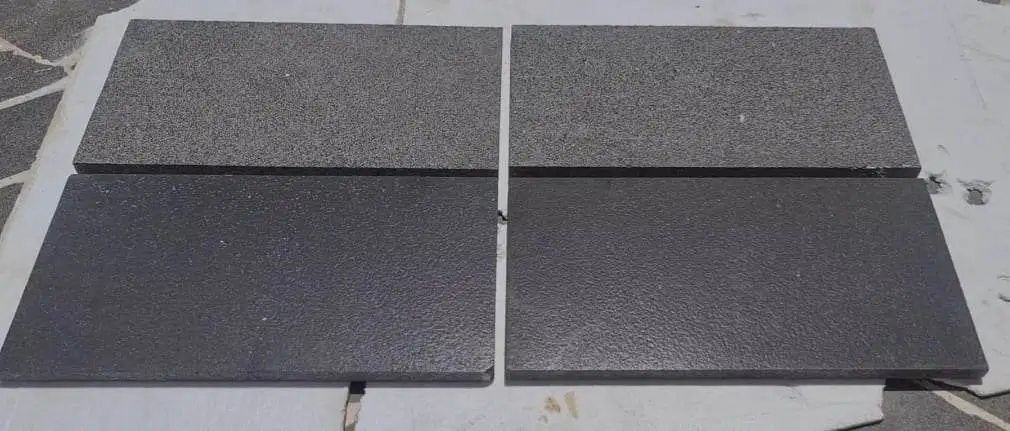
Reading the Surface Before You Start
Accurate diagnosis of the surface is essential before opening a single container of restorer product. Three distinct conditions require three different approaches, and mixing them up is the most common reason restoration work falls short.
- Efflorescence bloom — a white crystalline deposit sitting proud of the surface — must be removed with a diluted acid wash (pH 2–3) before any restorer is applied. Restorer applied over efflorescence locks the salts in place permanently.
- Failed sealant residue, which appears as a milky or streaky film, requires a dedicated stripper rated for penetrating sealants. Standard alkaline cleaners won’t dissolve cross-linked polyurethane or epoxy-based sealants effectively.
- True color recession — where the stone is clean but simply dull — is the correct target for a black limestone restorer treatment. The surface needs to be structurally sound, clean to the pore, and dry to below 3% moisture content before treatment.
- Surface spalling or micro-cracking means restorer chemistry alone won’t hold — you’re dealing with a structural deterioration issue that requires assessment before cosmetic treatment.
According to Natural Stone Institute limestone specifications, absorption rate and surface porosity are the two most critical factors in determining appropriate maintenance chemistry for limestone. Matching your restorer product to your stone’s specific absorption class — typically expressed as a water absorption percentage — determines whether you achieve full re-saturation or a patchy, uneven result.
Cleaning Protocols That Actually Work
Surface preparation is where most DIY restoration attempts fail. The temptation is to apply restorer the moment the stone looks clean to the eye — but visual cleanliness and pore-level cleanliness are entirely different conditions. Calcium-based limescale, soap residue from prior mopping, and biological matter from outdoor installations all sit below the visible surface layer and will interfere with restorer penetration if not removed.
For interior black limestone floors, a pH-neutral stone cleaner applied with a microfibre flat mop and allowed to dwell for five minutes before agitation delivers consistent results. Outdoor installations need a step up — a low-pressure rinse (under 1,000 PSI) combined with a purpose-formulated stone degreaser removes the traffic-film that standard cleaning misses. Avoid rotary pressure washing on honed or polished finishes; the mechanical abrasion reopens the pore structure unevenly, which will produce a blotchy result after restorer application.
Allow the surface to dry completely — and build in more drying time than you think you need. In humid conditions or after heavy cleaning, 48 to 72 hours is a realistic drying window before you can confidently reach that sub-3% moisture threshold. Applying restorer to stone that’s still releasing moisture traps vapor beneath the treatment layer and creates a permanent white haze that requires full stripping to correct.
Choosing the Right Black Limestone Restorer Product
The chemistry inside a restorer product matters more than the brand name on the label. Two broad families exist, and they produce meaningfully different results on black limestone pavers and floor tiles.
- Solvent-based colour intensifiers penetrate deeply into the pore network and deposit a resin carrier that re-saturates the stone from within. They produce the deepest, most saturated tone recovery and typically provide 3–5 years of performance before retreatment. They require adequate ventilation during application.
- Water-based penetrating restorers offer lower VOC profiles and faster recoat times, but they generally achieve 70–80% of the colour depth that solvent-based products deliver. They suit interior applications where ventilation is limited or where building codes restrict solvent use.
- Topical colour-enhancing sealants sit on the surface rather than penetrating it. They produce an immediate glossy result but wear from foot traffic within 6–18 months and can trap moisture if applied before the stone is fully cured — a critical issue for any outdoor installation exposed to freeze-thaw cycling.
For most projects involving black limestone pavers or honed floor tiles, a solvent-based penetrating restorer combined with a subsequent application of a breathable impregnator provides the best long-term outcome. The restorer addresses the color deficit; the impregnator seals against future contamination. Don’t attempt to combine them into a single application step — the chemistry competes and the result is unpredictable.
Application Method Step by Step
Your application technique determines whether the restorer fully penetrates or simply pools on the surface. Black limestone’s dense matrix means the product needs time and the right tool to work into the pore structure effectively.
- Apply in thin, even coats using a natural-bristle brush or a low-nap lambswool applicator — never a foam roller, which traps air and creates bubble artifacts in the finish.
- Work in sections of no more than 3–4 square metres, and maintain a wet edge to avoid lap lines where a dried leading edge meets fresh product.
- Allow the first coat to penetrate for 10–15 minutes, then buff away any excess that hasn’t absorbed using a clean, dry cloth. Excess product sitting on the surface will dry as a sticky, smeared film that’s difficult to remove without stripping.
- A second coat applied 2–4 hours after the first typically achieves the depth of color recovery that a single heavy application cannot — the first coat conditions the pore, the second coat fills it.
- Allow full cure — typically 24 hours for foot traffic and 72 hours for furniture loads — before subjecting the surface to normal use.
One detail that separates professional results from amateur ones: test your restorer product on an inconspicuous area and allow it to fully cure before committing to the full surface. Different quarry batches of black limestone respond differently to the same product, and a cured test patch tells you the actual result, not the label’s promise.
Black Limestone in Landscape and Design Contexts
Restoring black limestone is partly a maintenance decision and partly a design one. The tone you’re recovering has to align with the broader aesthetic context of the space — and that consideration is worth building into your restorer selection. For a modern minimalist scheme where the stone’s near-black, matte finish anchors a pale render or white limestone wall cladding, maximum colour saturation from a deep-penetrating solvent restorer is the right call. The contrast between the recovered stone and pale architectural elements is the entire visual point.
In landscape settings that lean toward natural or organic planting styles — ornamental grasses, textured bark mulch, and uncut stone edging — a slightly less intense finish often reads more authentically. A single coat of water-based restorer that brings the stone back to 80% of its original depth can actually suit these schemes better than an aggressive full-saturation result, which can look artificially dark beside naturalistic planting. This is a nuanced call, but it’s one worth making deliberately rather than defaulting to maximum intensity every time.
For projects where black limestone paving meets a black and white floor tile interior threshold — a common transition in contemporary architecture — restorer consistency across the threshold matters. The indoor tile likely holds its tone far longer than the exterior paving, so matching the restored outdoor tone to the existing interior reference point requires careful product selection and, sometimes, a diluted application on the indoor-adjacent sections. A black and white floor tile transition also makes tonal inconsistency in the restored paving more visible, so colour accuracy here is non-negotiable. Explore our natural black limestone range if you need to assess material tone across different stock batches before committing to a restoration approach.
Maintaining Restored Black Limestone
The work you put into a proper restoration cycle is only protected by what comes after. Black limestone that’s been through a restorer and impregnator treatment can hold its appearance for 3–5 years with a straightforward maintenance routine — but the routine has to be consistent.
- Clean weekly with a pH-neutral stone cleaner — any product outside the pH 7–9 range will degrade the impregnator layer prematurely and require earlier retreatment. This applies equally to black limestone pavers outdoors and honed floor tiles inside.
- Reapply the impregnating sealer every 18–24 months for outdoor installations and every 3 years for protected interior surfaces. The water bead test tells you when the surface has lost protection: pour 50ml of water onto the stone and observe. If it absorbs within 3 minutes, the impregnator is depleted.
- Address isolated staining immediately — oil-based stains respond to a poultice of diatomaceous earth and acetone; protein-based stains (food, organic matter) respond to a hydrogen peroxide-based poultice. Letting stains dwell for more than 48 hours allows them to migrate below the impregnator line and complicates removal significantly.
- For outdoor paving in freeze-thaw regions, inspect the surface each spring for micro-spalling or joint deterioration. Restorer chemistry can mask early-stage deterioration visually, so make physical inspection part of your annual maintenance protocol.
When Restorer Is Not Enough
There are situations where a black limestone restorer treatment is the right first step but not the complete solution. Recognising those situations early saves you from applying products to surfaces that need physical intervention first.
Severe efflorescence that’s been present for more than two seasons often indicates a persistent moisture source — a compromised DPC, inadequate drainage fall, or a failed bedding mortar joint. Restorer applied over this condition will produce a temporary result at best. The underlying moisture pathway has to be addressed before any surface treatment makes sense. USGS limestone composition data confirms that calcium carbonate — the primary mineral in black limestone — is chemically reactive in acidic and alkaline conditions, meaning persistent moisture creates ongoing dissolution that no surface product can reverse.
Deep scratching from abrasive traffic — common on restaurant floors, commercial entries, or any surface exposed to gritty foot traffic without matting — requires honing before restorer application. A 200-grit diamond hone followed by a 400-grit refinement pass returns the surface to a consistent micro-texture that restorer products can penetrate evenly. Attempting to restore an unevenly scratched surface produces a finish that amplifies the scratch pattern rather than concealing it.
Colour mismatch between restored and unrestored sections can also be a challenge when working on a partial area rather than the full floor. Always extend treatment at least two full tiles beyond the visibly affected zone, and feather the transition by applying a diluted final coat across the boundary line. This is the same principle used in furniture restoration — the eye catches abrupt tonal boundaries far more readily than gradual ones.
Ordering and Logistics Considerations
Your project’s success depends on having consistent material available throughout the restoration process — and that’s as relevant for replacement tiles as it is for restorer products. Colour variation between quarry batches is a real variable in black limestone; if you need to replace damaged tiles during a restoration project, sourcing from the same batch or as close to it as possible matters for tonal consistency. Citadel Stone maintains warehouse inventory across a national network, which typically means a 1–2 week lead time on replacement stock rather than the 6–8 week import cycle that complicates mid-project tile matching.
For large-scale commercial restoration projects, it’s worth confirming warehouse availability before scheduling your installation team. Restorer products and impregnating sealers also have shelf-life and temperature-storage requirements that affect how they’re transported by truck — solvent-based products classified as flammable liquids require specific freight handling, and delivery scheduling should account for this. Confirm product classification with your supplier before booking truck delivery on tight project timelines.
The Britannica limestone formation overview is useful context for understanding why black limestone varies between quarry sources — the depositional environment determines mineral density, and that density directly affects how restorer chemistry behaves on different material batches. It’s the kind of background knowledge that explains field variation rather than leaving you guessing.
Parting Guidance
A well-executed black limestone restorer guide comes down to three non-negotiable steps: accurate diagnosis before any product touches the surface, matched chemistry for your stone’s specific absorption class, and a disciplined maintenance routine that protects the result. Skip any one of those and you’ll be back to square one within 18 months. The right product applied correctly — on a properly prepared surface, with realistic expectations — consistently outperforms expensive products applied carelessly.
If you’re planning a broader stone project alongside your restoration work, the specification decisions that go into sourcing reclaimed stone are worth understanding early — reclaimed limestone paving considerations covers the material and quality factors that affect long-term performance of alternative limestone options. Bringing that knowledge into your project planning gives you a fuller picture of your material choices. When resealing alone cannot recover the original tone, restorer products used on Citadel Stone black limestone can re-saturate the surface effectively.
Related reading: does black limestone fade · black limestone sealer.