

Black basalt rock for landscaping carries a mineralogical density that most igneous alternatives can’t match — and that density is precisely what makes grade selection so consequential before you place an order. The pore structure, surface finish, and nominal thickness you specify will determine whether this stone holds its character through decades of seasonal cycling or starts showing stress fractures within a few years. This guide walks you through stone type, grade criteria, finish options, and the design decisions that separate installations that age beautifully from those that require early remediation.
What Makes Basalt Different From Other Landscape Stone
Basalt forms through rapid cooling of volcanic lava at or near the earth’s surface — a process that produces an exceptionally fine-grained, dense matrix with minimal visible porosity compared to sedimentary alternatives like limestone or sandstone. That tight grain structure is the defining characteristic you’re working with across every specification decision. According to USGS data on basalt volcanic rock properties, basalt is the most abundant volcanic rock on earth’s surface, with a consistent silicate-dominant composition that gives it the dimensional stability landscape architects value in high-traffic and structurally demanding settings.
The colour range runs from deep charcoal to near-black with occasional blue-grey undertones, depending on iron and magnesium content at the specific quarry. That tonal consistency is what drives demand — you’re not chasing veining patterns or hoping each pallet matches the last. What you’re managing instead is finish uniformity and thickness tolerance, both of which vary more between production runs than most buyers anticipate when they first specify this material.
For landscape applications, basalt’s low absorption rate is a key performance variable. Lower absorption means less moisture cycling through the stone body during freeze-thaw events, which directly reduces the internal stress that eventually causes surface spalling in more porous alternatives. Request the absorption test result — measured against ASTM C97 — from your supplier before committing to an outdoor specification in any region that experiences hard winters.
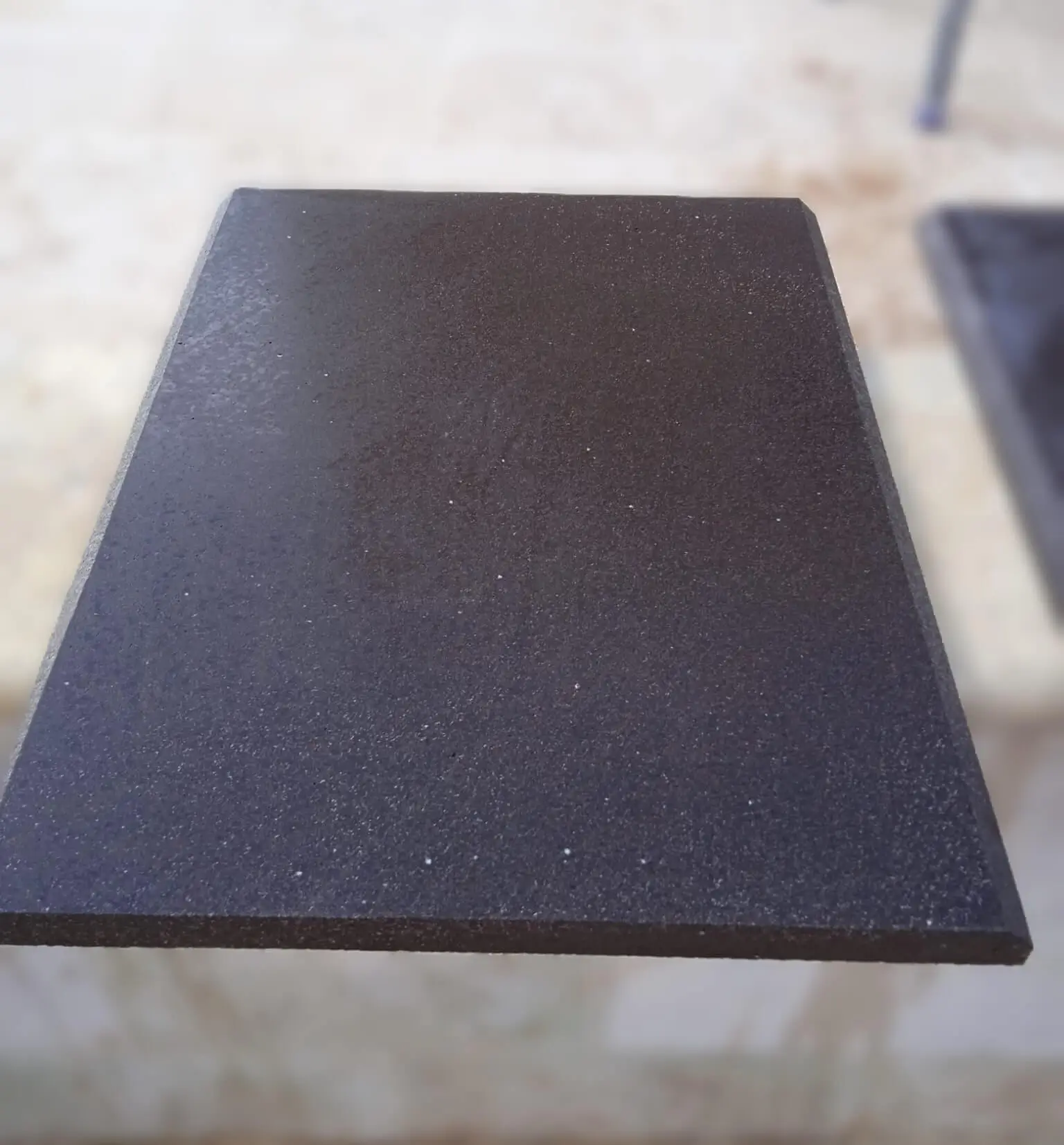
Stone Type and Grade Criteria for Black Basalt Rock for Landscaping
Not all black basalt rock for landscaping is graded identically, and grade terminology is not standardised across the supply chain the way ASTM classifications are for granite or marble. What you’ll encounter in practice are informal tiers — typically distinguished by surface consistency, edge tolerance, and thickness variance — and the names suppliers use for those tiers differ from one source to the next. Your specification needs to define acceptance criteria in measurable terms rather than relying on a grade label.
- Thickness tolerance: specify the acceptable variance in millimetres per piece — tighter tolerances matter most for recessed mortar beds and flush-set applications
- Edge calibration: sawn edges hold tighter dimensional tolerance than split-faced edges; mixing the two in a single plane reads as inconsistent from a viewing distance
- Surface defects: define acceptable natural fissures versus through-cracks — surface fissures are cosmetic, through-cracks affect structural integrity under point loads
- Colour banding: some basalt runs with lighter grey banding caused by mineralogical variation; decide up front whether this is acceptable for your project’s aesthetic intent
- Flatness: for large-format pieces, flatness deviation across the face affects mortar contact and long-term stability — ask for the maximum bow tolerance per linear metre
The Natural Stone Institute provides technical guidance on igneous stone paving standards that helps specifiers set realistic dimensional tolerances before procurement. Using that baseline as a starting point and then negotiating tighter criteria where your project demands it is a much more defensible approach than trusting grade marketing language alone.
Finish Options and Surface Texture
The finish you select for black basalt rock for landscaping changes the visual character, maintenance requirements, and surface texture of the stone far more dramatically than it does with lighter-coloured materials. On dark stone, every finish reads differently — what looks subtly matte on limestone can look almost wet on basalt, and a polished face on basalt produces a mirror-like depth that completely transforms a space.
- Honed finish: a smooth, matte surface that reveals the stone’s true colour depth without reflectivity — the most widely specified option for exterior landscape use because it maintains its appearance as it weathers
- Flamed finish: controlled thermal treatment opens the surface texture and produces a rough, tactile face — this texture is particularly relevant for areas where surface character matters, and the roughness changes how the stone interacts with light across the day
- Bush-hammered finish: mechanical texturing that produces a consistent pock-marked surface — visually interesting at close range and effective at breaking up large uniform planes in a landscape composition
- Split-face finish: the stone is cleaved rather than sawn, exposing the natural fracture plane — highly textural and suited to vertical applications like feature walls or raised planter faces
- Brushed or antique finish: mechanical brushing softens the surface and creates a slightly aged character — useful when you want the stone to integrate with traditional or heritage landscape styles rather than read as new material
One detail that often catches buyers out: the finish affects not just aesthetics but also the way the stone manages moisture on its surface. A flamed finish leaves an open, matte texture that disperses water differently than a honed face does. Understanding this distinction is critical for specifications around pools, water features, and drainage channels — and it belongs in any pre-purchase conversation about slip resistance. The current wet-surface test standard is ANSI A326.3, measured wet; the finish is the primary variable. If a tested value exists for the specific finish you’re specifying, the test report is available on request from your supplier.
Integrating Black Basalt Into Landscape Design Styles
Your design intent shapes which format, finish, and laying pattern makes sense for this material — and black basalt’s tonal weight means it reads very differently depending on what surrounds it. The stone has a disciplined, graphic quality that suits certain design vocabularies and can feel heavy or disconnected in others if you don’t plan the integration carefully.
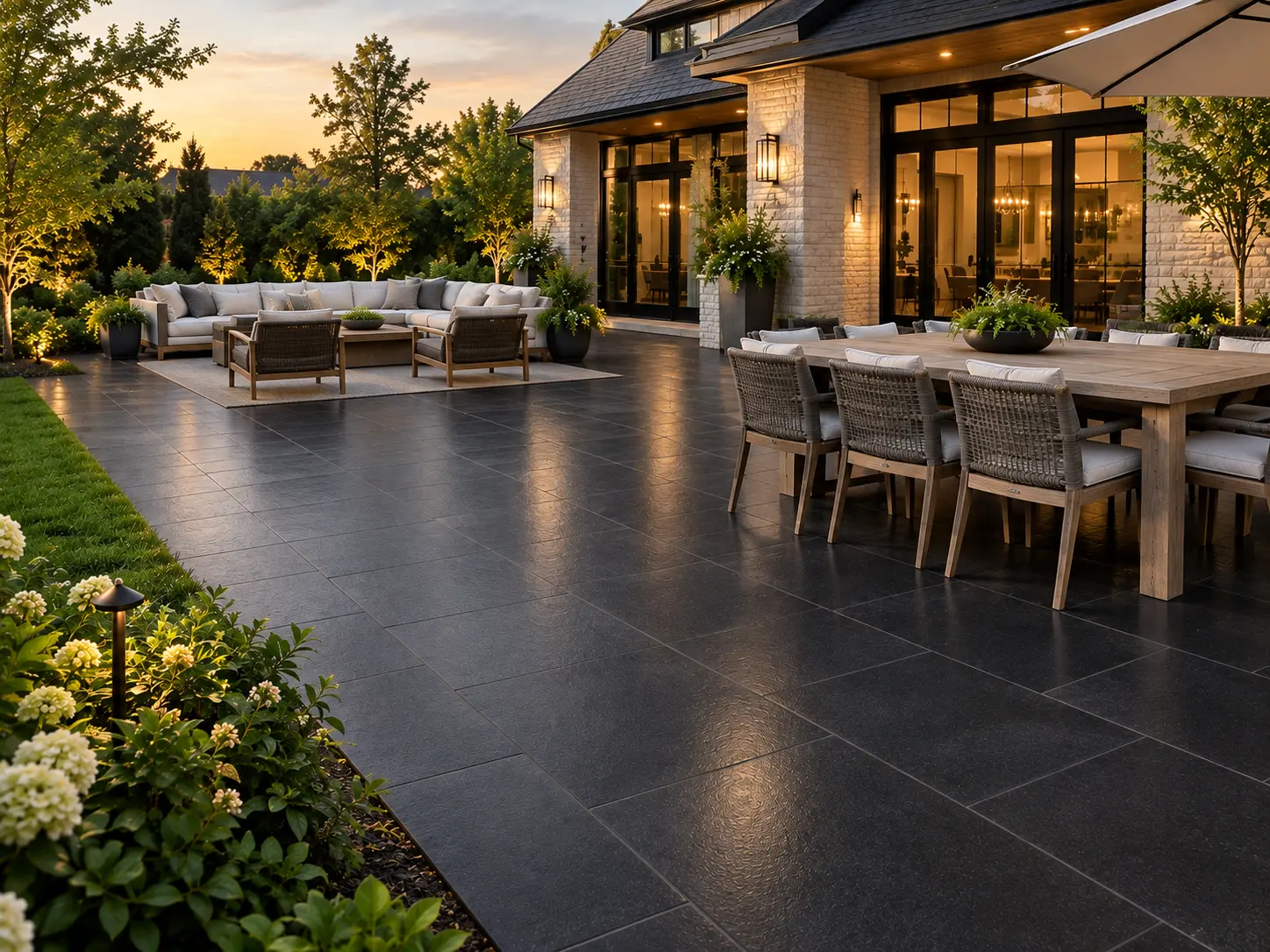
In modern minimalist landscapes, large-format basalt slabs laid in tight rectilinear grids amplify the stone’s natural geometry. The deep, uniform tone grounds the composition and creates a visual anchor that lighter paving materials can’t replicate. Planting palettes of architectural grasses, succulents, and restrained evergreen shrubs complement rather than compete with the stone’s density. The key specification decision here is surface flatness — for a minimalist read, you need consistent joint widths and a plane that reads as deliberately precise.
Desert xeriscaping presents a different but equally productive application for black basalt rock for landscaping. Against pale gravel, bleached terracotta tones, and drought-tolerant planting, the dark stone creates high contrast that gives a landscape structure without relying on water-hungry lawn areas. Stepping stones or pavers set into decomposed granite or crushed aggregate mulch use the basalt’s weight and permanence as an organising element. In this context, irregular or semi-random formats often suit the aesthetic better than tightly calibrated rectangular pieces.
Traditional and colonial landscape styles typically call for this stone in more modest roles — as edging, coping to raised beds, or as an accent material within a broader composition that uses softer-toned primary paving. Overusing basalt in these settings can make a landscape feel colder than the design intent calls for. The design discipline here is restraint: let the stone function as a punctuation element rather than the dominant surface.
Tropical planting environments are where dark basalt can look most dramatically effective. Against lush green foliage, the near-black tone creates a richness that mirrors the intensity of the planting itself. Water features, koi ponds, and naturalistic pools benefit from basalt’s colour depth — the stone reads almost like a still water surface when wet, which reinforces the water’s presence rather than competing with it.
Thickness and Format Selection for Structural Demand
Thickness specification for black basalt rock for landscaping isn’t arbitrary — it follows the point load and distributed load profile of the application. Foot-traffic-only paths can tolerate thinner nominal sections than driveways, vehicle courts, or areas with heavy planters and equipment access. Getting this decision wrong in the thin direction doesn’t produce immediate failure; it produces slow micro-fracturing that becomes visible after the first or second freeze-thaw season.
- Pedestrian-only paths and terraces: consult your structural engineer’s recommendation for the specific base type and stone format you’re using — never assume a generic thickness rule covers your project’s conditions
- Vehicle-rated surfaces: basalt specified for vehicle access needs both adequate thickness and a correctly engineered base — the stone and the base work as a system, and under-engineering either component compromises both
- Vertical cladding and feature walls: thinner sections are standard here, but check the flexural strength test result (ASTM C880) before specifying large unsupported panels — the test report is available from your supplier on request
- Pool surrounds and water features: standard landscape thicknesses are typically appropriate, but the bedding and drainage design matter as much as the stone section
- Stepping stones in planted areas: thicker sections resist the rocking that occurs when ground beneath the stone settles unevenly under planting and irrigation
Format choice — the plan dimensions of each piece — interacts with thickness in ways that matter for both aesthetics and structural performance. Very large format pieces with insufficient thickness create flexural stress across the unsupported span between bedding contact points. A test report on compressive and flexural strength, measured per ASTM C170 and ASTM C880 respectively, gives you the data you need to make this decision defensibly. At Citadel Stone, we recommend requesting those test reports as part of the procurement process rather than relying on rule-of-thumb guidance that doesn’t account for your specific project loading.
Basalt Porosity, Absorption, and Sealing Protocols
Here’s what most landscape specifiers miss about sealing basalt: the decision isn’t binary. You’re not choosing between sealed and unsealed — you’re choosing a sealer type, application interval, and maintenance protocol that fits the specific exposure conditions of your project. And on dark basalt, the wrong sealer choice is far more visible than it would be on a lighter stone.
Basalt’s low natural absorption rate means sealers that perform well on limestone or sandstone may over-penetrate or pool on the surface rather than binding uniformly. Impregnating sealers that work below the surface plane are generally preferred for honed and flamed basalt exteriors because they don’t alter the surface sheen. Topical sealers — those that form a surface film — can create a wet-look enhancement that works well in some design contexts but looks artificial in others. Test any sealer on a sample piece before committing to full-scale application, and let it cure fully before evaluating the result.
Your resealing interval depends on the sealer manufacturer’s stated performance window for your specific climate exposure — UV intensity, rainfall, freeze-thaw cycles, and foot traffic volume all affect how quickly a sealer depletes. You can expect long service from properly sealed basalt where drainage works and you reseal on the interval your sealer manufacturer states. Never assume an initial seal is permanent — the absorption test result for your specific stone, measured against ASTM C97, tells you how porous the surface is and how demanding the sealing protocol needs to be.
To explore our basalt rock for gardens and discuss sealer compatibility for your specific application, the product range is available with technical consultation as part of the ordering process.
Thermal Performance and Colour Retention in Direct Sun
Dark stone absorbs more solar radiation than lighter alternatives — this is a physical reality, not a drawback, but it needs to be factored into your specification for any sun-exposed surface. Black basalt rock for landscaping in full sun will reach surface temperatures measurably higher than light limestone or pale concrete in the same exposure conditions. For barefoot-use areas around pools and in entertaining spaces, this is a design consideration worth addressing in the material selection stage rather than discovering after installation.
The thermal mass characteristic also has a positive dimension: basalt retains daytime heat and releases it slowly into the evening. In gardens used through the shoulder seasons, this extends the comfortable use period of outdoor spaces. Placing basalt paving where it captures and holds afternoon sun — along seating areas or adjacent to water features — is a design move that skilled landscape architects use deliberately.
Colour retention under UV exposure is one of basalt’s genuine strengths. The dark tone comes from the iron and magnesium mineralogy of the stone itself — it doesn’t fade the way pigmented materials do, and the colour reads consistently across the life of the installation. According to Britannica’s overview of basalt volcanic rock formation and properties, the mineralogical stability of basalt under environmental exposure is well established — the stone’s colour is structural rather than surface-applied. You won’t be dealing with bleaching or tonal drift as the installation ages, which is one reason it holds up so well aesthetically in high-UV outdoor settings.
Ordering, Quantities, and Delivery Planning
Your quantity calculation for black basalt rock for landscaping needs to include a waste allowance that reflects the complexity of your laying pattern — not a generic percentage applied uniformly across all project types. Straight rectangular patterns in standard formats waste very little material. Diagonal patterns, curved edges, and irregular formats waste significantly more, and the cut pieces you generate at perimeters need to be accounted for in your order quantity.
- Straight grid pattern in calibrated rectangular format: plan for a modest waste allowance above net coverage area
- Diagonal or 45-degree pattern: waste increases substantially at perimeters — your quantity calculation should reflect this before ordering
- Irregular or opus incertum patterns: waste is harder to predict and depends on the size range of pieces you’re working with — a dry-lay trial section before cutting helps calibrate the number
- Always order enough to complete the project from a single production run: colour and texture consistency between production runs is not guaranteed, and matching material sourced later can be difficult
Delivery scheduling requires confirmed access to your site before the order ships. Basalt is a dense material, and pallet weights for stone shipments are substantial — your site needs to accommodate the delivery vehicle’s turning radius, overhead clearance, and offloading method. Offloading arrangements are confirmed before the delivery date, and lead times are quoted with the order rather than assumed. Citadel Stone cuts black basalt to order at our selected quarries, so confirming your specification details — format, finish, thickness, and quantity — at the outset is what drives an accurate lead time estimate for your project schedule.
For projects requiring phased delivery, discuss staging requirements when placing the initial order. Coordinating partial deliveries around your site’s construction programme prevents the double-handling that causes edge chipping on large-format basalt pieces — a detail that matters more for this material than for rougher-textured alternatives that hide minor edge damage.
Getting Your Black Basalt Rock for Landscaping Specification Right
The specification decisions that define a black basalt rock for landscaping installation — grade criteria, finish, thickness, sealing protocol, and thermal considerations — all interact with each other in ways that reward planning them together rather than in sequence. Get the grade criteria right and you avoid remediation costs. Get the finish decision right in the context of your design vocabulary and the installation reads as intentional rather than generic. Get the delivery and quantity planning right and you complete the project from consistent material without mid-project supply interruptions. The Natural Stone Institute’s resource on igneous stone variety selection offers a useful technical reference point for specifiers building procurement criteria for this material category. As you look ahead to the long-term care and maintenance dimension of your installation, basalt slab cleaning and care covers the ongoing protocols that keep this stone performing as specified over its service life. Basalt rock from Citadel Stone is known for a deep tone that stays rich under strong, direct sunlight.
Related reading: what is black basalt rock · how to place black basalt boulders · honed black basalt finish explained.