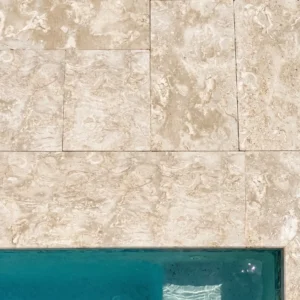
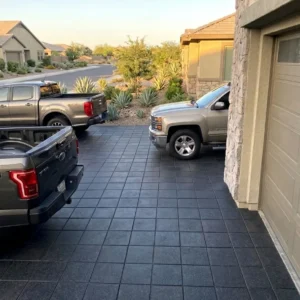
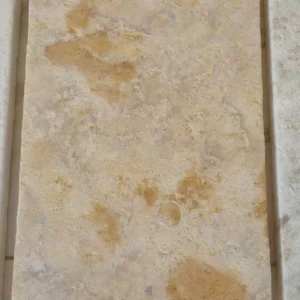
The flamed granite paver finish performs differently from every other surface treatment you can specify for granite — and the reason comes down to what the flame actually does to the stone’s crystalline structure. When a high-temperature torch passes across the surface, thermal shock causes the outer layer of feldspar and quartz crystals to fracture and pop away, leaving a coarse, open texture that bears almost no resemblance to the sawn blank it started as. That transformation matters for your specification because it changes how the surface interacts with water, foot traffic, freeze-thaw cycling, and base movement — in ways that honed or polished surfaces simply don’t.
How the Flaming Process Changes Granite at the Surface
Granite is an igneous rock composed primarily of interlocked quartz, feldspar, and mica crystals — dense, tightly bonded, and highly resistant to wear. The flaming process exploits the different thermal expansion coefficients of those minerals. Quartz expands rapidly under the flame; feldspar expands at a different rate. That mismatch causes micro-fractures along grain boundaries, and the surface literally blisters away in tiny fragments, exposing the underlying crystalline structure in a rough, matte relief.
What you end up with is a surface that is measurably coarser than the sawn base, with micro-peaks and valleys that create genuine mechanical texture. The depth and consistency of that texture depends on the torch speed, temperature, and the specific granite’s mineral composition — a coarse-grained grey granite will texture differently from a fine-grained black granite. For any particular stone, request the test report from your supplier rather than relying on a generic description, because the mineral makeup of one granite variety can produce a noticeably different result than another.
According to Natural Stone Institute granite durability and application specifications, granite’s dense mineral matrix makes it one of the most dimensionally stable natural stones available — a characteristic that carries through the flaming process and into long-term field performance. That stability is a key reason the flamed finish remains so consistent across service life, even in climates with significant temperature swings.
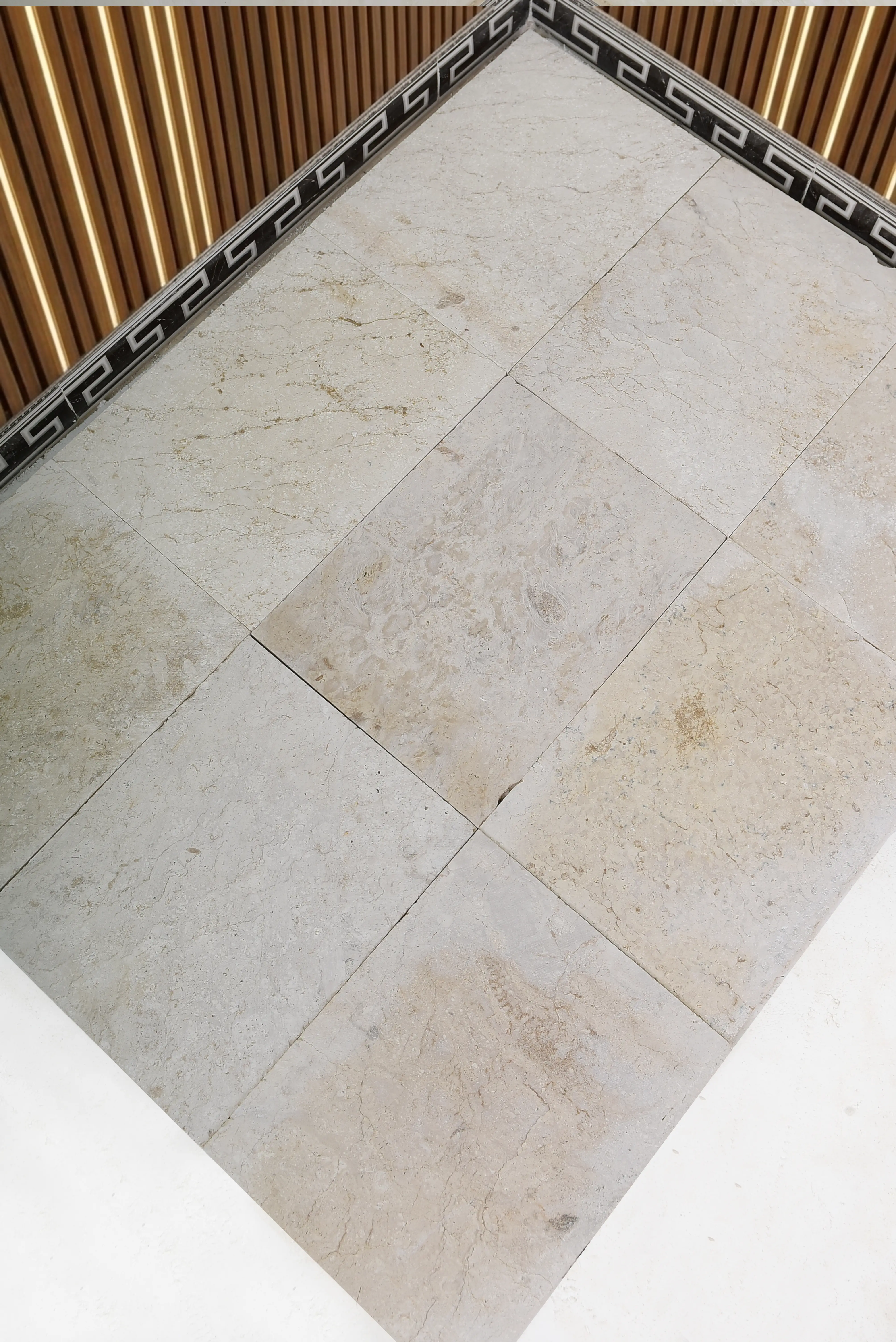
Texture Profile: What You Actually Get Underfoot
The coarse, open texture of a flamed finish is its defining characteristic, and it’s worth understanding what that means at the specification level. The surface isn’t uniformly rough the way sandpaper is — it has an irregular, crystalline relief that varies slightly across the slab face. That variation is part of what makes it visually distinctive and practically effective for outdoor applications.
- The matte, slightly whitened appearance results from the same micro-fracturing that creates the texture — quartz crystals scatter light rather than reflecting it, softening the visual contrast between light and dark minerals
- The texture depth is typically more pronounced than a brushed finish, placing flamed granite in the coarser range of surface treatments for natural stone
- Color tends to shift slightly lighter compared to polished or honed versions of the same stone — worth accounting for in your material board and sample approval process
- The open surface can hold moisture briefly after rain, but the lack of a tight, sealed surface means standing water drains away rather than pooling in a continuous film
- Under bare feet, the texture feels coarse and substantial — noticeably different from the smooth, cool contact of honed stone
Your finish selection should account for the visual shift, not just the functional one. Specifiers sometimes approve a sample of polished granite and then switch to flamed without running a new sample approval — the color difference can be significant enough to require client sign-off again.
Best Uses for Flamed Granite Pavers
The flamed granite paver finish is specified for applications where you need a durable outdoor surface with genuine mechanical texture and a natural, understated appearance. Its performance characteristics align well with several demanding project types.
- Pool surrounds and coping: the open, matte surface and water-shedding texture make it a practical choice for wet deck areas; pool deck specifications should follow ANSI A326.3, measured wet, and the finish is the variable that determines suitability — request the test report from your supplier
- Exterior walkways and public pedestrian plazas: the coarse texture holds up well under heavy foot traffic, and the dense granite base provides exceptional durability under repeated loading
- Driveways and vehicle-access areas: for driveways, use setts or cobbles at least 3.5 in (4 in standard) thick on a compacted base, or pavers 2 in (5 cm) or thicker mortar-bonded to a reinforced concrete slab
- Steps and ramps where texture depth is a design requirement — though finish alone is never a safety guarantee; confirm compliance with ANSI A326.3 wet testing via a test report on request
- Commercial plazas and civic hardscape where low maintenance and a long service life are primary drivers
- Exterior feature walls and split-face cladding transitions where the textured granite surface complements adjacent rough-face elements
The finish is generally not recommended for polished indoor applications — for dry indoor surfaces such as floors, countertops, and fireplace surrounds, a polished finish is the more appropriate choice. The flamed finish lives outdoors, in demanding conditions, where its texture and density give it a real performance advantage over finer finishes.
Slip Resistance Standards and Finish Selection
Specifying outdoor stone for public or semi-public applications means understanding how surface texture intersects with test standards — and the current standard that matters is ANSI A326.3, measured wet. The finish is the variable. That’s worth repeating: the stone itself doesn’t determine the outcome; the surface treatment does. A polished granite and a flamed granite from the same block will behave very differently under wet test conditions because their surface profiles are fundamentally different.
The predecessor to ANSI A326.3 was the ASTM C1028 static test, withdrawn in 2014. Some project specs still reference it — if you encounter one, flag it and update the reference to ANSI A326.3 measured wet. Publishing a slip figure or class here isn’t appropriate; if a tested value exists for a specific stone and finish combination, the test report is available on request from Citadel Stone.
For pool decks, wet steps, and slopes, specify a bush-hammered finish. For other outdoor paths, bush-hammered or brushed in our coarsest grit both work — check a sample against your project’s requirements before committing. The flamed granite paver finish occupies a similar textural range to bush-hammered for many applications, but finish decisions for safety-critical surfaces need to be confirmed against an ANSI A326.3 wet test report, not against a finish description alone.
Code Compliance and Structural Requirements for Outdoor Granite Paving
Base depth, edge restraint, and material thickness aren’t details you set by feel — local building codes govern them, and those codes vary by jurisdiction, soil type, frost line depth, and load classification. The flamed granite paver finish is the surface treatment; the specification underneath it is where structural performance lives.
For pedestrian applications, a minimum 3 cm (1¼ in) paver mortar-bonded to a prepared concrete base works for patios, pool decks, paths, and pedestrian plazas. For vehicle-traffic areas, the format changes: setts or cobbles at a minimum of 3.5 in (4 in standard) on a compacted base, or pavers 2 in (5 cm) or thicker on a reinforced concrete slab. Your local frost line depth determines how deep that base needs to go — in regions where ground freezes to significant depth, inadequate base depth is the most common cause of premature paving failure.
- Check IBC Chapter 21 and your local amendment for masonry and stone paving requirements in your jurisdiction
- Edge restraint requirements vary — some jurisdictions require mechanical edge restraints on all sides of freestanding paving; others accept mortar-set perimeter courses
- Seismic zones add lateral load considerations that affect mortar bed specifications and joint width — confirm with your structural engineer
- ADA compliance governs surface cross-slope, running slope, and joint width on accessible routes; the flamed granite paver finish is compatible with ADA surface requirements when installed correctly, but dimensional compliance is the installer’s responsibility
- Drainage slope and stormwater management requirements are increasingly part of local code — permeable jointing options may be required or incentivized in some jurisdictions
At Citadel Stone, we recommend confirming your local frost line and base depth requirements with your civil engineer before finalizing the specification — a base that works well in a temperate zone can perform poorly in a hard-freeze region if the depth isn’t adjusted to account for heave.
Comparing the Flamed Finish to Other Granite Surface Treatments
Understanding how the flamed granite paver finish sits relative to other granite surface options helps you make the right call for each application zone within a project — especially on larger sites where different areas have different functional demands.
Flamed vs. Polished
Polished granite delivers a mirror-like surface that reveals the stone’s full color depth and mineral detail. It’s the right choice for dry indoor surfaces — floors, countertops, vanity tops, and fireplace surrounds — where the reflective quality and easy-clean surface are assets. Outdoors, or anywhere the surface gets wet, polished granite is not the appropriate specification. The flamed finish is the outdoor specification; the polished finish belongs inside, away from water.
Flamed vs. Honed
Honed 60 Grit and Honed 120 Grit deliver a matte, satin surface without the coarse relief of a flamed finish. Honed granite is a strong interior specification — for floors, cladding, covered patios, and wall applications. For exposed outdoor use, especially in applications where texture depth is a functional consideration, the flamed finish provides a coarser profile that many specifiers prefer for high-traffic exterior zones.
Flamed vs. Brushed
Brushed finishes — whether Brushed 16 Grit for driveways and courtyards, Brushed 36 Grit for patios and pool surrounds, or Brushed 80 Grit for barefoot pool decks — achieve their texture mechanically, through abrasive wire brushing that opens the surface grain without the dramatic micro-fracturing of flaming. Brushed finishes tend to be more consistent in texture depth across the slab face. The flamed finish has a slightly more irregular, crystalline quality that many designers prefer for its more natural, stone-like appearance. Both are legitimate outdoor specifications — the choice depends on the project’s aesthetic intent and the specific application.
Sealing, Maintenance, and Long-Term Care
The coarse, open surface of a flamed finish creates more total surface area than a polished or honed face — which means it can absorb a penetrating sealer more readily, but also that it benefits meaningfully from sealing in applications where staining is a concern.
For exterior applications, a penetrating impregnating sealer applied to a clean, dry surface provides practical protection against oil, organic staining, and moisture ingress. The sealing interval depends on your sealer manufacturer’s stated guidance — not on a generic rule of thumb. Granite is among the denser natural stones, and sealer longevity on a flamed surface will differ from the interval on a honed or polished face of the same stone. Test in an inconspicuous area and follow the manufacturer’s stated reapplication schedule.
- Clean the surface before sealing — the open texture of a flamed finish holds particulates and organic debris that need to be removed before the sealer penetrates correctly
- Use a sealer rated for exterior use; some interior-grade sealers are not formulated for UV exposure and freeze-thaw cycling
- Regular sweeping and occasional pressure washing keeps the open texture clear; allow the surface to dry completely before any sealer reapplication
- In climates with significant freeze-thaw cycling, annual inspection of the paving joints and base condition is worthwhile — not because the granite is vulnerable, but because joint material and base settlement are the common failure points
According to ASTM C615 granite dimension stone quality standards, granite’s absorption characteristics are among the lowest of any natural stone — which means the sealer you apply is primarily protecting against surface staining rather than deep moisture penetration. That’s a useful baseline for managing client expectations around maintenance intervals.
Ordering, Delivery, and Project Planning
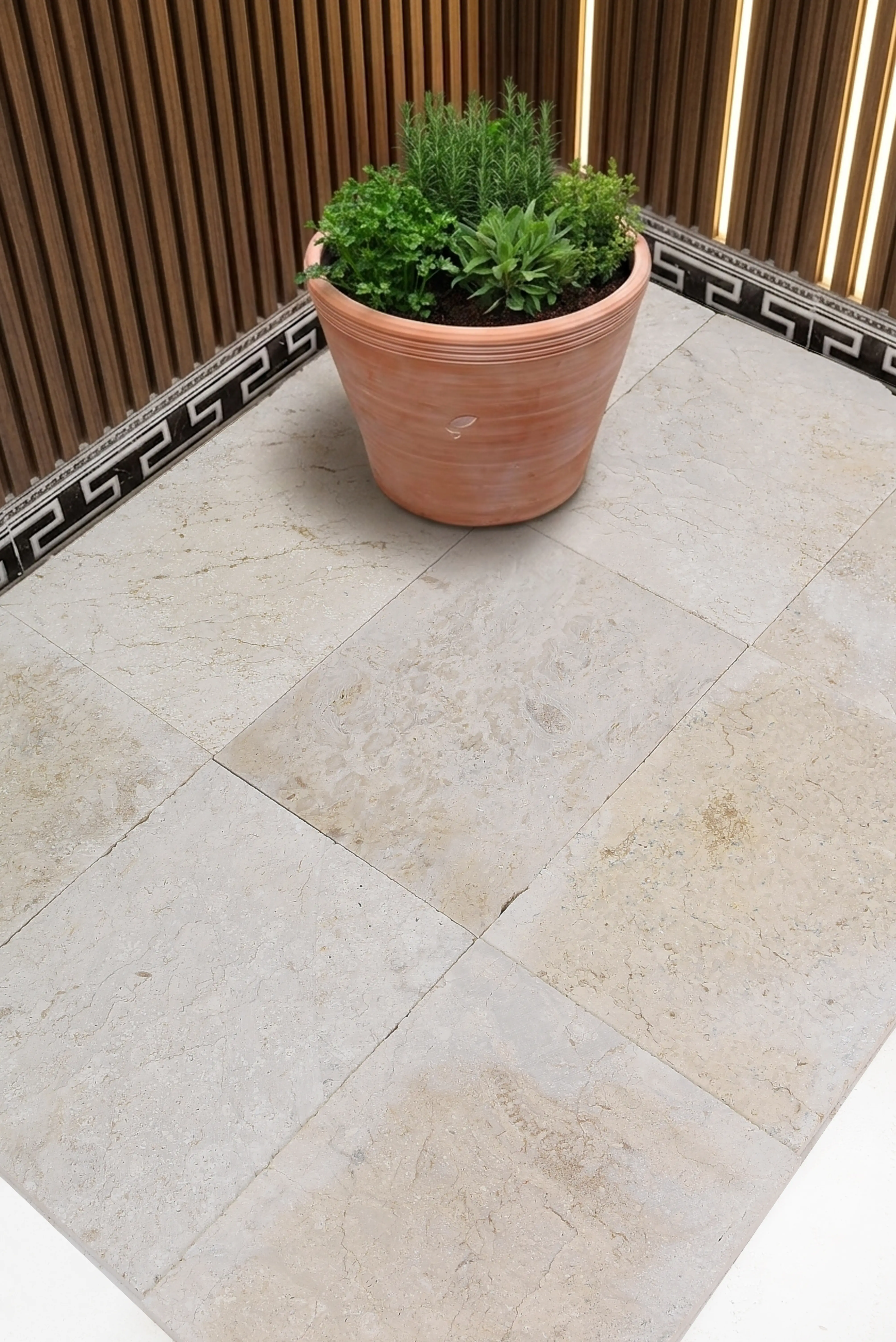
The flamed granite paver finish is produced to order — the flaming process happens at the quarry as part of the cut-to-order production sequence, which means lead times are quoted with the order rather than drawn from a ready-cut inventory. Citadel Stone stocks material at our selected quarries and cuts to the dimensions your project requires, so your order reflects your actual layout, not a standard size you’ve had to adapt to.
For the link between surface finish and the full product range, our flamed granite paver finish page gives you the size, thickness, and finish options available for current orders. Delivery is arranged and managed by Citadel Stone and confirmed before the order ships — your project’s access constraints and site conditions are worth noting when you place the order, because offloading logistics on tight sites or restricted access roads affect scheduling. Lead times are quoted with the order; confirm these against your installation programme before committing to a start date.
According to USGS granite production and construction use statistics, granite remains among the most widely specified dimension stones in North American construction — partly because of its performance credentials across a wide range of applications, and partly because the supply chain for cut-to-order granite is mature and well-established. That context matters when you’re comparing natural stone against manufactured alternatives on a project with tight delivery windows.
Getting Your Flamed Granite Paver Finish Specification Right
Your specification for a flamed granite paver finish starts with understanding what the finish actually is — not a coating or a treatment, but a permanent transformation of the stone’s surface structure through controlled thermal shock. That transformation produces a coarse, open, matte surface that is genuinely suited to outdoor applications where texture depth and dimensional stability matter. The base specification underneath it — thickness, mortar bed or compacted base, edge restraint, and drainage — is governed by local code, not by the finish, and confirming those requirements with your civil engineer and local building authority is non-negotiable.
Finish selection across a multi-zone project often means specifying different treatments for different areas: polished for dry indoor floors, honed for interior cladding and covered spaces, and flamed or bush-hammered for exposed outdoor zones. Each finish belongs in its correct context. As you plan your stone project, related material decisions can inform the broader specification — reclaimed granite paver inspection criteria covers an adjacent dimension of granite sourcing worth reviewing if reclaimed material is on your project’s agenda. Compared to honed or tumbled surfaces, the flamed finish Citadel Stone provides creates an open texture that sheds water and leaves a coarser, more open surface profile in wet conditions.
Related reading: granite paver color guide · granite pavers for driveways guide.