

Layout decisions for large format basalt pavers commit you to an outcome that’s difficult to reverse once setting material cures. The joint pattern, panel size, and edge alignment you specify at the drawing stage are the same decisions that determine how the finished surface reads from twenty feet away — and how it holds up over years of thermal cycling and loading. Getting these choices right means understanding how the stone’s dense, fine-grained structure interacts with your substrate and your design intent before a single paver is placed.
What Makes Large Format Basalt Pavers Different to Specify
Large format basalt pavers — typically panels running 600 mm and above on their long edge — amplify every base and layout error. A 50 mm deviation in substrate flatness that a small paver bridges invisibly becomes a rock on a large format panel. Your substrate preparation tolerance has to tighten accordingly: a maximum deviation across the bearing face is the first spec to write down, and it should come from your setting material manufacturer’s documentation, not from a general rule of thumb.
Basalt’s physical density — verifiable via test report on request — means individual large panels carry meaningful weight during placement. Plan your handling sequence before delivery is confirmed. Offloading arrangements and on-site movement paths affect both crew safety and paver integrity, so those logistics are worth working out while you are still in the planning phase.
- Substrate flatness tolerance must be tightened relative to small-format specs — confirm the maximum deviation with your setting material data sheet
- Panel weight increases with format size; two-person lifts and mechanical assist may be required for panels above a certain dimension threshold
- Thermal expansion accumulates across a run of large panels — joint spacing cannot be a cosmetic decision
- Cut-to-order dimensions mean your drawing set drives production; errors in the drawing translate directly into panels that don’t fit on site
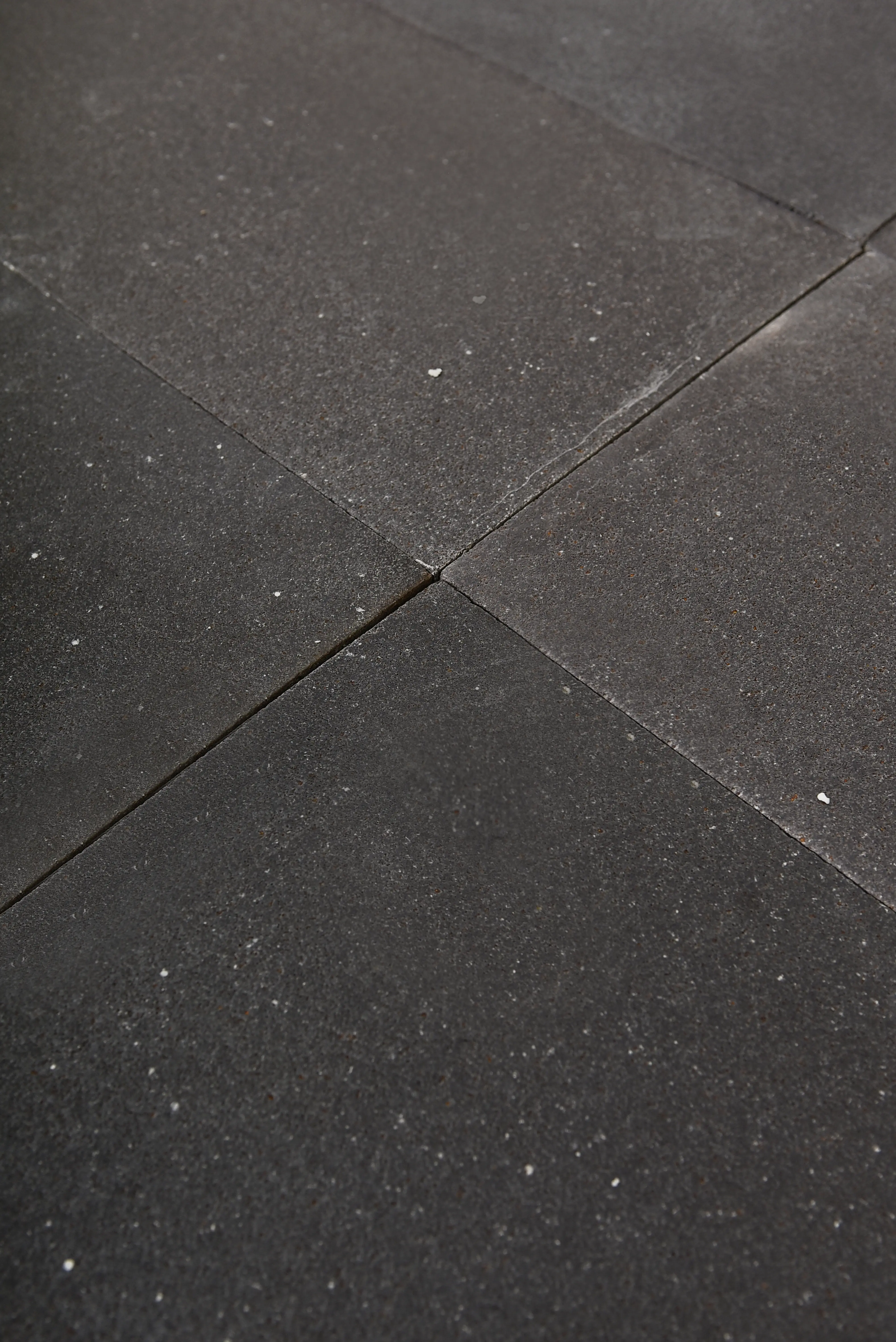
Base Preparation: The Variable That Governs Everything Else
Your base is the single greatest determinant of long-term performance for large format basalt paving. Dense igneous stone does not flex — it transmits point loads directly to the substrate. A base that consolidates unevenly after installation creates differential settlement that produces lippage, cracked panels, and broken joints. According to Natural Stone Institute technical stone specifications, base preparation standards for large format natural stone are more demanding than those for ceramic or concrete alternatives because natural stone does not tolerate substrate movement in the same way.
For pedestrian outdoor applications, a compacted aggregate base beneath a mortar bed or large-format setting material is the standard approach. For any vehicle-bearing area, the format and base specification change — but for patios, pool decks, and garden paths, your compacted base depth should be calculated from the soil type and expected load, not from a default figure. Clay-heavy soils require particular attention: seasonal moisture movement in clay can translate into substrate shift that opens joints and rocks panels, so drainage design is part of base design in those conditions.
- Specify a minimum compacted aggregate layer depth derived from soil assessment, not from a printed default
- Use a large-format setting material rated for the panel size you are specifying — standard cement-based adhesive is often insufficient for panels above 600 mm
- Back-butter large panels fully; spot-fixing causes hollow spots that propagate as cracking under load
- Drainage falls must be incorporated into the base profile, not corrected by varying mortar bed thickness
Joint Sizing and Movement Control Across a Large Run
Thermal expansion accumulates. A continuous run of large format basalt pavers across an exposed outdoor surface expands measurably between a cold winter morning and a hot summer afternoon. The coefficient of thermal expansion for basalt is verifiable from a supplier test report — request it from your supplier before you fix joint spacing, because the calculation belongs in your specification, not in a rule of thumb you find in a general installation guide.
Movement joints at perimeter edges and at intermediate intervals across long runs are non-negotiable. Their spacing should be derived from the thermal movement calculation for the specific stone and the climate range the project will see. Grout colour and joint width are aesthetic decisions only after the structural movement accommodation is resolved. Narrowing joints to achieve a seamless visual effect without providing movement relief is the specification error most likely to produce cracked panels within the first two or three years of service.
The USGS description of basalt volcanic rock properties outlines the dense, crystalline structure that gives basalt its rigidity — the same characteristic that means it transfers thermal stress to joints rather than absorbing it through flex. Design the joint pattern to accommodate that behaviour, and the finished surface holds its geometry. Ignore it, and the joints crack for you regardless of installation quality.
Finish Selection and How It Shapes the Layout
Finish choice and layout pattern are inseparable decisions for large format basalt paving. A polished finish on a large panel amplifies reflections and makes joint lines read more prominently — making panel alignment and joint consistency a higher-stakes call. A bush-hammered or brushed finish distributes visual texture across the surface, which is more forgiving of minor joint variation and suits outdoor settings where the surrounding planting and hardscape are the primary design statement.
For pool decks, ramps, and wet areas, choose a bush-hammered finish. For other outdoor paths, bush-hammered or a brushed finish in our coarsest grit both work — check a sample against your project conditions before committing. For interior floors, covered terraces, and pool houses, a Double-Brushed 60 or Honed 120 Grit finish gives a refined surface that suits both contemporary and transitional interiors. Polished finishes belong on dry indoor surfaces only: floors, walls, countertops, and fireplace surrounds where moisture is not a factor.
Landscape design context influences the finish decision as much as function does. A minimalist courtyard with clean-lined planting and pale aggregate groundcover reads well with a honed or lightly brushed basalt panel in a stack-bond or large-offset pattern. A garden with mixed planting layers, specimen trees, and varying ground textures suits a bush-hammered or split face treatment that echoes the natural variability of the landscape rather than working against it. Your finish choice either reinforces or conflicts with the design language around it — that alignment is worth resolving at the specification stage.
Pattern and Alignment: Where Design Intent Meets Site Reality
Stack bond — panel long edges aligned in a continuous grid — is the dominant layout choice for large format basalt paving in contemporary and modern minimalist projects. It maximises the visual impact of each panel, keeps joint lines clean and legible, and suits the stone’s uniform coloration and fine grain. The trade-off is that stack bond is the least forgiving of substrate irregularity or panel sizing variation; every panel in a stack-bond grid references every other panel, so a single sizing error compounds across the run.
Choosing Between Bond Patterns for Large Panels
Stretcher bond — offset by half a panel on alternating rows — distributes structural load more effectively and is more tolerant of minor size variation. It reads as slightly less formal, which works with transitional landscape styles and with mixed planting designs that benefit from a less rigid geometry. For our basalt pavers, both patterns are achievable because panels are cut to order, meaning your specified dimensions are the production dimensions — not a nominal size with variable tolerances that accumulate across a run.
Diagonal layouts add complexity and waste. A 45-degree pattern on a rectangular space requires cutting at every perimeter edge, which increases offcut volume and on-site labour. For large format panels where individual pieces represent significant material cost, the waste factor is worth calculating before the pattern goes to tender. Where a diagonal layout is the right design call, factor the cut waste into your order quantity from the start.
Ordering and Production Planning for Cut-to-Order Panels
Large format basalt paving is a cut-to-order product. Your drawing set is the production brief, which means the accuracy of your dimensions at the order stage determines the fit on site. Dimension panels from finished face to finished face, accounting for joint width, so that the production dimension is the dimension that lands in place — not a dimension that requires field adjustment after delivery.
Citadel Stone stocks basalt at our selected quarries and cuts panels to the dimensions specified in your order. Lead times are quoted with the order and should be built into your programme before groundworks begin. Truck access at the delivery point affects offloading logistics, so confirm site access constraints when you request a quote — that information shapes delivery scheduling. Order a calculated quantity plus a documented allowance for cuts and breakage; the allowance percentage increases with the complexity of the layout and the number of perimeter cuts your pattern requires.
- Confirm finished-face dimensions on your drawing, not slab dimensions — production cuts to your specified number
- State the finish on the order: brushed grit, honed grit, bush-hammered, or polished — each is a different production process
- State the thickness: 3 cm (30 mm) for patios, paths and pool decks; for driveways, setts at least 3.5 in thick on a compacted base, or pavers at least 2 in (5 cm) mortar-bonded to a reinforced concrete slab
- Include a breakage and cut allowance in your order quantity — the exact percentage depends on your layout complexity
- Confirm truck access and unloading arrangements at the delivery address before finalising the delivery schedule
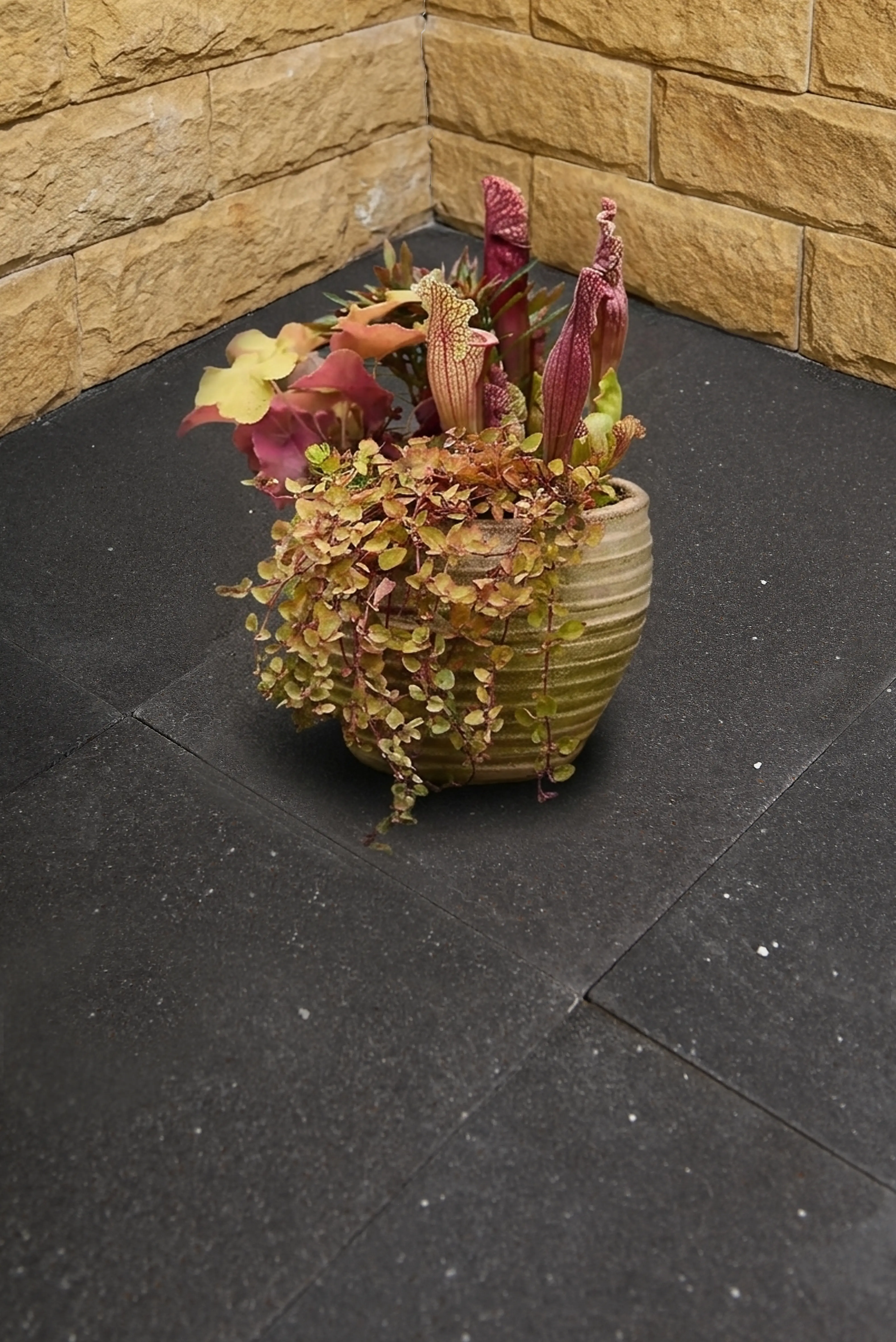
Sealing and Long-Term Surface Care
Basalt is a dense volcanic stone with low porosity relative to sedimentary alternatives. Its absorption characteristics are verifiable from a test report — request it from your supplier, because the figure informs your sealer selection and reapplication interval. According to basalt’s volcanic formation and construction properties, its crystalline microstructure produces a surface that resists staining more readily than open-pore sedimentary stones, though a penetrating sealer is still the standard recommendation for outdoor large format basalt paving exposed to organic debris, poolside chemicals, or high-traffic foot contact.
Apply sealer after installation and before the surface goes into service. Reapplication intervals depend on the sealer manufacturer’s guidance and the surface exposure conditions — high-UV outdoor surfaces with frequent foot traffic require more frequent reapplication than sheltered or low-traffic areas. The reapplication schedule is the maintenance commitment you are making when you specify large basalt pavers outdoors; factor it into the project handover documentation so the end user understands what periodic maintenance looks like.
- Use a penetrating impregnating sealer rated for dense igneous stone — surface coatings can trap moisture under the panel
- Test the sealer on a sample panel before applying to the full surface — confirm the finish effect matches expectations
- Clean the surface before reapplication and allow complete drying before sealing
- For pool-adjacent areas, confirm the sealer is rated for exposure to pool water and cleaning chemicals
Getting Large Format Basalt Paver Specifications Right
Planning large format basalt paving is a sequence of interdependent decisions — base preparation, joint sizing, finish, pattern, and ordering — where each choice constrains the next. The stone’s rigidity is an asset when the substrate and movement joints are specified correctly, and a liability when they are not. Verify physical properties from a supplier test report, derive joint spacing from a real thermal movement calculation, and confirm your panel dimensions are production-ready before the order goes in. As you plan your stone project, related surface applications can inform your material decisions — brushed basalt finish options covers how grit selection and surface texture influence performance and aesthetics across a range of outdoor and indoor applications. Large format basalt from Citadel Stone suits clean, low-joint layouts, with every paver cut to order from our selected Middle East quarries.
Related reading: how basalt is formed · types of basalt.