Color is rarely the first variable specifiers lock down in a granite paver color guide, but it should be. The tone, veining pattern, and finish you choose interact with natural light in ways that shift a paver’s apparent hue dramatically from morning to dusk — and a slab that reads pale silver in a showroom can read almost blue-grey under a midday sun. Getting your color selection right means understanding how feldspar concentration, mineral grain size, and finish type each contribute to the final visual result, not just pulling a sample under fluorescent light and calling it done.
What Actually Drives Granite Color
Granite color is a function of mineral composition, not pigment. The three primary minerals — feldspar, quartz, and mica — are present in varying ratios depending on the quarry, and each one contributes a distinct visual character. Feldspar tends toward warm pinks, creams, and reds; quartz adds translucent grey and white tones; dark mica (biotite) introduces flecks of black and deep charcoal. Your paver’s dominant color comes from whichever mineral is most abundant in that particular stone body.
Veining in granite differs from the dramatic sweep you see in marble. In granite, what looks like veining is actually the interlocking crystalline texture — the way mineral grains cluster and orient during cooling. Coarser grain structures create a more mottled, speckled appearance. Fine-grained granite reads as a more uniform field of color. That distinction matters when you’re specifying large-format pavers, because a coarse-grained stone will show more variation from one paver to the next, which can either enhance or complicate a design depending on the pattern you’re laying.
Red and Pink Granite Pavers: Warmth and Mineral Intensity
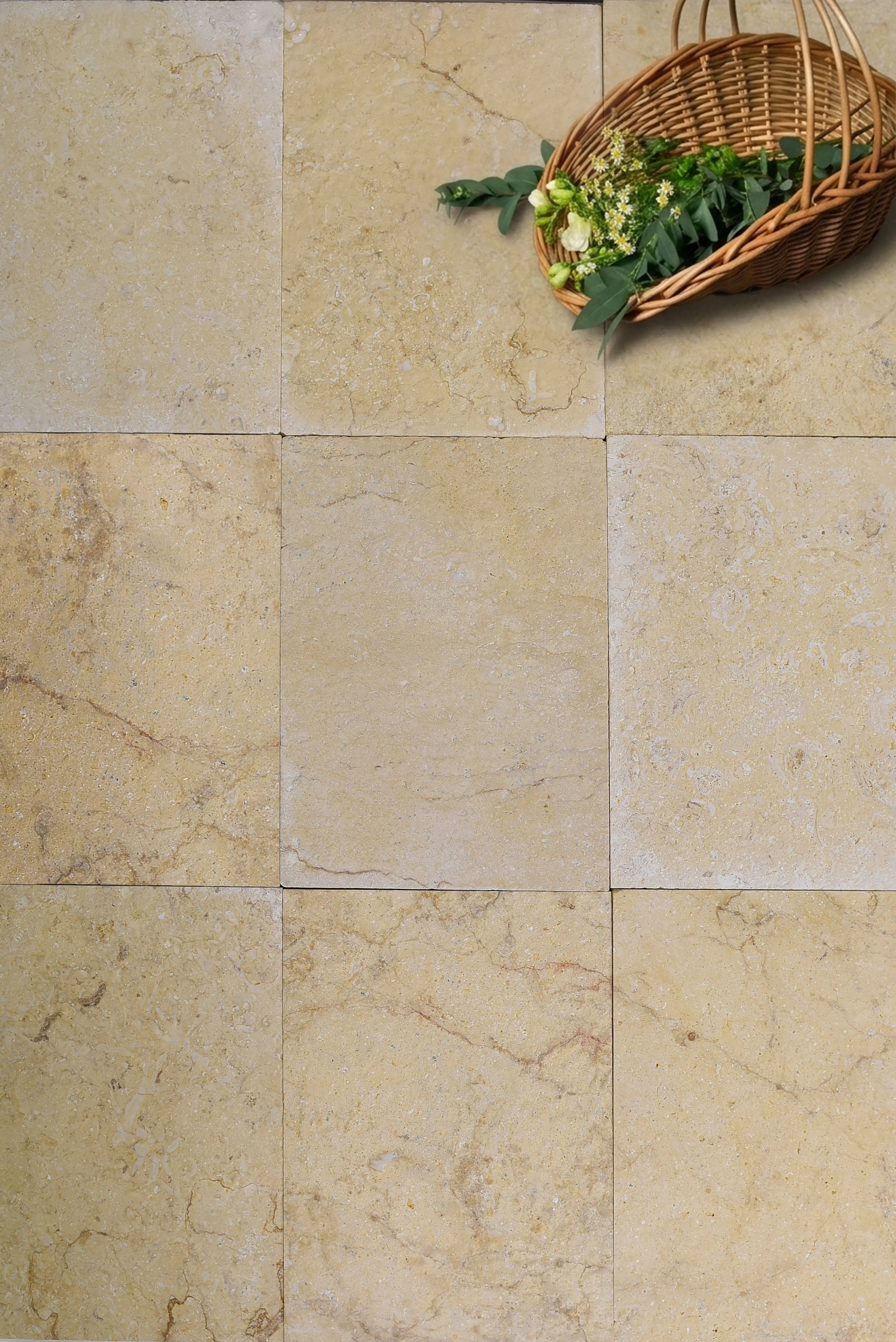
Red granite pavers draw their tone from a high concentration of potassium feldspar — specifically orthoclase, which takes on rich coral, burgundy, and terracotta hues depending on iron content and grain size. You’ll find these stones in a wide range from true brick-red through to a muted rose, and the variation within a single quarry can be significant. Specification tip: request a spread sample of at least eight to ten pieces before locking in a batch, because the color range across pavers is wider than a single slab suggests.
Pink granite pavers sit at the lighter end of that feldspar-dominant spectrum. The pink tones are softer, often blended with grey quartz, which gives the surface a warmth without intensity. These work particularly well in residential courtyard and pathway applications where you want a natural stone look that stays visually light without reading as stark white. According to Natural Stone Institute granite durability and application specifications, feldspar-rich granites demonstrate strong resistance to environmental weathering, making them well-suited to outdoor paving in varied climates.
- High feldspar content drives the most saturated reds and pinks — look for this in the mineral composition report
- Iron-rich variants tend toward deeper red-brown tones that warm further with UV exposure over time
- Pink granites with significant quartz content will read lighter and cooler in shade
- Honed finishes reduce apparent saturation in both red and pink tones; flamed finishes open the surface and reveal more mineral complexity
- Batch variation in red and pink granite pavers is higher than in grey or black granite — always request production samples
Grey and Silver Granite Pavers: Versatility Across Applications
Grey granite is the most widely specified color in the granite paver color guide for one straightforward reason: it transitions well between architectural styles without competing with surrounding materials. The grey spectrum in granite runs from cool blue-grey through warm silver and taupe, depending on the feldspar-to-quartz ratio and mica type. A stone with white mica (muscovite) will read as silver in direct sun. A stone with dark mica reads cooler and more charcoal in tone.
Your finish selection has more impact on grey granite than on any other color family. A polished grey granite reads as a high-contrast architectural material — the kind you see on formal entry approaches and contemporary commercial frontages. The same stone honed goes softer and more matte, reducing glare and diffusing the mineral sparkle. Flamed grey granite opens the crystal structure and introduces a strong texture that shifts the perceived color toward a lighter, chalkier tone outdoors. You’re essentially choosing three different visual results from the same raw stone, which is why finish selection must happen alongside — not after — color selection in your specification.
- Silver-grey granites with white mica brighten considerably in direct sun — factor this into your lighting study
- Cooler blue-grey granites tend to read consistently across different light conditions, making specification more predictable
- Honed grey granite develops a subtle patina over time as fine surface texture weathers — this is normal and adds character
- For large commercial paving runs, grey granite batch consistency is generally easier to manage than red or pink material
Blue Mist Granite Pavers: What the Name Actually Describes
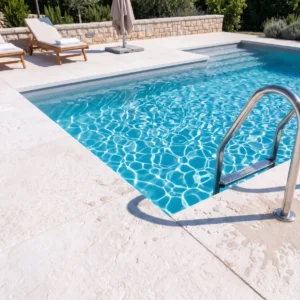
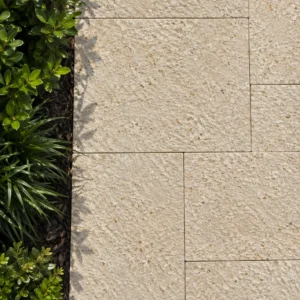
Blue mist granite pavers occupy a specific niche in the granite color spectrum that often surprises designers seeing the material in person for the first time. The “blue” in the name is a quarrying and trade description, not a literal hue — the stone is actually a fine-grained grey granite with a subtly cool undertone and a uniform mineral scatter that reads as a misty, soft-blue-grey under certain light conditions, particularly overcast northern light. In full midday sun, the same stone can read almost silver-white.
That light-sensitivity is what makes blue mist granite a strong candidate for pool surrounds, garden terraces, and light-coloured facade applications. The stone’s visual consistency — fine grain, low variation — lends itself to clean, contemporary layouts where you want the paving to recede and support planting or architecture rather than compete with it. The ASTM C615 granite dimension stone quality standards cover the structural performance parameters that apply to fine-grained granites like blue mist, including flexural and compressive benchmarks that your structural specification should reference — request the test report from your supplier to confirm the specific values for the batch you’re ordering.
- Light conditions at the site matter enormously — visit the installation location at different times of day before finalizing a blue mist selection
- Fine grain means lower variation between pavers, which simplifies pattern work and joint alignment
- Blue mist tones can shift noticeably between a honed and a flamed finish — order actual finished samples, not raw stone chips
- The stone is well-suited to mixed installations where it needs to coordinate with white or light concrete elements
Black and Dark Granite Pavers: Where Finish Changes Everything
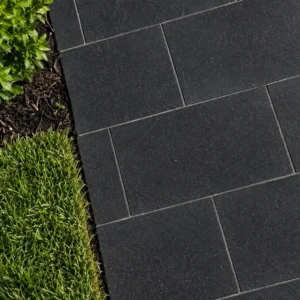
Black and dark granite pavers present a paradox that catches many specifiers off guard: the finish you specify has a more dramatic visual impact on dark granite than on any other color in the family. A polished black granite paver has a mirror-like surface that intensifies the black to an almost wet-looking depth. The same stone flamed goes a full two or three tones lighter — the opened crystal structure scatters light rather than reflecting it, revealing lighter mineral inclusions that weren’t visible in the polished face.
That distinction carries real specification consequences. If your design intent is a bold, dark surface, a polished or fine-honed finish is the right call. If you’re specifying dark granite for an outdoor driveway or high-traffic walkway where surface texture is the priority, a flamed or bush-hammered finish delivers the texture while accepting the visual trade-off of a lighter, less intense tone. Dark granite also absorbs significantly more radiant heat than light granite — this is relevant for outdoor barefoot areas in full-sun exposures, and worth flagging to residential clients before the order is placed.
How Finish Affects Color Perception Outdoors
Every professional who has worked through a granite paver color guide eventually arrives at the same hard-won insight: the finish is the second color decision, not a secondary consideration. Here’s the mechanism. A polished finish creates a highly reflective surface that amplifies the depth and saturation of the stone’s base color — reds get richer, blacks get deeper, greys become more architectural. A honed finish cuts the reflectivity without fully opening the stone’s pore structure, producing a soft matte tone that reads as slightly lighter and less saturated than the polished equivalent.
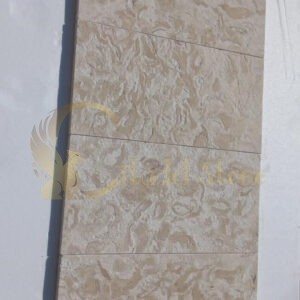
Flamed and bush-hammered finishes go further. The thermal process used in flaming micro-fractures the surface, leaving a textured face that scatters incoming light in multiple directions. This does two things: it reduces glare significantly, and it reveals the full mineral palette of the stone including lighter quartz and feldspar inclusions that are invisible in a polished face. A flamed red granite, for example, often reads as terracotta or rust rather than deep burgundy — a shift of several perceived tones from the same raw material. Your sample set for any granite project should include finished samples, not raw stone, viewed outdoors in the site’s actual light conditions.
The USGS granite production and construction use statistics confirm granite’s dominance in the dimension stone paving market nationally — and one reason specifiers return to it repeatedly is precisely this finish versatility, the ability to dial in radically different aesthetic outcomes from a structurally consistent material.
Soil Conditions and Base Preparation for Granite Paver Installations
Color selection gets all the attention, but the ground beneath your granite pavers determines whether the visual result you’ve specified actually holds up over time. Granite is a dense, low-absorption igneous stone — it moves very little in response to moisture. The substrate beneath it, however, can move considerably, and the soil type at your site is the primary variable that determines how much differential movement you’ll need to design around.
Expansive clay soils present the most significant challenge in granite paver installations. Clay swells when wet and contracts when dry, and if your compacted aggregate base isn’t deep enough to decouple the pavers from that movement cycle, you’ll see joint cracking, lippage, and localized settlement within a few seasons. The mitigation is a well-compacted, free-draining aggregate base of adequate depth — the specific depth depends on the clay expansion index for your site’s soil, which a geotechnical test report will establish. Generic depth rules don’t account for regional soil variability, and that’s where many residential installations fall short.
- Sandy soils drain well but can shift under load if not adequately compacted — specify a fine-to-medium angular aggregate for base stability
- Caliche-heavy soils in arid regions require breaking and removal before base construction — the hardpan layer prevents drainage and creates frost-like uplift conditions
- Rocky subgrades can create uneven bearing — hand-tamping and a levelling sand layer are often required to achieve consistent bedding
- Organic-rich topsoils must be fully excavated before base construction — settling rates in organic material are incompatible with rigid stone paving
- Request a geotechnical assessment on sites with unknown or variable soil conditions before specifying base depth
Proper drainage geometry is as important as base depth. Granite pavers don’t absorb water the way a more porous stone will — surface water has to go somewhere, and if your cross-fall is insufficient, water pools at joints and the freeze-thaw cycle does work on the bedding layer over time. A minimum fall of 1:80 across the paved surface is a practical starting point, adjusted for site geometry. Our technical team at Citadel Stone reviews base specification with clients on complex sites — it’s part of ensuring the stone you select performs the way the specification intends.
Veining, Texture, and Pattern Design Decisions
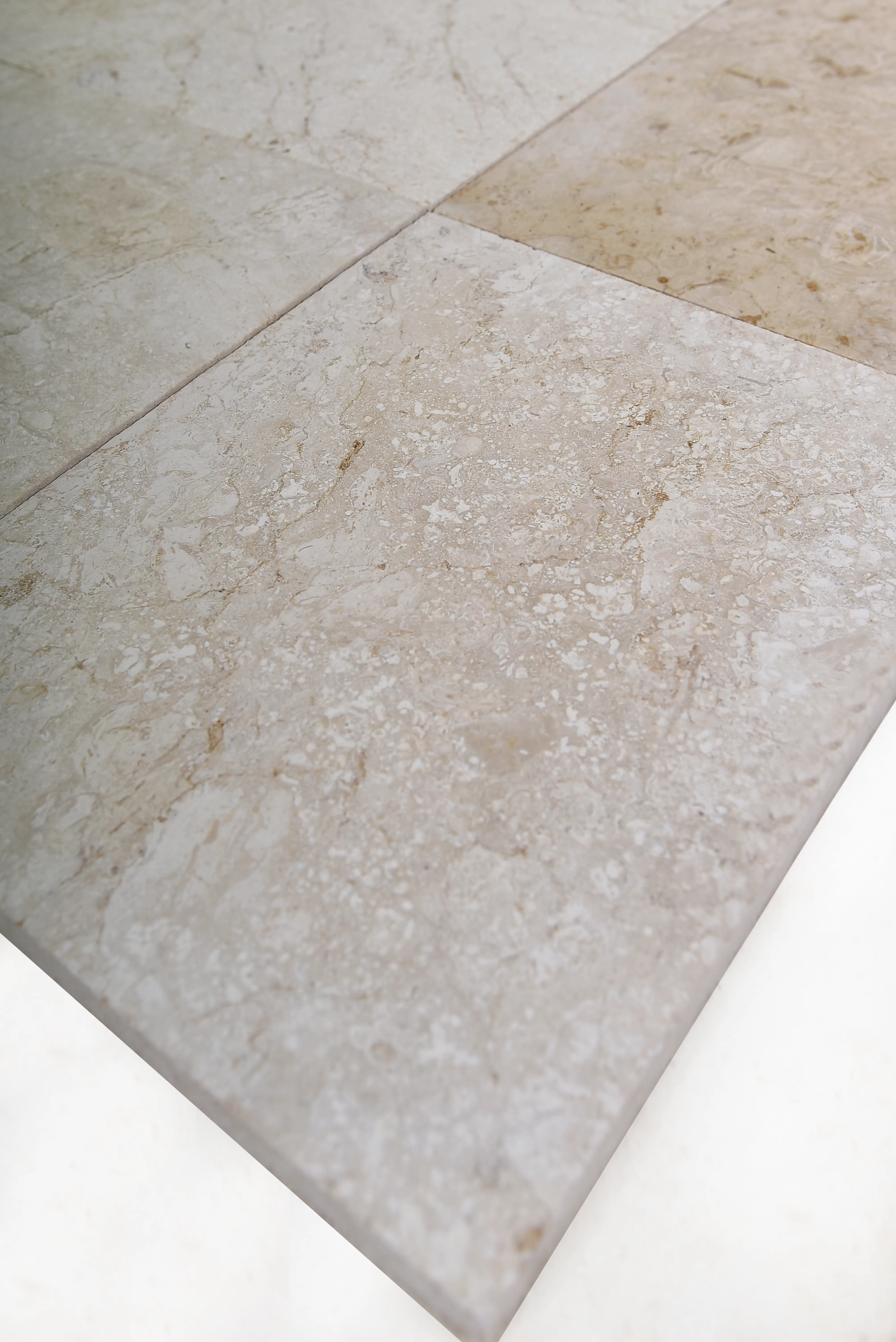
Granite’s crystalline texture — what most people loosely call veining — behaves differently from the linear veining in marble or the bedding planes in sedimentary stone. In granite, the mineral scatter is essentially random, which means it doesn’t have a directional grain you can align or oppose in a pattern. This is actually an advantage for large paving installations: you don’t need to worry about vein direction relative to laying direction, and you can rotate pavers freely without creating visual discontinuity.
The practical implication for your layout is that pattern work in granite is driven by joint geometry and format size, not by veining alignment. Ashlar patterns, running bond, and herringbone all read well in granite because the stone’s visual texture is consistent across orientations. Where you do need to pay attention is color graduation across the paver field — in naturally variable stones like red granite pavers, the quarry batch can drift slightly in tone from one pallet to the next. Dry-laying a section before final bedding, and drawing from multiple pallets simultaneously, keeps the color distribution even across the installation.
For projects where you’re specifying Granite Pavers across a mixed-format layout — say, a large-format field paver combined with a smaller border or sett detail — finish consistency across formats is something to specify explicitly. A honed field paver next to a flamed border sett in the same color family will read as two different stones in certain light conditions because of the finish-driven color shift described earlier.
Ordering, Sampling, and Batch Management
The granite paver color guide conversation doesn’t end at material selection — it extends into how you manage the ordering process to ensure what arrives on site matches what you approved at sample stage. Batch consistency is the variable that most often creates disappointment on delivery, and it’s entirely manageable with the right approach to specification and ordering.
Start with a spread sample — a minimum of eight to twelve pieces that represent the full variation range within the quarry batch, not a single best-face piece chosen to show the stone at its most attractive. Review that sample outdoors in natural light at different times of day. The spread sample tells you the range you’re committing to; a single piece only tells you the best-case scenario. Citadel Stone cuts granite pavers to order at our selected quarries, which means the material you specify goes into production for your project — batch drift between a sample order and a production run is a known industry issue, and it’s minimized when the stone is cut from the same face as the approved sample.
- Specify color range tolerance in your order documents — vague color description leaves interpretation to the producer
- For large projects, request a pre-production sample batch before full cutting commences
- Delivery scheduling and site access requirements should be confirmed well in advance — offloading arrangements for full pallet deliveries need adequate site access and a confirmed unloading plan
- Order a minimum of ten percent additional coverage beyond the measured area to allow for cuts, site waste, and future repairs from a matching batch
- Store delivered pavers under cover in a dry area until installation — long outdoor exposure before laying can cause surface bloom on certain granite types
Final Considerations for Your Granite Paver Color Guide
A well-specified granite paver color guide decision involves three interdependent choices — color family, finish type, and batch management — and the interaction between them determines the final result on site. Your color selection should be made from finished samples, not raw stone or catalog imagery, because the finish transforms the apparent tone in ways that raw material simply doesn’t show. The subgrade and soil conditions at your site are just as important as material quality: even the best stone performs poorly over a poorly prepared base, and understanding your soil type before you finalize base depth is a step that pays for itself in long-term stability.
For projects where granite is being specified across multiple areas of a property — driveways, pathways, and outdoor entertaining spaces — material and finish consistency across those areas is worth considering from the outset rather than as an afterthought. A coordinated specification across formats and applications creates a more resolved visual result and simplifies batch management. If your project includes a vehicular surface, granite driveway specification guidance covers the structural and load-bearing considerations that complement the color and finish decisions outlined here. Finish choice shifts perceived color outdoors, so reviewing Citadel Stone samples under natural light before ordering is a step worth taking.