

What the Comparison Really Hinges On
Bluestone alternatives don’t all fail the same way — and that’s the detail most comparison guides skip. Black basalt pavers and traditional bluestone both look compelling on paper, but their divergence shows up in freeze-thaw cycles, edge behavior under mechanical stress, and long-term surface stability in climates where the ground heaves seasonally. The real specification question for anyone evaluating bluestone alternatives isn’t which stone looks better; it’s which one holds its geometry after three winters of movement beneath it.
Basalt is an igneous stone — dense, low-absorption, and formed under conditions that eliminate the internal layering planes common in sedimentary bluestones. That structural difference matters enormously when you’re evaluating how a paver responds to subsurface frost pressure or the point loading from heavy furniture legs. Bluestone, depending on its source, can carry natural cleavage planes that amplify freeze-thaw stress in ways that don’t show up in the first season but become obvious by year four or five.
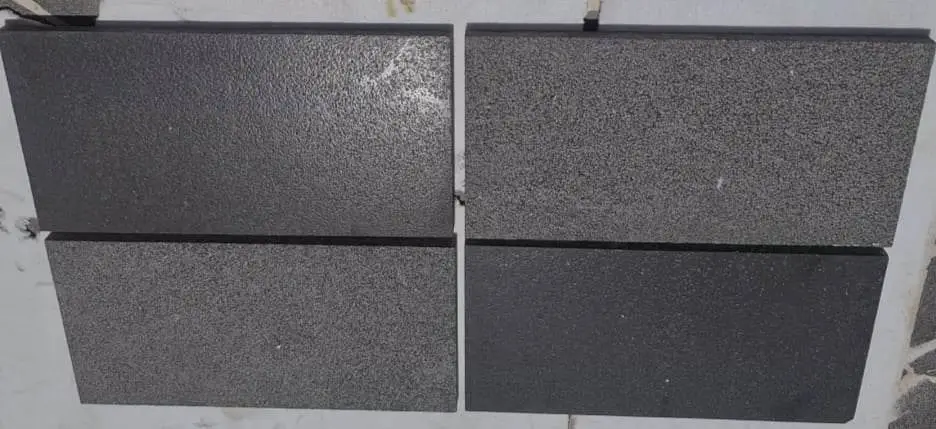
Basalt vs. Bluestone: A Structural Breakdown
The mineralogical gap between these two stones is wider than their similar gray palettes suggest. Basalt is a fine-grained volcanic rock composed primarily of plagioclase feldspar and pyroxene — minerals that interlock tightly during rapid cooling, leaving almost no pore pathways for water infiltration. Bluestone, which is a regional term applied to several sedimentary and some metamorphic stone types, varies considerably in density and internal structure depending on its quarry origin, as documented in bluestone geological classification and properties.
- Basalt absorption rates are typically very low, meaning minimal water enters the stone body under wet conditions — critical in freeze-thaw regions where absorbed moisture expands on freezing
- Bluestone absorption varies by source; some varieties absorb enough moisture to develop surface spalling over repeated freeze-thaw cycles
- Basalt’s interlocked crystalline structure resists surface delamination, while certain bluestones with pronounced bedding planes can flake along those planes under seasonal stress
- Honed basalt finishes maintain dimensional stability better than cleft-surface bluestone, which can develop irregular edges over time as weathering follows natural grain lines
Your choice among bluestone alternatives hinges partly on what “bluestone” actually means in your market. In some regions the label refers to a dense diabase or trap rock — genuinely comparable to basalt in performance. In others, it covers a softer sandstone that performs very differently. Confirm the mineralogy before you lock in a specification.
Cost of a Bluestone Patio vs. Basalt: Full Lifecycle View
The upfront bluestone pavers cost per square foot often runs moderately lower than premium black basalt, but that initial gap can invert across a 15–20 year horizon. Here’s where the math shifts: bluestone in freeze-thaw climates typically requires surface grinding or replacement of individual units by year eight to twelve in demanding installations, while dense basalt installations commonly reach the 15-year mark with only routine joint sand replenishment and occasional resealing.
- Bluestone patio cost per square foot at installation: varies by thickness, finish, and region — get current warehouse quotes for your project scope
- Basalt tends to carry a higher per-unit cost but lower maintenance expense over a decade of service
- Replacement labor — cutting out and resetting individual cracked pavers — can exceed the original material cost difference within two replacement cycles
- Joint sand loss is faster under bluestone installations where surface irregularity increases wind-driven water infiltration through joints
The lifecycle framing matters especially for commercial clients who need to amortize maintenance costs across a depreciation schedule. A material that holds its surface and geometry for 18–20 years without intervention carries real financial value beyond aesthetics. Request current pricing from the Citadel Stone warehouse for your square footage — delivered cost varies by region and current inventory position, so a quote with your postal code gives you the most accurate project number.
Does Bluestone Crack in Winter? What the Field Shows
This is one of the most searched questions in paver specification, and the honest answer is: it depends heavily on the specific stone type and the installation base. True dense trap-rock bluestone performs well in cold climates. Sandstone-based bluestone sold under the same regional label is a different story — and USGS sandstone and bluestone dimension stone classification data confirms the wide variance in physical properties across stones sold under the same trade name.
The cracking mechanism in freeze-thaw conditions follows a predictable sequence. Water enters micro-pores and bedding planes, freezes, expands approximately 9% by volume, and exerts tensile stress on the stone from within. Stones with higher absorption and pronounced internal structure are most vulnerable. Your base preparation amplifies or dampens this risk: a well-drained compacted aggregate base that prevents water pooling beneath the slab dramatically reduces the freeze-thaw stress reaching the stone.
- Thermal cycling below 28°F is the critical threshold — below this, absorbed water freezes and mechanical expansion begins
- Bluestone pavers in cold climates perform best in 1.5-inch or thicker gauges; thinner cuts have less mass to resist cracking forces
- Joint sand that washes out leaves unsupported edges — the most common crack initiation point in both bluestone and basalt installations
- Polymeric joint sand, properly set, reduces moisture infiltration beneath units and extends joint integrity through multiple freeze-thaw seasons
Basalt Pavers in Cold Climates: Performance Analysis
Basalt’s cold-climate track record is strong precisely because its near-zero absorption leaves almost no internal water to freeze. The stone’s dense crystalline structure has no bedding planes for water to exploit, and its modulus of rupture — the resistance to bending stress — makes it well-suited to installations where frost heave creates differential movement in the base. Specifying basalt pavers for cold climates carries a reasonable expectation of decades of service life, provided the base preparation is correctly executed.
The specification detail that matters most in freeze-thaw regions isn’t the stone — it’s the base drainage geometry. A 6-inch compacted aggregate base with a 2% cross-slope to a defined drainage outlet protects both basalt and bluestone pavers from the majority of freeze-thaw damage. Where that base fails or drains inadequately, even basalt will eventually experience joint failure and unit displacement, though surface cracking is far less likely. For detailed guidance on specifying basalt for cold-climate winters, our technical pages walk through base depth requirements for different frost penetration zones.
Black basalt pavers in the 2-inch nominal thickness range handle the point loads and seasonal base movement typical of residential and light commercial cold-climate installations. At Citadel Stone, we routinely advise specifiers to confirm their frost-line depth with local building departments before fixing base depth — frost penetration in northern climates can reach 36–48 inches in exceptional cases, requiring deeper aggregate courses than standard guides suggest.
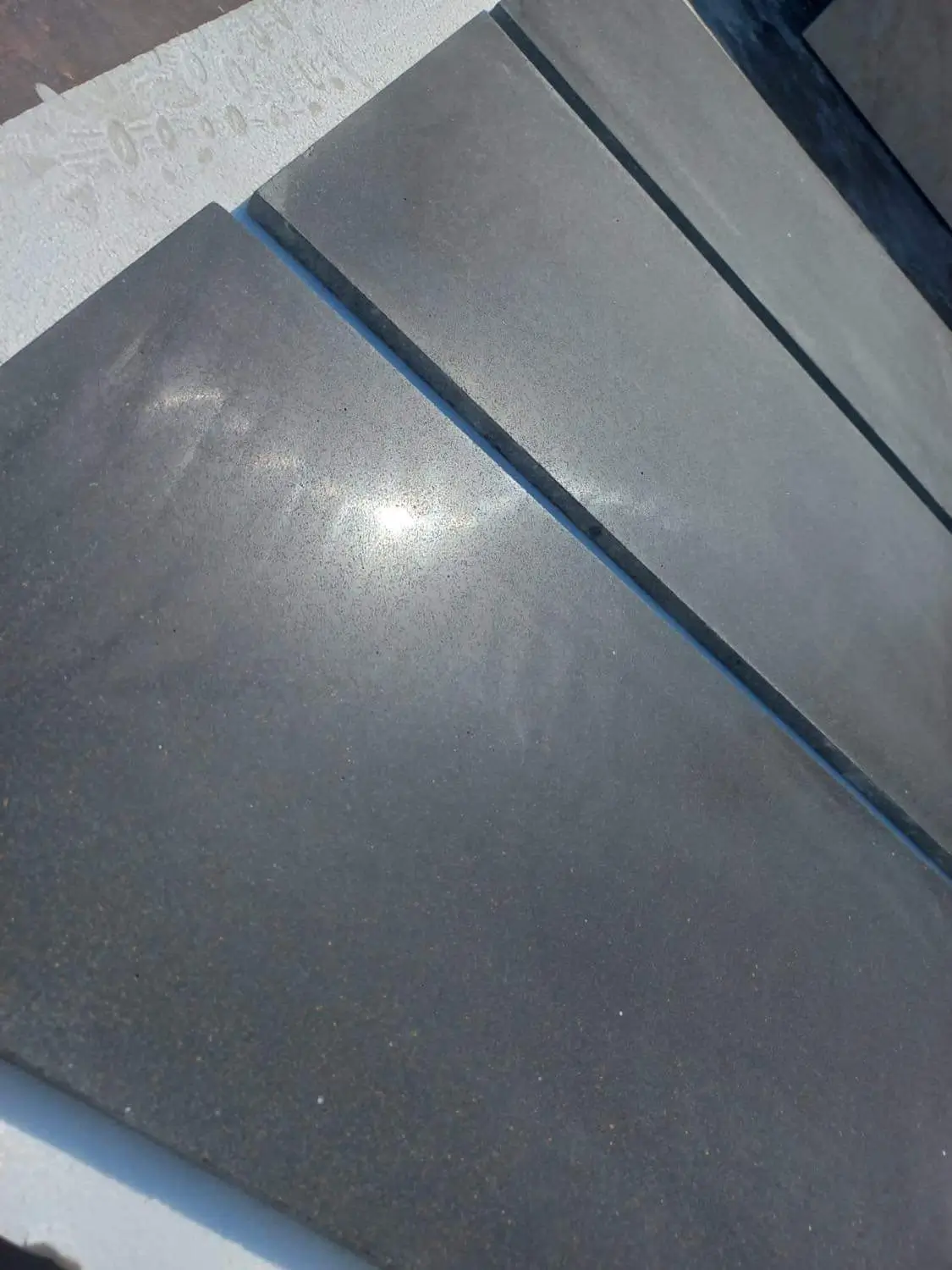
Storm, Wind, and Impact Resistance: Which Stone Holds
Severe weather puts installation quality under a kind of stress test that calm conditions never reveal. Wind-driven rain penetrates joints at much higher velocity than standard rainfall, carrying fine particles that gradually erode polymeric sand binders and widen joint gaps over repeated storm cycles. Once joint width exceeds roughly 3mm, you lose the interlocking friction that keeps units stable under the lateral forces generated by high-wind events.
Hail impact is a less-discussed but real concern in exposed patio installations. Basalt’s hardness gives it a meaningful advantage here — the stone’s surface resists pit formation from hail impact better than softer sedimentary bluestones. Field inspection after hail events on bluestone patios frequently reveals surface pitting and, in severe cases, edge chipping along cleft surfaces. Black basalt pavers show substantially less surface damage under equivalent hail conditions, a factor worth noting when specifying stone for an exposed rooftop terrace or uncovered pool deck.
- Edge restraints must be mechanically anchored into stable substrate — not just friction-set — in high-wind zones; wind-driven lateral force on an unrestrained field of pavers can walk the perimeter units progressively outward
- Joint integrity under wind-driven rain is best maintained with polymeric sand rated for joint widths matching your actual installation gaps — not a universal product applied to the wrong gap width
- Impact resistance of basalt makes it a technically stronger choice for exposed applications where hail or falling debris is a realistic risk
- The Natural Stone Institute igneous stone paving technical standards provide additional guidance on igneous stone performance characteristics relevant to exposed installations
Finish Options and Slip Considerations
Your finish selection determines the practical character of the installed surface far more than the base material choice between basalt and bluestone. Both stones are available in honed, flamed, bush-hammered, and natural cleft or sawn finishes — each producing a meaningfully different surface texture that affects both aesthetics and wet-surface behavior. The finish is the variable that matters for slip resistance, and the relevant evaluation standard for wet conditions is ANSI A326.3, which governs dynamic coefficient of friction testing in wet conditions.
- Flamed finishes on basalt produce a coarsened surface texture through thermal shock, making a popular choice for pool surrounds and wet-area applications
- Honed basalt has a smooth, matte surface that reads as elegant indoors but warrants careful finish selection for wet outdoor use — consult ANSI A326.3 and consider an anti-slip treatment for pool deck applications
- Cleft bluestone surfaces are naturally irregular, which typically delivers better wet-surface texture than polished alternatives, though performance varies by cleft depth
- Bush-hammered finishes on both stones create mechanically textured surfaces well-suited to step treads and ramp approaches in climates with regular rain or snow
The slip resistance topic requires that you assess specific finish samples against your intended application’s wet-use conditions. Never rely on marketing language — request ANSI A326.3 test data for any finish you’re specifying in a wet or transitional environment, or add a tested anti-slip treatment to the specification.
Sourcing, Lead Times, and Project Planning
One practical dimension of the basalt vs. bluestone decision that rarely appears in material guides is supply chain reliability. Domestic bluestone from established quarries carries relatively predictable lead times, but quality consistency across multiple orders can vary — particularly for large projects where matching color and cleft depth across several deliveries matters. Basalt sourced from our selected quarries across the Middle East and other regions delivers exceptional consistency batch to batch because igneous stone formation produces more uniform coloration and structure than sedimentary deposits.
Truck access constraints at the delivery site should factor into your paver thickness selection. Full crates of 2-inch basalt pavers are heavier per unit count than equivalent bluestone orders, and if your project site requires hand-carrying material from the street, that weight difference adds up across a large installation. Coordinate truck delivery timing with your installation crew to ensure the material moves efficiently from delivery to staging area without weather exposure delays.
- Confirm warehouse stock levels for your specific finish and thickness before issuing purchase orders — some basalt finishes have longer lead times than standard bluestone cuts
- Order a minimum 10% overage for both materials to account for cuts and any units damaged during delivery or installation
- For phased projects, lock in a batch from the same warehouse stock to ensure color consistency across installation phases — this matters more for bluestone than basalt, but applies to both
- Citadel Stone maintains warehouse inventory accessible nationally, which can reduce delivery lead times compared to direct-import timelines on custom orders
Parting Guidance: Choosing Among Bluestone Alternatives
Choosing between basalt and traditional bluestone alternatives comes down to your climate severity, your maintenance tolerance, and the finish character you want underfoot over the long term. In mild climates with minimal freeze-thaw cycling, quality bluestone performs reliably and delivers an aesthetic warmth that many designers prefer. In cold climates where the ground moves seasonally and storms arrive with real force, the structural profile of black basalt pavers — dense, low-absorption, hard-surfaced — gives your installation a meaningful mechanical advantage. Base preparation quality is non-negotiable for both: no stone performs well over an inadequately drained or compacted base, regardless of its mineralogy. As you plan your hardscape project, related stone selections can also enrich the overall design — our detailed overview of red travertine color and grain covers how warm-toned natural stone performs in complementary outdoor applications. Order a sample of each stone and judge them in your own hands, or request a free quote with your ZIP or postal code for delivered basalt pricing.
Related reading: river rock project showcase · river rock suppliers guide · river rock suppliers cost.