

The difference between a river rock project that looks polished for decades and one that fades into an eyesore within a few seasons often comes down to supplier quality — not installation skill. This river rock suppliers guide cuts through the noise by helping you evaluate what actually matters: stone grading consistency, sizing calibration, color stability under prolonged sun exposure, and the logistics chain that gets material to your site in usable condition. These factors separate commodity suppliers from partners worth building a long-term sourcing relationship with.
What to Look for in River Rock Suppliers
Your first evaluation should focus on grading standards. River rock sold without calibrated sizing creates immediate problems in the field — uneven coverage, unstable bedding in pathway applications, and visible gaps that look unfinished. A reputable supplier grades material to tight tolerances, typically within ±5mm of stated sizing, so your coverage calculations remain accurate from planning through installation.
Color consistency across batches is the second major factor. Natural stone varies quarry-to-quarry and extraction-layer-to-extraction-layer, which means your second delivery can look noticeably different from your first if the supplier isn’t sourcing from a controlled quarry face. Request samples from the actual production run — not showroom display pieces, which tend to be hand-selected.
- Grading certification: ask whether the supplier follows ASTM dimension stone guidelines for size consistency and material quality
- Batch documentation: reputable suppliers provide lot numbers that allow you to reorder from the same quarry run
- Moisture content on delivery: river rock shipped at high moisture adds dead weight and can affect apparent color until fully dried
- Washing standards: stone should arrive free of clay fines, which clog drainage layers and interfere with adhesive bonding in set installations
- Minimum order thresholds: confirm whether the supplier can fulfill both small residential top-up orders and large commercial volumes
River Rock Sizing and Application Matching
Sizing selection is where most buyers make their most consequential mistake. The wrong size for the application doesn’t just look wrong — it performs poorly under load, migrates in heavy rain, and creates drainage characteristics you didn’t plan for.
Here’s a practical breakdown of how size ranges map to applications:
- ¾-inch to 1-inch: best for tight-packed pathway fill, planter borders, and drainage trench backfill — the interlocking geometry reduces migration
- 1-inch to 2-inch: the workhorse size for dry creek beds, decorative mulch replacement, and foundation perimeter drainage
- 2-inch to 3-inch: suitable for accent features, water feature surrounds, and erosion control on gentle slopes
- 3-inch to 5-inch: large-feature river rock for focal point installations, boulder-effect dry stream beds, and retaining base layers
- Mixed river rock blends: use with caution — the aesthetic appeal of mixed sizing often conflicts with practical drainage and stability requirements
Your drainage layer specification should drive size selection more than aesthetics in functional installations. A decorative bed that also serves as a French drain channel needs the 1½-inch to 2-inch range for adequate void space — going smaller defeats the drainage purpose entirely.
White River Rock: Selection and Long-Term Performance
White river rock is among the most UV-sensitive natural stone products in the landscape palette — and that’s worth addressing directly before specifying it. The high silica and calcium carbonate mineral content that produces the crisp white appearance also makes the stone reactive to surface oxidation and UV-driven patina development over time. In sun-exposed installations, you can expect a shift from bright white toward a warmer, slightly yellowed tone within two to three seasons without protective intervention.
That shift isn’t a defect — it’s a natural mineral response to UV exposure. According to NSI natural stone variety specifications, porous stone surfaces exposed to UV radiation and atmospheric moisture undergo gradual surface chemistry changes that affect color rendering. The practical implication is that your sealing schedule needs to account for UV protection, not just moisture resistance.
For white river rock in full-sun applications, a penetrating silane-siloxane sealer applied within 30 days of installation and refreshed on a biennial cycle maintains color fidelity more effectively than surface sealers. Surface sealers trap oxidation products under the coating and can actually accelerate yellowing by blocking the UV-reflective surface.
- Specify white river rock with a verified mineral brightness rating of 85+ for projects where sustained white appearance matters
- Avoid iron-bearing stone in white river rock blends — iron oxidation produces rust staining that no sealing schedule prevents
- In high-UV installations, the first sealer application is the most critical — apply to clean, dry stone at temperatures between 50°F and 85°F
- Annual inspection of sealer integrity in south-facing exposures is more important than a fixed annual reapplication schedule
Tan River Rock: Durability and Finish Considerations
Tan river rock performs differently under UV than white varieties, and that difference works in your favor for many applications. The iron and mineral compounds that produce tan, buff, and warm ochre tones are more photostable than the calcium-dominant minerals in white stone. Color drift under UV exposure is typically slower and results in a warmer deepening of tone rather than the yellowing shift seen in white river rock.
The practical advantage is that tan river rock requires a less aggressive sealing schedule. For decorative dry applications — mulch replacement, planter infill, accent borders — an initial penetrating sealer followed by reapplication every three to four years is typically adequate to maintain surface integrity without significant color shift. The USGS dimension stone production data documents how silicate and iron-bearing sedimentary stones in the tan-to-buff color range demonstrate superior weathering stability compared to high-calcium white varieties in field exposure conditions.
Your finish selection also affects UV performance in tan river rock. Tumbled or naturally rounded stone with no applied finish weathers most predictably. Honed tan river rock used in set applications — mortared path edging or water feature surrounds — benefits from a UV-stable sealer more than loose-laid decorative applications because the honed surface exposes more mineral surface area to direct UV and oxidative weathering.
Evaluating Supplier Logistics and Delivery Reliability
Stone quality at the quarry and stone quality at your project site are two different conversations. What happens between those two points — washing, grading, warehouse staging, palletizing, and truck delivery — determines whether your order arrives in usable condition.
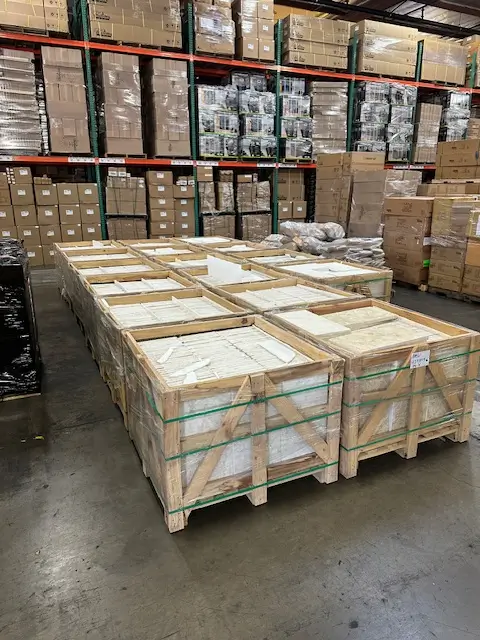
Confirm whether the supplier maintains domestic warehouse inventory or operates purely as an import-on-demand model. Warehouse stock means faster lead times — typically 5 to 10 business days — while import-cycle suppliers can run 6 to 10 weeks from order to delivery. For phased projects, that lead time difference is a scheduling risk you need to account for early in your planning.
- Ask whether the supplier’s warehouse location affects freight cost to your delivery address — regional proximity matters for bulk tonnage
- Verify pallet weight and configuration before your truck delivery — river rock on standard 2,200 lb pallets is manageable with a standard liftgate, but some suppliers ship 3,000+ lb pallets that require a forklift on site
- Confirm whether the truck delivers to curb, driveway edge, or can be directed to a staging area — driver instructions matter when the crew isn’t on site at time of delivery
- Request delivery confirmation photos from the supplier’s warehouse team before the truck leaves — it’s faster to catch a packing error before transit than after
- For large commercial volumes, ask about split-delivery scheduling to keep site logistics manageable
Citadel Stone maintains national warehouse inventory with consistent stock rotation, which means lead times stay predictable even during high-demand seasons when import-dependent suppliers experience allocation delays.
Sourcing Quality River Rock for Lasting Installations
The quarry origin of your river rock matters more than most buyers realize. Stone sourced from river-worn deposits in active water courses has a fundamentally different surface structure than manufactured round rock — the water abrasion process creates a dense, micro-smooth surface that resists staining and supports UV-reflective properties that contribute to better long-term color retention. Manufactured round stone, produced by tumbling angular quarry material, lacks that natural surface density and typically shows UV-driven surface changes more rapidly.
For high-visibility projects where appearance retention is a specification requirement, ask your supplier to document quarry origin. Quality suppliers can trace material to specific extraction regions. For projects where you’re specifying river rock alongside complementary stone materials, explore our natural stone selection to understand how different stone families can be paired for cohesive, durable installations.
When evaluating suppliers at the specification stage, the Natural Stone Institute provides technical guidelines that help you frame the right questions. According to NSI stone variety technical guidance, documented quarry provenance and grading consistency are among the strongest indicators of long-term material performance — claims that can’t be substantiated by the supplier are worth treating with skepticism regardless of price.

Calculating Coverage and Ordering Correctly
Coverage calculation errors are the single most common ordering mistake in river rock projects, and they almost always run in the same direction — underordering. The instinct to estimate light and top up later creates real problems: the top-up order often comes from a different production batch, the color match is imperfect, and a second delivery doubles your freight cost on a relatively small quantity.
Here’s the field-proven calculation approach for loose river rock applications:
- Measure your coverage area in square feet
- Determine your desired depth in inches — 2 inches for decorative applications, 3 to 4 inches for drainage and erosion control
- Use this formula: (square footage × depth in inches) ÷ 324 = cubic yards required
- Add 10% to account for compaction, irregular area edges, and minor waste — this is your order quantity
- For tonnage conversion: one cubic yard of river rock typically weighs 1.3 to 1.5 tons depending on stone density — confirm the supplier’s specific material weight before converting
Your project’s truck access constraints affect how this material can be staged. If your site doesn’t allow a direct delivery truck approach to the installation area, factor in secondary handling — moving river rock by wheelbarrow adds significant labor time and can affect your project schedule.
Common River Rock Installation Mistakes to Avoid
The most expensive river rock installation mistake isn’t material failure — it’s base preparation failure. River rock laid directly on soil without a compacted aggregate base or geotextile separation layer migrates over time as the stone sinks into the substrate. You end up with bare patches, uneven coverage, and a material condition that’s difficult to correct without full removal.
- Skip the weed barrier fabric under dry-laid river rock only if your drainage performance is the priority — barrier fabric reduces drainage void space by up to 30% in heavy rain events
- Compact a 4-inch aggregate base layer before placing river rock in pathway applications — compaction prevents the settlement that creates rocking stones and uneven walking surfaces
- Account for edge restraint in pathway and border applications — river rock without physical edging migrates laterally, widening over time and thinning the intended coverage depth
- In water feature applications, confirm the stone is clean of clay and fine particles before placement — fines cloud water and clog pump filters within days of filling
- Avoid mixing river rock sizes in the same functional layer — the smaller material fills the voids between larger pieces, collapsing drainage performance and creating a semi-compacted mass that’s difficult to maintain
At Citadel Stone, we’ve seen projects where material quality was excellent but base preparation was skipped to save time — the result was a warranty conversation six months later that cost more to remediate than the base prep would have. The stone isn’t the variable; the substrate is.
Parting Guidance
Choosing the right river rock comes down to a combination of material specification, supplier verification, and installation discipline — and this river rock suppliers guide has covered the framework for evaluating all three. The details that matter most are grading consistency, quarry provenance, and a logistics chain you can rely on for phased projects. UV exposure and sealing protocols are not afterthoughts — they’re the difference between a 5-year installation and a 20-year one for exposed applications.
Your supplier’s warehouse depth and truck delivery reliability deserve as much scrutiny as stone quality. A premium product that arrives late, on the wrong pallet configuration, or in mixed batches creates site problems that undermine otherwise well-specified projects. As you review complementary stone applications that pair well with river rock installations, the real yard results and project examples provide practical context for how these materials perform across a range of conditions. Sourced direct from quarries in Turkey, the Mediterranean, and beyond, our river rock ships in calibrated batches for consistent coverage.
Related reading: choosing river rock suppliers · river rock suppliers · how to install river rock.