The specification decisions you make before a single paver is set determine whether your white travertine installation looks pristine for decades or begins showing joint failure and surface inconsistency within a few seasons. Choosing white travertine pavers isn’t just about picking the lightest tone in the sample rack — it requires you to match finish type, fill condition, and sealing protocol to your specific loading and environmental conditions. What most project planners underestimate is how dramatically the surface finish alters both the aesthetic outcome and the maintenance burden over time, and that gap between expectation and reality is where most specification errors originate.
Understanding Tone Variation in White Travertine
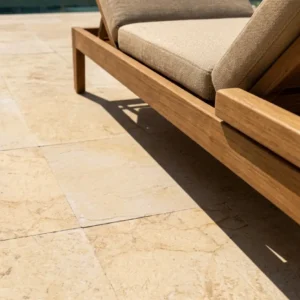
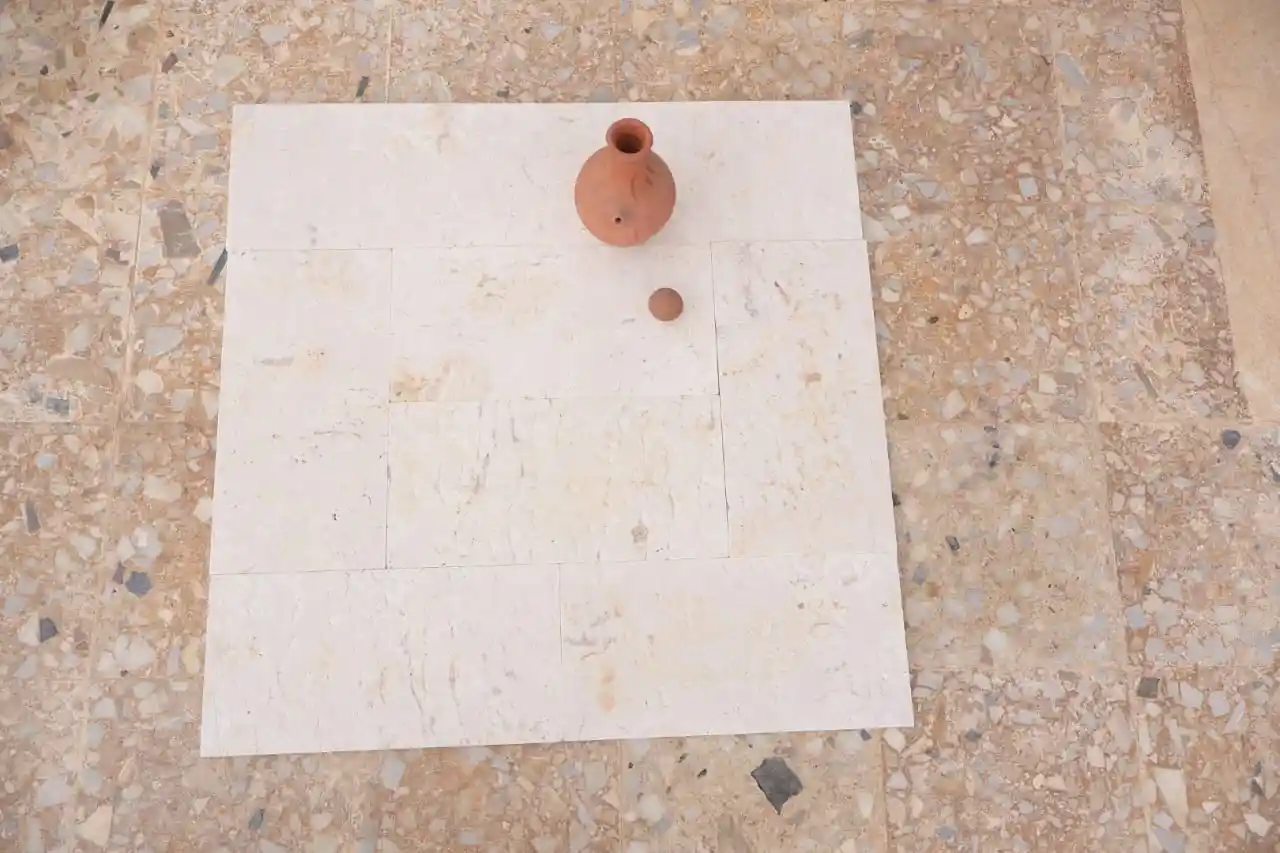
White travertine isn’t a single colour — it’s a family of tones that ranges from warm cream-white with gold veining through to the cooler, almost silver-white that quarries from Middle East sources consistently produce. Your finish selection interacts directly with that base tone, and the two combine to determine how the installed surface reads in direct sun versus shade. A honed finish on a warm-toned white will read noticeably more ivory than a brushed finish on a silver-white blank from the same nominal colour category.
The pore structure in white travertine is coarser than in ivory or walnut variants, which means the voids are more visually prominent when left unfilled. In filled pavers, the grout compound used to close those voids tends to read slightly lighter or slightly darker depending on the compound mix — this matters when you’re specifying for a large continuous deck where tonal consistency is critical. Request samples from the specific warehouse batch you’ll be receiving, not just from a display board, because tone varies between quarry runs even within the same grade designation. This is especially relevant when choosing white travertine pavers in the snow stone colour range, where even subtle batch variation is immediately visible against a uniformly pale field.
Finish Types and Their Performance Implications
The finish you specify for white travertine pavers does more than affect appearance — it directly determines slip resistance, maintenance frequency, and surface temperature under direct sun. Each finish carries a distinct performance profile, and choosing white travertine pavers with the wrong finish for your application is a common source of callback complaints.
- Honed finish: Smooth, matte surface with a light sheen. Absorbs staining agents more readily than polished and requires resealing on a 12–18 month cycle in high-use outdoor environments. Provides consistent tonal uniformity across the slab face.
- Brushed or antique finish: Surface texture opens the stone slightly, leaving a low-sheen, lightly textured face. Best performer for pool surrounds and barefoot zones. According to Natural Stone Institute travertine properties and outdoor suitability, the open surface structure of travertine also moderates heat absorption — relevant when pavers receive extended direct sun exposure.
- Tumbled finish: The most textured option. Edges are softened and corners rounded during tumbling. Excellent slip resistance but grout joints are harder to keep clean because texture traps debris. Ideal for rustic or informal applications.
- Polished finish: Reserved for interior or covered outdoor applications. Polished white travertine reads as highly reflective and visually elegant, but it becomes extremely slippery when wet and is inappropriate for exposed outdoor use.
- Sandblasted finish: A less common but effective option for heavily trafficked zones. Consistent texture across the face, good drainage performance, and retains the bright white tone without the smoothness of a honed surface.
Your application context should drive finish selection before you even look at tone samples. Pool decks and wet zones should default to brushed or tumbled. Dry pedestrian walkways and covered terraces can accommodate honed. Interior or sheltered outdoor dining areas are where polished has a place.
Filled vs Unfilled Travertine: What Field Experience Tells You
The filled-versus-unfilled decision is one of the most misunderstood specification choices in white travertine paver selection. Filled pavers have their natural voids grouted at the factory — this creates a smoother surface, reduces debris accumulation, and makes the slab easier to clean. Unfilled pavers retain their natural void pattern, which gives a more characterful, textured appearance but requires more careful joint design and sealing.
For outdoor applications, filled white travertine pavers perform more predictably in maintenance terms. The voids in unfilled material can collect organic matter — especially in shaded zones — which accelerates biological staining. In high-traffic commercial applications, the exposed voids in unfilled product can chip at the edges under point loading, particularly in thinner nominal gauges. That said, unfilled travertine in a tumbled finish is genuinely beautiful and appropriate for lower-traffic residential garden paths where natural character is the design priority.
One detail worth knowing: factory fill compounds vary in quality between suppliers. Some use a Portland-based grout that holds well and matches the stone tone accurately; others use an inferior compound that can shrink and pull away from the void edges within 18–24 months of outdoor exposure. Ask your supplier to specify the fill compound type — this isn’t a question most buyers think to ask, but it separates a durable installation from an early maintenance problem. For the most comprehensive look at this specific decision point, Snow White Travertine Pavers provides detailed comparison data on filled and unfilled options across the full tone spectrum.
Sizing, Thickness, and Structural Loading
White travertine paver selection requires you to align slab dimensions with your base specification and expected load profile. Standard formats run from 12×12 inches through to 24×24 inches and beyond in large-format options, with thicknesses typically ranging from ¾ inch (nominal tile grade) through 1¼ inch and 2 inch (structural paver grade).
For pedestrian-only applications with a well-compacted aggregate base, 1¼ inch thickness in white travertine handles typical residential foot traffic without risk of flexural failure. Move to 2 inch nominal the moment you introduce wheeled loads — outdoor furniture dollies, service carts, or light vehicle access. The flexural strength of white travertine typically falls in the range of 1,200–1,800 PSI depending on the specific quarry run; ASTM C1527 travertine dimension stone specifications provides the testing methodology that allows you to verify these values from supplier test certificates before committing to a specification.
- 12×12 inch format: Best for irregular or pattern-mixed layouts. Easier to cut around curves and obstacles. Lower wastage on complex geometry.
- 16×16 or 18×18 inch format: The most versatile for large outdoor decks. Minimises joint lines while remaining manageable for single-person installation.
- 24×24 inch format: Creates a clean, expansive look on open pool decks and terraces. Requires a flatter base — any base variation over ¼ inch per running foot causes rocking and cracking at joints under foot traffic.
- Mixed-format patterns (e.g., 16×24 combined with 8×16): Popular in European-influenced designs. More complex to lay but visually dynamic. Requires precise cutting and significantly more planning time.
The white travertine paver selection process should include confirming that the paver gauge (actual measured thickness, not nominal) is consistent across the batch. Gauge variation above ⅛ inch between slabs makes achieving a level surface extremely difficult and increases adhesive consumption substantially.
Thermal Cycling, Joint Design, and Long-Term Performance
This is the section most specification guides skip over, and it’s where installations fail in the field. White travertine has a thermal expansion coefficient of approximately 4.5–5.0 × 10⁻⁶ per °F, which means a 24-inch paver undergoes measurable dimensional change across a 60°F day-to-night temperature swing — roughly 0.006 to 0.007 inches of movement per slab. That sounds small, but across a 400 square foot deck with tight joints, cumulative thermal stress builds at perimeter edges and fixed boundary conditions until something gives.
In environments with significant temperature cycling — morning frost followed by afternoon heat in shoulder seasons, or overnight drops of 30–40°F in arid climates — joint design becomes a structural calculation, not just an aesthetic choice. Minimum joint width of ⅜ inch is appropriate for most travertine paver applications, but in freeze-thaw regions, ½ inch joints filled with a flexible polymeric sand or a modified grout allow the thermal movement to dissipate without cracking. Standard cement grout in tight joints fails within two to three freeze-thaw cycles in cold climates — a failure pattern that’s almost always preventable at specification stage.
Expansion joints at fixed boundaries — walls, columns, and pool beam edges — must be specified at every 10–12 linear feet in thermally active zones, and those joints must be filled with a compressible backer rod and UV-stable sealant, not grout. This detail is consistently omitted from residential project specifications but shows up as a warranty claim within 18 months in locations where seasonal temperature swings exceed 50°F. The USGS data on limestone and travertine natural mineral formation confirms the calcium carbonate crystal structure that makes travertine beautiful also makes it moderately sensitive to freeze-thaw cycling — something your joint detail needs to accommodate from day one.
Sealing Protocols for White Travertine Pavers
White travertine’s porosity typically falls between 3% and 8% depending on the source and finish — measurably higher than granite and comparable to soft limestone. For outdoor applications, that porosity means the stone will absorb water, oils, tannins from leaves, and organic compounds from pool chemicals if left unsealed. On snow stone and other bright white travertine varieties specifically, staining is more visible than on ivory or walnut variants because the base tone provides no camouflage for discolouration.
Your sealing specification should start before installation: the back face and edges of each paver benefit from a back-seal coat of penetrating impregnator before bedding, particularly in wet applications. After installation and grouting, allow the grout to cure fully — minimum 28 days for cement-based grout — before applying the surface seal. Applying sealer over partially cured grout traps moisture and promotes efflorescence, which reads as a white chalky haze on the surface and is notoriously difficult to remove from an already-light stone.
- Penetrating impregnators (silane/siloxane based): Recommended for outdoor white travertine paver selection in all applications. Highly resistant to water and oil penetration without changing surface sheen. Reapply every 18–24 months for outdoor exposed surfaces.
- Topical sealers (acrylic or polyurethane): Not recommended for outdoor white travertine. These form a film on the surface that peels under UV exposure and thermal cycling, trapping moisture beneath and accelerating surface flaking.
- Colour-enhancing impregnators: Deepen the tone slightly and add a subtle wet-look appearance. Some specifiers use these to enrich the stone’s natural veining on white travertine — appropriate for sheltered terraces but may make the surface read slightly less bright in direct sun.
Base Preparation and Bedding Method
Base preparation quality determines approximately 70% of the long-term performance of white travertine paver installations — the material itself does the other 30%. This ratio holds regardless of stone quality, and it’s a truth that field experience reinforces consistently.
For standard residential pedestrian applications, a minimum 4-inch compacted aggregate base (¾ inch crushed stone compacted to 95% Proctor density) followed by a 1-inch screeded sand layer provides a stable bed. In areas with expansive clay soils or high organic content, increase aggregate depth to 6 inches and consider a geotextile separation layer between the sub-base and aggregate. Any sub-base movement telegraphs directly to the stone above — travertine’s moderate flexural strength doesn’t tolerate differential settlement as well as a thicker, denser material like granite cobble.
The debate between mortar-set and sand-set installation for white travertine pavers comes down to application context. Sand-set allows individual paver removal for base repairs — a practical advantage in large-format installations where isolated subsidence is possible. Mortar-set provides better resistance to lateral movement and is the correct choice for pool surrounds and elevated terraces where waterproofing continuity matters. For mortar-set applications, use a polymer-modified thinset or medium-bed mortar rather than standard Portland mortar — the polymer additives provide the flexibility that calcium carbonate stones need to accommodate thermal movement without debonding.
Ordering, Logistics, and Project Planning
White travertine paver selection extends into your procurement and logistics planning — two areas where projects lose time and money through avoidable errors. The first thing to confirm when sourcing white travertine is warehouse stock availability in your required quantity. If the warehouse holds the volume you need from a single production batch, you avoid the tonal inconsistency that occurs when multiple quarry runs are mixed across a project.
Calculate your order quantity by adding 10–12% to your net measured area for cutting waste and breakage on standard rectangular formats. For mixed-format or irregular pattern work, increase the overage to 15%. Ordering short and topping up from a second delivery batch risks receiving product from a different quarry run with a subtly different tone — a difference that becomes very apparent once both are installed side by side in direct sun. Citadel Stone maintains warehouse inventory across its national supply network, which allows you to confirm full-batch availability before committing to a project timeline and avoids the 6–8 week import delays that catching a stock gap mid-project creates.
Truck delivery logistics are worth addressing early in project planning. Large-format white travertine pavers on pallets require clear truck access to the installation site — standard delivery trucks need a minimum 12-foot clear width and a firm, level surface for pallet drop. If your project site restricts truck access, confirm whether your supplier can arrange smaller delivery vehicles or crane-off options before you sign off on the order. A delivery that can’t reach the installation point adds significant double-handling cost and risk of breakage to your project budget.
Getting Your White Travertine Paver Specification Right
Choosing white travertine pavers rewards specifiers who think through the complete decision chain — tone, finish, fill condition, thickness, joint design, sealing protocol, and base specification — rather than treating any single factor in isolation. The material’s visual impact is genuinely exceptional when specified correctly, but that result depends on matching every element of the system to your application’s loading, drainage, and thermal environment.
Finish selection is the first decision that locks in all others: it determines slip performance, maintenance frequency, and how the tone reads across different lighting conditions. Joint design and expansion accommodation are the most commonly underspecified elements and the most common source of early installation failure, particularly in climates where temperature cycling between seasons or between day and night creates cumulative stress on rigid joint materials. Your base preparation quality sets the ceiling on how well the surface performs regardless of material quality — and that ceiling is non-negotiable.
As you plan your broader hardscape specification, tile format and sizing decisions often intersect with paver layout planning in ways that affect total material waste and installation efficiency. travertine tile sizing and format guidance covers how format dimensions affect layout planning for natural stone projects. Buyers working through Citadel Stone can compare filled and unfilled travertine finishes side by side to match the surface brightness their project requires.