What Pool Chemistry Does to Limestone Pavers
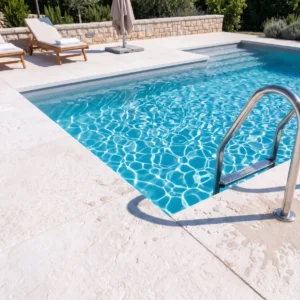
Chlorine drift, pH fluctuations, and splash-out don’t just wet limestone pavers around pool areas — they actively work on the stone’s calcium carbonate matrix over time. You’ll notice it first as a subtle surface dulling, then as micro-pitting if the chemistry swings acidic consistently. The critical threshold most pool owners miss is pH dropping below 7.2 for extended periods; at that point, the mild acid actively dissolves the binder that holds the stone’s crystalline structure together. Keeping your pool water balanced isn’t just a swimmer comfort issue — it’s a direct limestone preservation strategy.
Routine Cleaning That Actually Works
Your cleaning schedule should run on a two-tier rhythm: a light rinse-and-sweep weekly, and a proper wash-down with a pH-neutral stone cleaner every four to six weeks. Dish soap and general-purpose household cleaners are off the table — most are alkaline enough to strip sealer and acidic enough in their surfactant chemistry to etch polished or honed finishes. For limestone pavers around pool areas specifically, a cleaner formulated for calcium-based stone at a pH of 7 to 8 is the right call every time. Rinse thoroughly after cleaning; residue left on a hot surface in direct sun can leave tide marks that bond surprisingly hard to the stone.
For organic staining — algae, tannins from nearby vegetation, bird droppings — an oxygen-based cleaner applied with a dwell time of eight to twelve minutes before a stiff-bristle scrub handles most cases without damaging the surface. Avoid wire brushes entirely. A natural fiber or nylon brush protects the finish while still giving you the mechanical action you need. According to NSI limestone care data, improper cleaning products are among the leading causes of premature surface degradation on natural limestone in outdoor pool environments.
Sealing Limestone Pavers Around Pool Zones
The sealer you choose changes everything about long-term maintenance. Penetrating impregnating sealers are the right specification for pool decks — they don’t sit on the surface as a film, so they won’t peel, bubble, or create slip hazards when the stone gets wet. Film-forming topcoat sealers may look appealing in a showroom, but in a pool environment where thermal cycling and constant moisture are facts of life, they delaminate and trap moisture beneath the surface, which causes spalling from underneath. That’s the kind of damage that costs far more to repair than the sealer saved.
Reapplication frequency depends on traffic and UV exposure intensity. In high-use residential pool areas, plan on resealing every 18 to 24 months. A simple water-bead test tells you when the time has come: pour a small amount of water on the stone’s surface — if it absorbs in under 30 seconds rather than beading, the sealer has exhausted its effectiveness. At that point, you’re working with an unsealed surface, and every splash of pool water is depositing calcium and chlorine directly into open pores.
Limestone vs Travertine Pavers for Pool Decks
The limestone vs travertine pavers debate comes up constantly in pool deck specifications, and the answer isn’t as simple as one being better. Travertine’s characteristic voids require filling prior to installation, and those fills need periodic maintenance — unfilled or poorly filled voids collect debris and moisture, which creates localized deterioration in freeze-thaw regions. Limestone in dense, low-porosity grades tends to be more dimensionally stable over time, but requires diligent sealing because its absorption rate, while lower than travertine, is still significant enough to stain without protection.
Both materials benefit from the same cleaning discipline, but travertine’s filled voids need a gentler cleaning approach — high-pressure washing can blast filler out and create new entry points for water. Your choice between limestone vs travertine pavers should factor in your climate conditions, your willingness to maintain filler integrity, and the finish you prefer. USGS limestone composition data provides useful baseline context on the mineral structure of both calcium carbonate stone types, which explains why they respond similarly to acid-based cleaners.
Dealing with Efflorescence and Mineral Deposits
Efflorescence — those white, powdery deposits that appear on stone surfaces — is calcium salt migrating from within the stone or the substrate, drawn to the surface by moisture movement. Around pool areas, you’ll also deal with calcium carbonate scale from splash-out and hard water evaporation, which looks similar but behaves differently. Efflorescence brushes away and typically reduces after the first one to two seasons as residual salts work their way out. Scale deposits need a poultice or a diluted solution of white vinegar applied carefully — but test any acid-based treatment on an inconspicuous area first, because even mild acidity can etch the surface of softer limestone grades.
- Dry-brush efflorescence first before applying any liquid treatment — wetting it can push salts further into the pores
- Calcium scale from pool splash-out responds to a food-grade citric acid solution at 5% concentration, applied briefly and rinsed thoroughly
- Never use muriatic acid on limestone — the reaction is fast, permanent, and typically catastrophic for the surface finish
- Repeat efflorescence after two full seasons often signals a drainage or substrate moisture problem that needs investigation, not just surface treatment
Pavers with Pebbles and Mixed-Material Pool Surrounds
Combining pavers with pebbles in a pool surround design is a popular aesthetic choice, but it introduces a cleaning challenge worth understanding before you commit to the layout. Pebble inlays or aggregate borders trap organic debris — leaves, insects, algae — more effectively than flat paver fields, and the irregular surface geometry makes mechanical cleaning less efficient. Your maintenance protocol needs to account for this: a leaf blower on low setting followed by a targeted rinse works better than broad sweeping, which just redistributes debris into the gaps.
From a chemistry standpoint, pavers with pebbles in aggregate border zones also retain moisture longer after rain or splash-out, which creates localized conditions that promote algae growth. Treating those zones with a diluted stone-safe algaecide two to three times per season keeps growth from establishing. Make sure the algaecide you select is pH-neutral and explicitly rated safe for natural stone — pool algaecides formulated for concrete or tile can have surfactant chemistries that damage limestone sealers.
Surface Finish and Slip Resistance in Wet Zones
Finish selection is a safety decision as much as an aesthetic one. Honed limestone offers a smooth but non-reflective surface and less underfoot texture than a tumbled or brushed finish; verify any wet-area selection against the ANSI A326.3 wet DCOF threshold (0.42). Tumbled or brushed finishes perform even better in wet conditions, registering COF values above 0.70 in most tested samples — that’s the kind of margin that matters when barefoot traffic exits a pool and steps onto hot stone. Polished finishes, while visually striking, drop below acceptable wet-slip thresholds and are genuinely hazardous in an uncontrolled pool surround environment. According to ASTM stone slip resistance standards, wet COF testing should be part of your specification review for any natural stone installed in splash zones or pool deck applications.
- Honed finish: acceptable wet COF, easy to clean, moderate stain resistance with sealing
- Tumbled finish: highest wet COF, texture traps more organic debris but offers excellent traction
- Brushed finish: good mid-range traction, visually attractive, compatible with most sealer types
- Polished finish: avoid entirely in pool deck contexts — wet traction is insufficient for safe use
Budgeting for Maintenance Across the Project Lifecycle
Maintenance costs for limestone pavers around pool installations aren’t uniform — site-specific conditions affect both material costs and labor rates significantly. In markets where natural stone installation is common and the trade is competitive, professional cleaning and resealing services run between $1.50 and $2.50 per square foot. In regions where stone contractors are less concentrated, that same service can run $3.50 to $5.00 per square foot, simply because fewer qualified contractors are bidding the work. That variance compounds over the 20-year service life of a well-maintained stone deck — it’s worth calculating the lifetime maintenance cost, not just the installation price, when you’re evaluating material options.
Sourcing your sealer and cleaning products through the right channels also affects your ongoing budget. Products available through specialty stone distributors are almost always better formulated than box-store alternatives — and the price differential per application is small compared to the cost of remedying a sealer failure on several hundred square feet of pool deck. Freight distance matters at the installation stage too: if you’re sourcing from a warehouse that requires significant haul distance to your site, your per-unit stone cost will reflect that logistics overhead. Factor it into your total project cost early rather than absorbing it as a surprise line item at delivery. Truck access to your property also shapes delivery scheduling — confirm clearance heights and driveway load ratings before your order ships.
For ongoing technical reference on sealer selection and application intervals specific to your installation, Citadel Stone stone care guidance provides product-specific recommendations that align with real-world pool deck performance requirements.
Old World Pavers and Aged-Finish Pool Surrounds
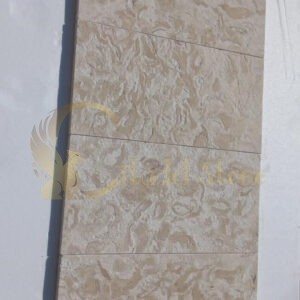
Old world pavers — tumbled, chiseled-edge, or antiqued-finish limestone — bring a distinctive aesthetic to pool surrounds, but their irregular surfaces require a slightly different cleaning approach than flat-cut contemporary formats. The textured surface traps more particulate and requires a stiffer brush and more deliberate scrubbing to clear debris from textured zones. The good news is that the aged finish is highly forgiving of minor staining and wear — surface variation is the point of the aesthetic, and minor weathering often enhances rather than detracts from the look over time.
- Grout joints in old world pavers installations tend to be wider — clean them with a narrow grout brush rather than a broad stone brush
- Chiseled edges can chip under high-pressure washing; keep your nozzle distance at 18 inches or more from the surface
- Re-sand joints annually in high-traffic pool areas — sand loss from foot traffic and water flow exposes substrate and creates instability at slab edges
- Sealer application is more challenging on heavily textured surfaces — a penetrating sealer applied by pump sprayer and worked in with a brush ensures even coverage in recessed zones
Long-Term Performance of Limestone Pavers Around Pool Areas
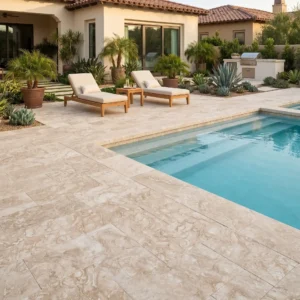
Maintaining limestone pavers around pool areas comes down to three consistent disciplines: chemistry awareness, appropriate sealer selection with honest reapplication timing, and cleaning products that are genuinely formulated for natural stone. Every shortcut in any of those three areas eventually shows up as a surface problem that costs more to correct than the original maintenance would have. The stone itself is highly resistant and capable of decades of service life in demanding pool environments — what shortens that timeline is almost always maintenance neglect or the wrong product choices. As you plan related hardscape elements for your property, scalloped stone border options explore how shaped paver formats can complement your pool surround design with added visual interest. At Citadel Stone, we source our limestone directly and maintain warehouse stock that supports project timelines without the extended lead times that import-only sourcing creates. Stone selected from natural stone quarries worldwide gives our limestone pavers around pool zones a texture known for reducing standing water.
Related reading: how limestone is made · french pattern limestone pavers · pavers with rock in between.