What Makes This Combination Work
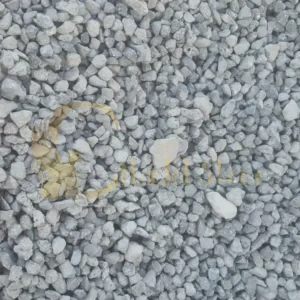
Decomposed granite with pavers succeeds or fails based on one factor most designers overlook before they commit to a layout: the differential settlement rate between the two materials. Decomposed granite compacts down over the first season, while your paver field holds its elevation — and if you haven’t accounted for that gap during grading, you end up with proud paver edges that catch foot traffic and erode the DG surface around every stone. Getting the sub-base transition right from the start is the detail that separates installations that age gracefully from ones that need reworking within three years.
Design Ideas That Actually Hold Up
Your strongest design moves with decomposed granite and pavers come from treating the two materials as a deliberate contrast system rather than a fill-and-place afterthought. The DG acts as the ground plane — warm-toned, textural, permeable — and your paver elements provide the hard geometry that anchors the composition. Here are the layout approaches that deliver the most visual impact and the most practical longevity:
- Stepping stone ribbons: Single-file or staggered rows of rectangular pavers set flush in a DG field create a defined path without a hard edge — ideal for garden walkways where a formal look would feel out of place
- Paver grid inserts: A repeating grid of square pavers set at 24-inch centres across a DG courtyard gives the space structure and lets the DG infill read as intentional negative space rather than bare ground
- Border and field reversal: A continuous paver border surrounding a DG centre panel is one of the cleanest ways to define an outdoor dining or seating area without pouring concrete
- Irregular flagstone scatter: Larger irregular paver pieces placed in an informal cluster work well in naturalistic garden schemes where a rigid grid would contradict the planting style
- Raised paver islands: Setting pavers slightly proud of the DG by 6–8mm creates a subtle visual lift that also helps drainage sheet away from the stone faces
Paver Material Selection for DG Pairings
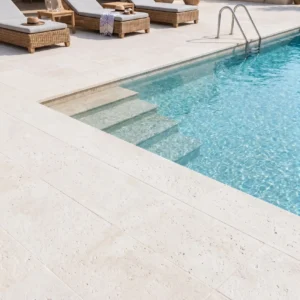
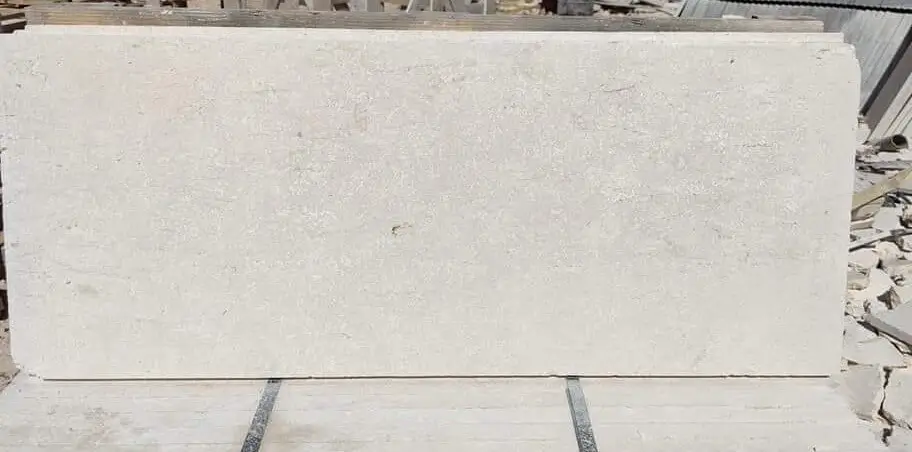
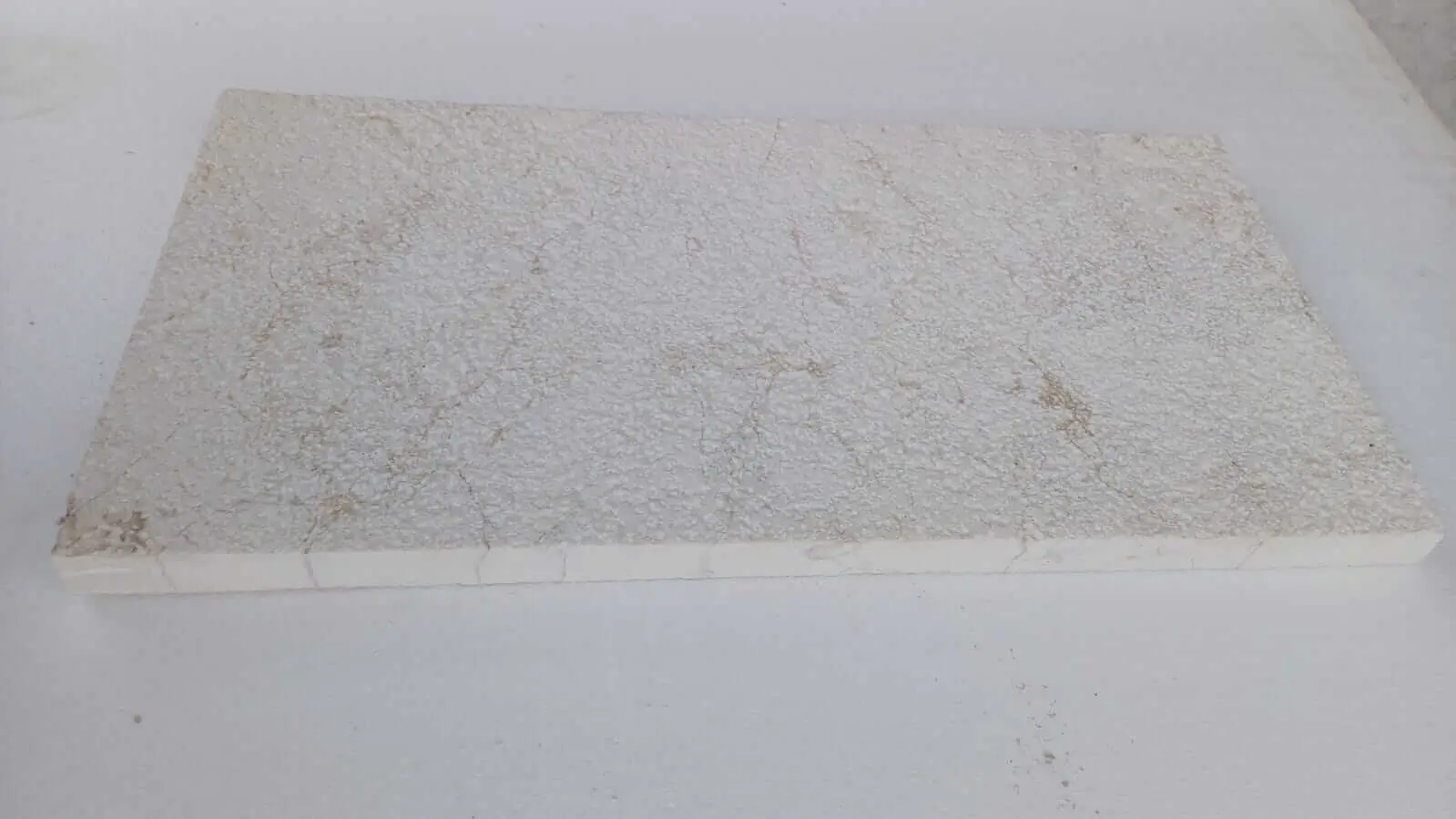
Natural stone pavers outperform concrete alternatives in decomposed granite with pavers installations because the thermal expansion coefficients are closer to the compacted granitic material beneath them. Limestone pavers are a particularly strong pairing — their warm buff and cream tones echo the golden hue of most decomposed granite, creating a palette that feels cohesive rather than forced. According to NSI limestone properties, limestone’s moderate absorption rate and surface texture also provide reliable traction when DG dust migrates onto the paver face during dry periods — a real-world condition that polished surfaces handle poorly.
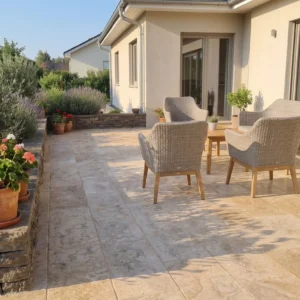
Travertine brings a similar warmth but with a slightly more open surface texture, which gives it grip advantage in applications where the DG is loose-laid rather than stabilised. Bluestone and basalt read colder in tone and work best when your landscape design intentionally contrasts cool stone against warm earth — a pairing that suits modern minimalist schemes well but can feel disconnected in traditional or naturalistic garden styles. Your material choice should match the tonal temperature of your DG supply, and that varies considerably between sources.
Pavers With Rocks: How to Integrate Natural Boulders
Pavers with rocks — meaning boulder or cobble accents placed within a DG and paver composition — add a third layer of scale that elevates a flat hardscape into something with genuine landscape character. The key constraint is weight distribution: boulders placed directly on compacted DG will migrate over time as the surface weathers, so you’ll want a concrete collar or a set gravel pocket beneath any stone larger than 200kg. Smaller cobble groupings placed at paver corners or along border edges don’t need this treatment and can be repositioned seasonally if your design evolves.
The ASLA permeable surface guidance reinforces what field experience confirms: mixing permeable DG with hard paver elements and natural rock features performs best when the overall drainage gradient maintains a consistent 1.5–2% fall across the entire plane. Rock placements that interrupt that gradient create ponding points — something you won’t notice until the first heavy rain after installation. Pavers with rocks also benefit from intentional colour coordination; selecting boulder tones that echo your paver palette ties the composition together rather than letting the stone accents read as incidental.
Pavers With Holes: Open-Joint and Lattice Options
Pavers with holes — specifically open-cell or lattice-format pavers — offer an interesting middle ground in decomposed granite compositions. Rather than setting solid pavers in a DG field, you can set lattice pavers with the DG filling the voids, which creates a highly permeable surface with the structural definition of a hard paver grid. This approach works particularly well on gentle slopes where erosion control matters as much as aesthetics. The DG-filled cells stabilise against sheet wash while the paver structure prevents the kind of rut formation that plain DG develops under heavy foot traffic.
Your grading and compaction spec for lattice pavers in DG needs to be tighter than for solid pavers — target 95% Standard Proctor compaction on the sub-base before setting, because any differential settlement under individual cells creates a rocking surface that degrades rapidly. The USGS dimension stone production data highlights the breadth of natural stone formats available for exactly these kinds of hybrid applications, and the range of thickness and cell-geometry options in natural stone lattice formats has expanded significantly over the past decade. Pavers with holes also extend naturally into driveway aprons and overflow parking areas where full permeability is a stormwater management priority.
Design Styles That Define the Palette
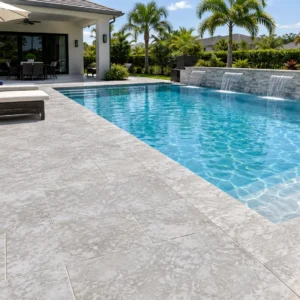
Your landscape design vocabulary has a significant influence on which paver formats and DG grades work together most convincingly. Desert xeriscaping environments call for angular, warm-toned limestone pavers paired with stabilised decomposed granite in a buff or gold grade — the tight colour range between the two materials creates a seamless, low-contrast composition that reads as intentional rather than economical. In tropical planting schemes, the challenge reverses: rich green foliage creates enough contrast that a cooler-toned stone like blue limestone or silver-grey basalt pavers in DG becomes a restful counterpoint rather than a competing element.
Traditional colonial and formal garden styles typically demand a more structured layout — a symmetrical paver grid or a central paver panel with a DG surround — and in those contexts, the DG grade matters enormously. A fine-screened, stabilised DG reads as refined and deliberate; a coarser, unstabilised grade reads as unfinished. Modern minimalist schemes are the most forgiving of paver and DG pairings because the design logic is built on restraint — a single material in two formats, clean geometry, and a limited palette. You can reference the Natural Stone Institute stone variety guide to match specific stone tones to your design palette before ordering samples.
Natural Stone Paver Specifications for DG Installations
Thickness is the specification decision that carries the most downstream consequences in decomposed granite with pavers installations. For pedestrian-only applications, 1.25-inch nominal limestone or travertine pavers perform reliably — but the moment you introduce wheeled equipment, delivery vehicles, or occasional vehicular access, you need to step up to 2-inch nominal minimum. The point load distribution through a thin paver into a DG base is fundamentally different from a concrete bed, and the failure mode — cracking at the paver edge rather than the centre — catches specifiers off guard because it looks like a handling damage pattern rather than a load failure.
- Pedestrian walkways and garden paths: 1.25-inch to 1.5-inch nominal thickness, compacted DG sub-base at 4 inches minimum
- Courtyard and patio use: 1.5-inch to 2-inch nominal, 6-inch compacted aggregate base beneath DG layer
- Occasional light vehicular access: 2-inch minimum, concrete spot footings under paver edges at vehicle crossing points
- Stabilised DG infill panels: Match paver thickness to DG layer depth so finished surfaces align within 3mm tolerance
- Natural stone pavers in freeze-thaw regions: Prioritise lower absorption grades — target below 3% water absorption per ASTM C97 to reduce spalling risk
You can explore the full thickness and format options available through Citadel Stone paver material range to match your project’s load and aesthetic requirements before finalising your specification.
Installation Sequence and Common Field Errors
The installation sequence for decomposed granite with pavers requires you to set your paver field first and fill with DG second — not the other way around. Attempting to set pavers into a pre-spread DG layer leads to inconsistent seating depth because DG compresses unevenly under the paver’s weight during tamping. Set your pavers on a prepared aggregate base, confirm all are flush within your tolerance, then spread and compact DG to fill between and around the paver edges in 50mm lifts.
Here’s what most installers get wrong on the DG compaction step: they apply water too aggressively to activate the fines and end up over-saturating the upper layer, which creates a firm crust over a soft core. That crust fails under the first foot traffic cycle and leaves an unsightly surface depression around every paver. Target a moisture content that produces a firm handprint impression — damp enough to compact, not wet enough to smear. At Citadel Stone, our technical team recommends a final dry-compaction pass with a plate compactor after the DG has cured for 24 hours to lock the surface layer without adding more moisture.
Ordering and Project Planning Logistics
Coordinating the paver and DG components of your project requires sequencing your orders carefully. Natural stone pavers ship on pallets and need truck access to your site — confirm your delivery point has clearance for a standard flatbed before your order is processed. DG typically arrives loose in bulk loads or in super-sacks, and the two deliveries don’t need to arrive simultaneously; in fact, staging the pavers first and the DG second gives you working space during the paver-setting phase.
Citadel Stone’s warehouse inventory for natural stone pavers is maintained to support fast turnaround nationally, which means lead times for standard formats are typically one to two weeks rather than the longer import cycles associated with custom or non-stocked material. Factor that into your project schedule alongside your DG supplier’s lead time, and build in a buffer for the compaction and cure period before any landscaping or planting around the finished surface begins.
Parting Guidance
Decomposed granite with pavers rewards the projects that treat material selection, sub-base engineering, and design intent as a single integrated decision rather than three separate tasks. Your paver choice sets the tonal and textural anchor for the whole composition — get that right and the DG grade, the joint width, and the layout pattern follow naturally. Nail the compaction sequence and the differential settlement tolerance, and your installation will hold its geometry and its appearance through multiple weather cycles without remediation. As you finalise your specification and consider complementary hardscape elements for your property, shellstone limestone pavers for natural stone projects offer another dimension of texture and character worth reviewing alongside your primary material selections.
Stone for nationwide projects ships from internationally sourced quarries, giving landscapers limestone pavers that contrast handsomely against decomposed granite joints.
Related reading: how limestone is made · french pattern limestone pavers · pavers with stones in between.