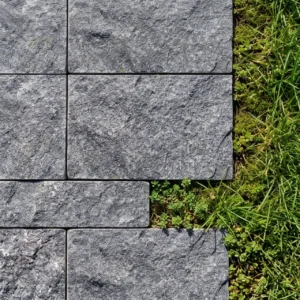
Stone Selection Starts with Heat Tolerance, Not Aesthetics
Round fire pit pavers carry a thermal load that most general-purpose hardscape stone simply isn’t engineered to handle. The repeated cycling between ambient temperature and radiant heat — often exceeding 400°F at the inner ring — causes differential expansion that will fracture insufficiently dense material within a season or two. Your material selection has to lead with heat tolerance before you consider color, texture, or cost.
Dense, low-porosity natural stone performs best in this application. Basalt, hard limestone, and certain granites all tolerate radiant heat well, provided you select material with an absorption rate below 0.5% and a compressive strength above 8,000 PSI. Travertine, despite its popularity, requires careful evaluation — the open-pore structure that makes it so comfortable underfoot near pools creates thermal stress points when it’s used as a surround for a fire feature.
Layout Geometry: Why a Circle Is Harder Than It Looks
The geometry of a circular fire pit layout is where most DIY and even some professional installations go wrong. You’re not laying a rectangular grid — you’re managing radial joints that fan outward from a central point, and each successive ring has a longer arc than the one inside it. That arc difference compounds quickly: the jump in circumference from a 4-foot-diameter inner ring to a 6-foot outer ring is roughly 6.28 linear feet, which means your pavers need to accommodate a meaningful joint-width gradient.
There are two practical approaches to managing this geometry when installing circle fire pit pavers:
- Use tapered pavers cut specifically for circular layouts, with a narrower back edge and wider face — these close the fan joint cleanly without packing full-width sand in wide outer gaps
- Use a uniform rectangular paver and accept a graduated joint width, keeping the narrowest joint at the inner ring no less than 3/8 inch and the outer joint no more than 3/4 inch to maintain structural integrity
- For multi-ring designs, recalculate your module count at every course — a paver that fits 12 units per ring at 48 inches of diameter may require 16 units at 60 inches
- Establish your pit’s finished outer diameter before ordering material — guessing within 6 inches of accuracy still translates to a full-ring module error at the outer course
Pavers for round fire pit designs work best when you pre-dry-lay the full outer ring before committing to a base pour. This step catches geometry errors before mortar is involved, and it’s the single most time-saving move in the layout sequence.
Base Preparation and Drainage: What Fire Pit Installations Get Wrong
Drainage design is often treated as an afterthought in fire pit construction, but it’s actually the variable most likely to determine long-term stone integrity. Standing water beneath a fire pit surround accelerates joint erosion and — in regions with heavy seasonal rainfall or rapid freeze-thaw cycles — causes the base to shift unevenly. Even in drier climates with periodic monsoon-pattern downpours, a poorly drained base can heave after a single intense rain event.
Your base section should include:
- A minimum 6-inch compacted aggregate base (3/4-inch clean crushed stone works better than processed gravel here — it drains faster and compacts more predictably)
- A crown or slight outward slope of at least 1/8 inch per foot across the paver surface to shed water away from the pit center
- A sand setting bed of 1 inch nominal depth, not exceeding 1.5 inches — thicker sand beds allow lateral shift under repeated thermal expansion cycles
- Open joints packed with polymeric sand, rated for high-heat applications — standard polymeric sand can soften and blow out when exposed to sustained radiant temperatures above 250°F
In regions where hurricane-season rainfall or extended wet periods are standard, you should also consider installing a simple French drain ring at the outer perimeter of the patio surround. This isn’t overcautious engineering — it’s the difference between a base that stays level for a decade and one that develops a low spot by year three. According to Natural Stone Institute stone variety specifications, moisture management beneath natural stone installations is a primary factor in long-term performance across all climates.
Comparing Circle Fire Pit Pavers: Limestone, Basalt, and Granite
The three most field-tested natural stone options for circle fire pit pavers each bring a different performance profile. Understanding the trade-offs helps you match material to your project conditions rather than defaulting to whatever is most familiar.
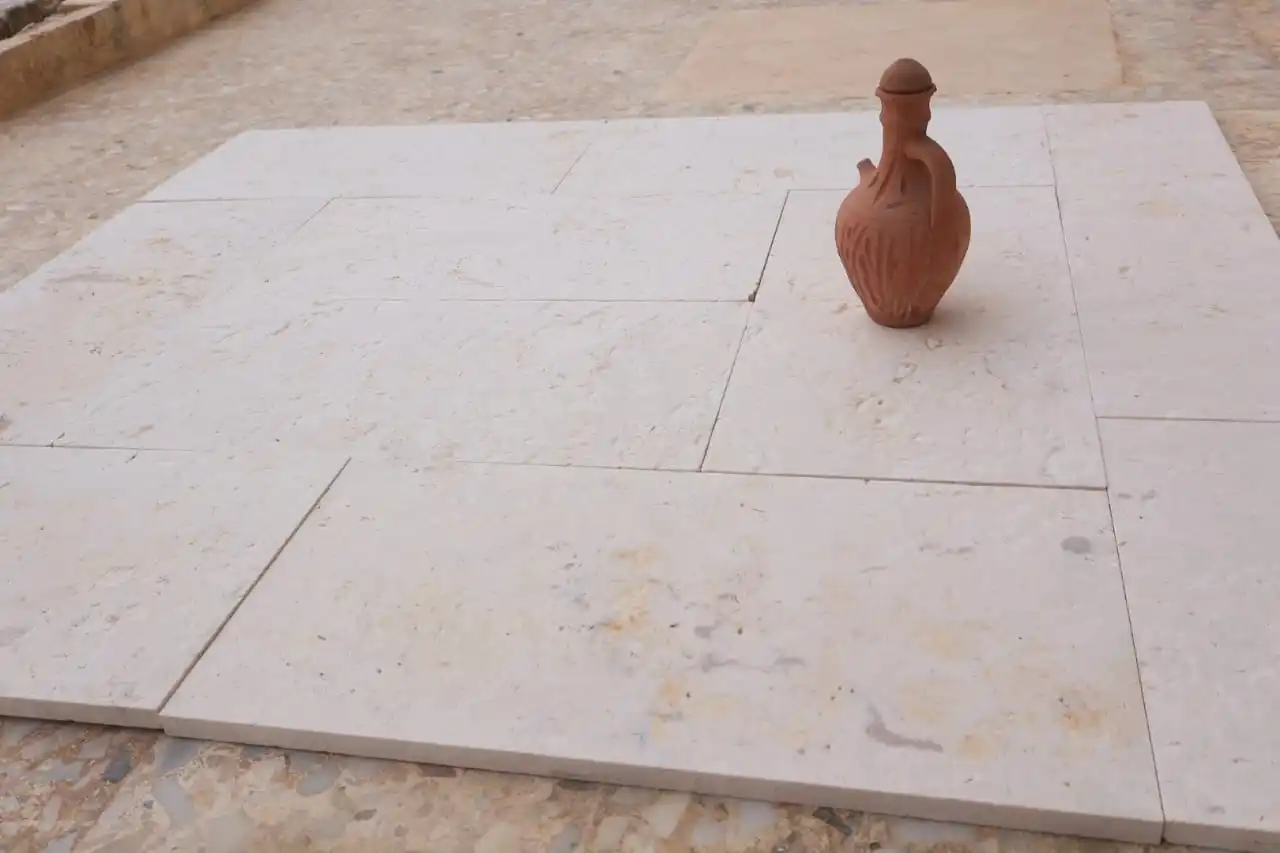
Limestone in the 2.5-to-3-inch thickness range is the most forgiving material to work with on a circular layout. It cuts cleanly for tapered units, handles moderate radiant heat well, and its neutral color palette suits most landscape styles. Dense limestone from Middle East quarries — where formation pressures produce particularly tight grain structures — offers absorption rates below 0.3%, which is well within the performance threshold for round fire pit paver applications. You can explore our heat-compatible stone pavers for limestone options that meet these density specifications.
Basalt brings the highest compressive strength of the three, typically exceeding 15,000 PSI, and its extremely low absorption rate makes it highly resistant to moisture infiltration in high-rainfall climates. The trade-off is workability — basalt is harder to cut into tapered units, which means your layout options are more constrained unless you have access to a wet-saw setup with a diamond blade rated for dense igneous stone.
Granite occupies the middle ground. It’s more workable than basalt, exceptionally durable under radiant heat, and widely available in the thickness ranges suited to fire pit surround work. According to ASTM C615 granite dimension stone quality standards, qualifying granite must demonstrate compressive strength above 19,000 PSI — a threshold that gives you significant confidence in long-term thermal performance.
Thickness Specifications for Pavers for Round Fire Pit Applications
Thickness is the specification most frequently under-specified on fire pit projects, particularly by homeowners working from general patio guidelines. Standard 1-inch patio pavers are designed for pedestrian load distribution across a broad, stable base — not for the concentrated point-load cycling and thermal stress of a fire feature surround. Your minimum thickness for circular pavers for fire pit use should be 2 inches nominal, with 2.5 to 3 inches preferred for the inner ring where radiant heat exposure is highest.
Field performance data from multi-year fire pit installations consistently shows that thinner pavers at the inner ring develop micro-fractures along the face within two to three seasons, particularly in climates with dramatic temperature swings between morning and evening. This isn’t a material quality failure — it’s a specification error. The right material, under-specified in thickness, will still underperform.
- Inner ring (closest to fire): 2.5–3 inch thickness minimum
- Middle and outer rings: 2-inch nominal is acceptable if the base is correctly prepared
- Stepping stones or seating-area pavers beyond the surround: standard 1.5-inch material is fine at this distance
- Verify actual finished thickness at delivery — nominal dimensions from quarries can run 1/8 to 3/16 inch short of stated spec
Sourcing, Lead Times, and Warehouse Stock
Timing your material order correctly matters more on circular fire pit projects than on standard rectangular patio work, because you’ll almost certainly need a secondary order to address cut units and geometry corrections. Ordering with a 15% overage built into your module count is standard practice, but for a tight circular layout with tapered cuts, 20% is more realistic.
Rather than quoting a standard shipping window, Citadel Stone cuts each order at its selected quarries and confirms the lead time once the specification is agreed. Confirm warehouse stock availability for your selected material before finalizing your project schedule, particularly if you’re working against a seasonal deadline. Your truck access conditions at the delivery site also affect how material is staged — a pallet of 3-inch limestone runs roughly 2,400 pounds, so plan your delivery path accordingly. According to USGS dimension stone production and use data, natural stone dimension products remain one of the most consistently supplied hardscape materials in the US market, with limestone and granite representing the dominant categories by volume.
Joint Treatment and Sealing for Fire Pit Stone Surrounds
Joint treatment for round fire pit pavers diverges from standard patio practice in two important ways. First, the radial joint geometry means you have both head joints and fan joints to manage — they behave differently under thermal expansion and require consistent compaction depth rather than just surface-level filling. Second, heat exposure near the inner ring will degrade standard sealers faster than the product’s stated reapplication interval suggests.
For sealing, use a penetrating impregnator rated for temperatures above 500°F if you’re treating the inner ring. Film-forming sealers — the type that leave a surface sheen — will bubble and peel when subjected to sustained radiant heat, leaving the stone face unprotected and visually compromised. On the outer rings and seating-area pavers, a standard penetrating impregnator applied every two to three years is adequate maintenance.
- Apply sealer to dry stone only — minimum 48 hours after final wash or rain exposure
- Do not seal within 6 inches of an active fire area — let that inner band remain unsealed to allow thermal breathing
- Reapply sealer to mid and outer rings on a 24-to-36-month cycle depending on UV intensity and rainfall frequency in your climate
- Test sealer compatibility on a sample unit from your specific batch — not all stone from the same quarry absorbs at identical rates
Getting Round Fire Pit Paver Specifications Right
Getting the full system right — geometry, material thickness, base drainage, and joint treatment — is what separates a round fire pit surround that stays level and intact for decades from one that starts showing problems within a few seasons. Natural stone is the right material for this application, but it performs at its best when every specification decision is made intentionally rather than by default. As your project moves from planning to execution, other stone maintenance considerations will come into play around the broader patio area — for one example, managing biological growth on stone surfaces is a practical topic worth understanding before your installation is complete. At Citadel Stone, we review material specifications with project owners before orders are confirmed, because the decisions made at the specification stage are the ones that determine long-term outcomes. Calculating the arc length of each course is the detail most builders overlook, and Citadel Stone can assist with module counts once the pit diameter is confirmed.
Related reading: how limestone is made · french pattern limestone pavers · Pavers With Rock in Between: Spacing and Drainage Ideas.