

What the Finish Actually Does to Grey Limestone
The honed grey limestone finish guide conversation starts at the surface — literally. A honed finish is produced by stopping the grinding process before the stone reaches a full reflective polish, leaving a matte-to-low-sheen plane that’s flat, closed, and slightly silky to the touch. That controlled abrasion collapses the micro-peaks on the crystal matrix, which tightens the surface pore structure compared to a sawn-cut slab. In practical terms, you get better resistance to surface staining from the moment the stone lands on site, before you’ve even reached for a sealer. The density of the honed layer also influences how grey limestone reads visually — cool blue-grey tones deepen, veining becomes crisper, and the overall palette reads two to three shades richer than the same material in a tumbled state.

How Tumbled Grey Limestone Differs in Character
Tumbled limestone takes a fundamentally different path. Instead of controlled surface grinding, raw-cut pieces are rotated in a drum with abrasive media — the mechanical tumbling rounds edges, pits surfaces, and breaks the face texture into an irregular, antiqued plane. The result is a stone that feels deliberately aged and carries a rougher, more open surface texture than anything produced by honing. Edge profiles become softly chamfered and inconsistent, which is precisely what makes tumbled pieces look genuinely weathered rather than factory-processed.
Your selection between these two finishes hinges on more than aesthetics. Tumbled grey limestone pavers carry a higher natural coefficient of friction — the surface topography provides grip that a flat honed plane simply cannot replicate without mechanical grooving. That trade-off matters considerably for pool surrounds, exterior steps, and any surface that will experience wet foot traffic regularly. The Natural Stone Institute limestone specifications note that surface texture directly influences absorption rate and slip performance, both of which shift meaningfully between a honed and tumbled treatment on the same limestone block.
Specification Metrics That Separate the Two Finishes
Here’s where specification writers often leave precision on the table. Both finishes originate from the same grey limestone slab stock — sourced from Middle East quarries known for consistent blue-grey tonality — but the final surface specification produces measurably different performance numbers:
- Honed surface: smooth underfoot — adequate for interior floors and covered exteriors, marginal for wet exterior use without grooving
- Tumbled surface: substantially more texture, and the usual choice for exterior wet zones — specify against the ANSI A326.3 wet DCOF threshold (0.42)
- Water absorption on honed surfaces: 3–6% by weight depending on limestone density, with the closed honed layer reducing ingress slightly versus a raw-sawn cut
- Water absorption on tumbled surfaces: 5–9% by weight — the open pitting created by tumbling increases absorption and demands more aggressive sealing schedules
- Nominal thickness for exterior honed grey limestone pavers: 20mm–30mm for pedestrian applications, 40mm for vehicular zones
- Tumbled pieces: typically supplied at 20mm–30mm with slightly irregular face depth variation of ±3–5mm due to the tumbling process itself
the ANSI A326.3 wet DCOF threshold (0.42) is the number to carry into every finish conversation with a client. Grey limestone honed to a flat plane can satisfy that threshold in covered locations; it struggles without surface modification in fully exposed wet zones. Tumbled meets it comfortably on most tested lots. According to ANSI A326.3, the measurement methodology matters — be certain your supplier can produce wet-surface test data, not just dry-surface figures, before specifying a finish for any exterior application.
UV Exposure and Long-Term Finish Appearance
This is a dimension that rarely gets adequate attention in finish selection conversations. UV exposure acts on grey limestone differently than temperature cycles do — it’s a photochemical process that affects the mineralogical binders in the stone’s calcium carbonate matrix, particularly at the surface where the finish treatment lives. On a honed surface, the closed, flat plane reflects a measurable proportion of incident UV rather than absorbing it, which slows surface oxidation and colour shift. You’ll notice this in long-running installations: honed grey limestone slabs installed in full sun retain their blue-grey tone substantially better over a 10–15 year window than comparable tumbled material, which has far more surface area exposed to UV per square foot due to its irregular, pitted texture.
Tumbled grey limestone, with its open surface morphology, absorbs more UV energy per unit area. Over years of full-sun exposure, this tends to drive a visible lightening — the stone bleaches towards a warmer buff-grey rather than retaining the cooler blue-grey that makes this material distinctive. That’s not a reason to avoid tumbled finishes in sun-exposed settings, but it absolutely affects your sealing strategy. For tumbled grey limestone pavers in high UV environments, a penetrating impregnating sealer with UV-inhibiting additives applied on a 12–18 month schedule is practical maintenance — compared to 24–36 months for honed surfaces in comparable exposures. The USGS limestone composition data confirms that calcium carbonate surface chemistry is susceptible to photochemical degradation, making surface treatment selection a direct long-term performance variable.
Sealing Schedules for Each Finish
Sealing grey limestone isn’t optional — but the protocol differs enough between finishes that treating them identically produces predictably inconsistent results.
- Honed grey limestone: apply a penetrating silicone or fluoropolymer impregnator at installation, allow full cure (typically 48–72 hours), then reseal every 24–36 months for interior and shaded exterior applications, or 18–24 months for fully exposed exterior surfaces
- Tumbled grey limestone: the open pore structure typically requires a two-coat application at installation to achieve adequate penetration depth — a single coat on pitted tumbled surfaces often misses lower micro-voids
- Pre-sealing test: always apply a water bead test after sealing — water should bead at 3–5mm diameter on the surface; if it absorbs within 60 seconds, the seal coat is insufficient
- Topical sealers on honed stone: use with caution — topical coatings can create a slight sheen that alters the matte character of a honed specification and may peel under thermal cycling
- Re-sealing indicator: when a water bead absorbs within 90 seconds rather than 3–5 minutes, the seal is exhausted and reapplication is due
For honed grey limestone finish guide specifications on sun-exposed terraces, your sealing schedule should be reviewed after the first summer rather than defaulting to a fixed calendar interval. UV load varies enough between fully exposed south-facing slabs and partially shaded north-facing installations that a site-specific resealing trigger — absorption rate rather than calendar date — consistently outperforms a blanket annual schedule.
Installation Variables That Affect Finish Selection
Your base preparation affects how both finishes perform long-term, and the finish selection should inform your base specification — not the other way around. Honed grey limestone pavers require a flatter, more consistently prepared substrate than tumbled pieces. Because the honed surface is mechanically flat, any base irregularity reads directly through the finished plane as a lippage line between adjacent pavers — the eye catches it immediately against the reflective flat surface. Your aggregate base should be compacted to 95% Proctor density with a maximum surface deviation of ±3mm across a 3-metre straight edge before any setting bed is applied.
Tumbled grey limestone is more forgiving of minor base inconsistency — the irregular face and rounded edges make small lippage differences visually absorbed rather than highlighted. That said, don’t let the finish’s forgiving character reduce your base preparation standard below acceptable. Structural failure from inadequate compaction affects tumbled and honed pavers equally, regardless of what the surface looks like. When you’re reviewing our our limestone finish selections, note the recommended thickness specifications alongside the finish — the two specifications are linked, not independent variables.
Matching Each Finish to the Right Application
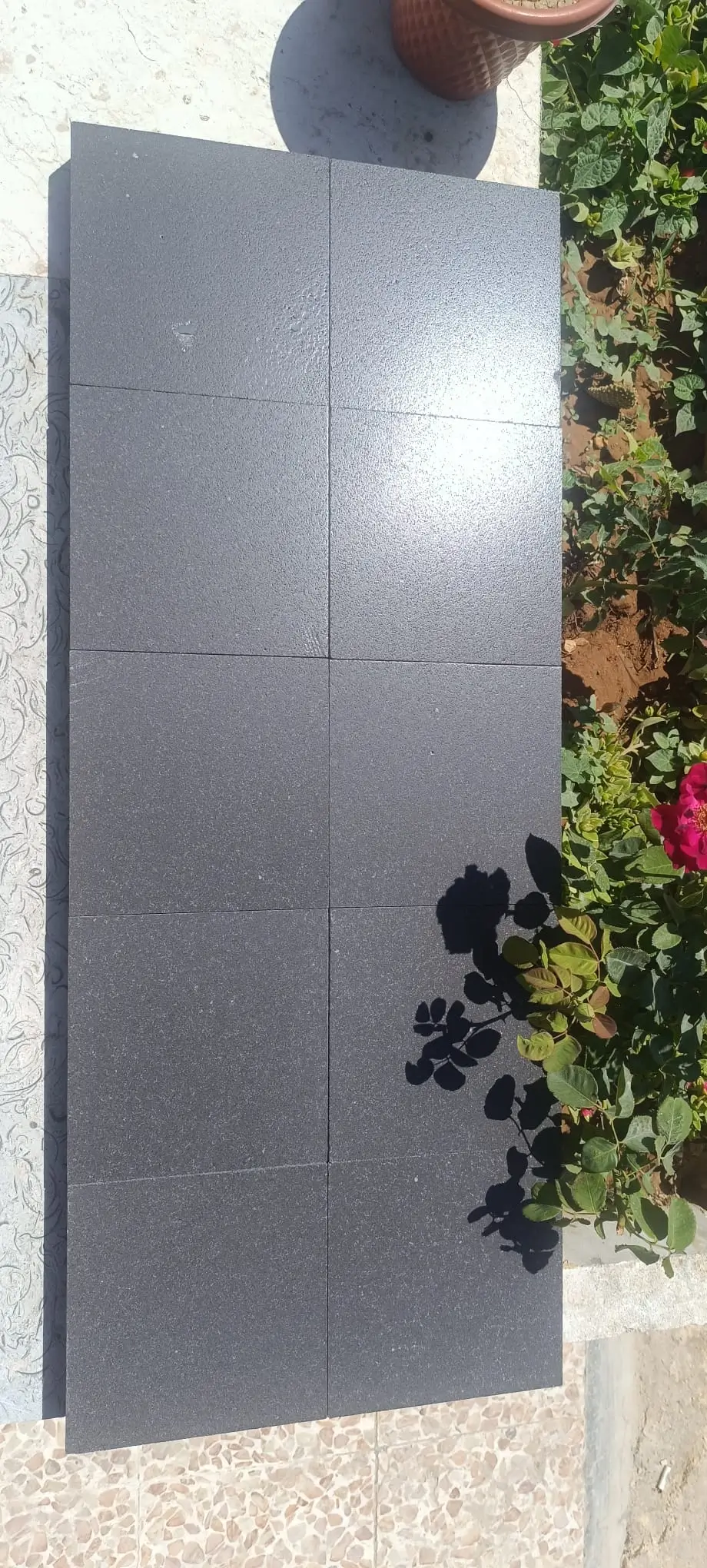
The applications where honed and tumbled grey limestone genuinely excel don’t overlap as much as clients often assume. Grey limestone honed to a flat plane belongs in applications where visual precision, tonal consistency, and a controlled aesthetic are the primary deliverables — interior flooring, formal terraces, covered loggias, commercial lobbies, and any setting where the crisp, contemporary grey palette is the design intent. The flat plane also suits large-format cutting (600mm × 900mm and above) where tumbling would be impractical and the edge treatment needs to be sharp and clean.
- Honed grey limestone: ideal for interior floors, covered terraces, formal pool surrounds with grooving, retail and hospitality interiors, feature wall cladding
- Tumbled limestone slabs: ideal for casual garden paths, courtyard paving with traditional or rustic aesthetics, exposed pool decks where natural grip is required, and any setting where the material should read as aged and informal
- Mixed applications: some projects specify honed for the interior transition zone and tumbled for the exterior continuation — a legitimate strategy that maintains tonal consistency while varying grip and character by zone
- Avoid honed in ungraded outdoor zones: sloped exterior surfaces without mechanical grooving should not receive honed finishes regardless of the project budget or aesthetic preference
At Citadel Stone, we regularly consult with project teams on exactly this finish-to-application pairing before any warehouse stock allocation is confirmed. Getting the finish wrong at specification stage is recoverable on paper — it’s considerably less recoverable once the material is on a truck and the installation crew is ready to start.
Supply Timing and Logistics for Both Finishes
Honed grey limestone is typically carried in higher warehouse volume than tumbled material, reflecting broader demand from both residential and commercial project types. Your lead time from warehouse confirmation to truck delivery for standard honed paver sizes — 400mm × 400mm, 600mm × 600mm, and 600mm × 300mm — typically runs 5–10 business days when stock is confirmed. Tumbled limestone slabs and pavers often carry a slightly longer lead window depending on the batch cycle, particularly for irregular mixed sizes that require hand-sorting before dispatch.
Confirm your finish specification and exact quantity requirements — including a 10–12% wastage allowance for cutting and breakage — before your warehouse reservation is locked. Format changes after warehouse allocation can push lead times significantly, especially for tumbled material where the batch character (colour variation, edge treatment consistency) needs to be matched from the same quarry run. Citadel Stone supplies both finishes nationally, and our technical team can advise on current warehouse stock levels and realistic truck delivery scheduling before you commit your project timeline to either finish.
Getting the Honed vs Tumbled Decision Right for Your Project
The honed grey limestone finish guide decision ultimately rests on four factors you should resolve before a sample is ordered: the application’s wet-surface requirements, the aesthetic register of the project, the UV exposure the installation will face over its lifetime, and your client’s realistic maintenance commitment. Honed delivers precision, tonal depth, and a contemporary character that’s difficult to replicate with any other finish — but it demands a surface that’s appropriate for its lower wet COF, a sealing schedule the client will actually maintain, and a base preparation standard that matches its visual precision. Tumbled grey limestone forgives more in the field, ages more gracefully under UV load, and provides natural grip without surface modification — at the cost of a more open surface that absorbs more aggressively and requires consistent penetrating sealer maintenance to prevent long-term staining.
Beyond grey limestone, your broader natural stone project may involve complementary material choices worth understanding in detail. For a closer look at how related limestone options perform in different contexts, grey-blue limestone cost and specification covers another dimension of limestone selection that frequently intersects with finish decisions. When reviewing samples at Citadel Stone, the contrast between a honed and a tumbled grey limestone surface is immediately apparent in both sheen level and edge texture.
Related reading: grey limestone color guide · grey limestone varieties compared.