

What Slate Actually Does Underfoot
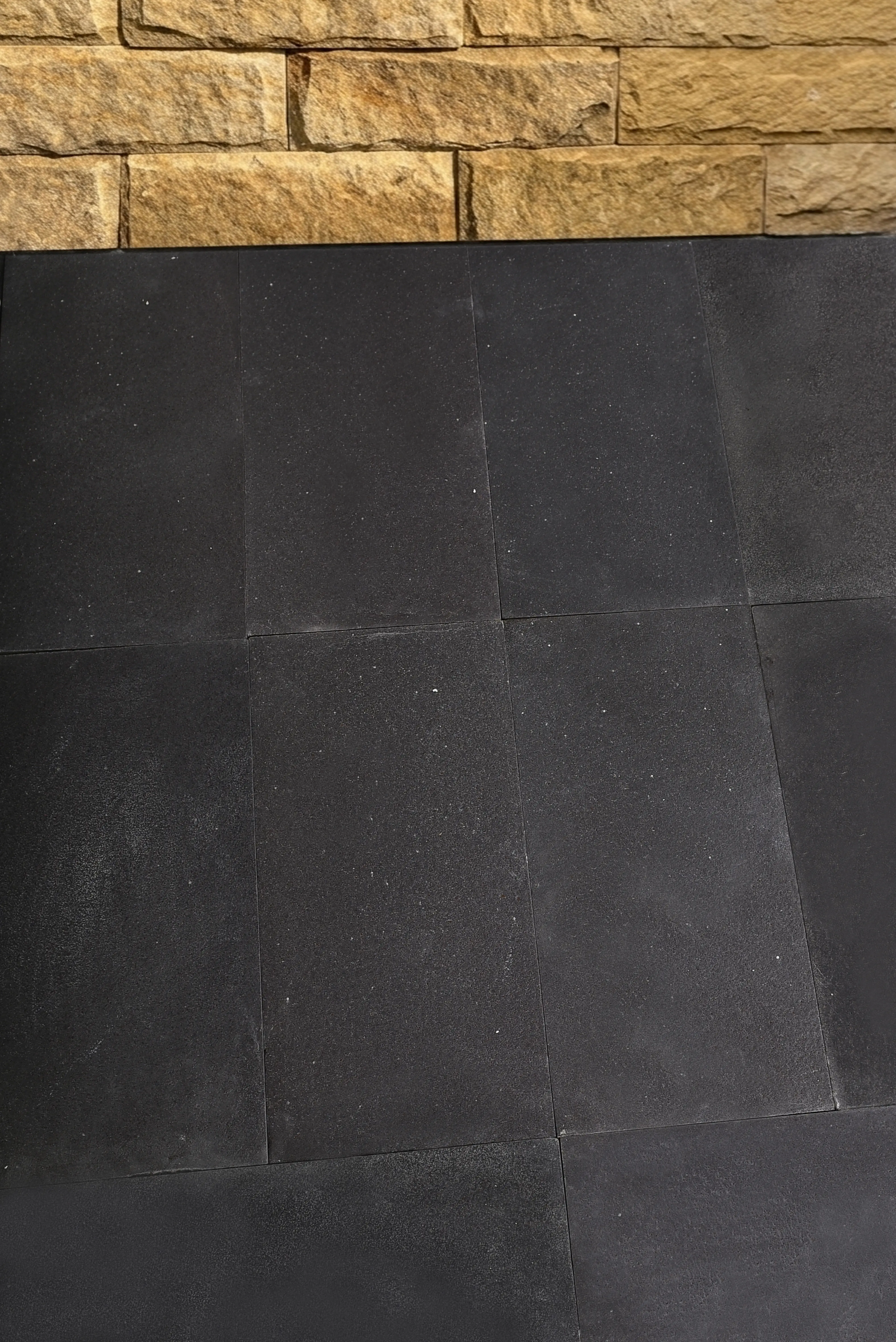
Blue black slate paving slabs have a riven surface that develops naturally when the stone cleaves along its foliation planes — and that texture is doing real structural work, not just providing aesthetics. The micro-ridges hold a coefficient of friction well above 0.6 on the wet static scale, which means foot traffic stays stable even when the surface is saturated. According to ASTM C629 slate dimension stone specifications, correctly graded slate maintains its surface integrity through repeated wet-dry cycles without the progressive smoothing you see with polished materials. The critical variable most installers overlook is that this performance depends entirely on how the slab is bedded — a hollow spot behind a riven face creates flex, and flex eventually fractures the stone along its natural cleavage.
Base Preparation and Compaction Depth
Your base is carrying every load the slate will ever see, so the preparation stage deserves as much attention as the slab selection itself. For a standard residential patio or garden path, a minimum 100mm compacted hardcore sub-base topped with a 30–40mm sharp sand or mortar bed is the accepted baseline. In areas with poor drainage capacity in the native soil — heavy clay profiles especially — you’ll want to push that hardcore layer to 150mm and consider a geotextile membrane between the sub-grade and the aggregate to prevent fines migration.
- Compact the hardcore in 75mm lifts rather than one deep pour — deeper single lifts trap voids that compress unevenly under load
- Check for soft spots after compaction by walking the base — any flex or depression needs additional material and re-compaction
- Allow the sub-base to settle for 48 hours before laying if recent rainfall has saturated the ground
- A mortar bed of 4:1 sand-to-cement ratio gives you workability without excessive shrinkage cracking
The temptation is to rush the base work because it disappears under the finished surface, but this is where most black garden paving slabs failures originate. A base that looks fine on day one will betray itself in the second or third winter when freeze-thaw cycling amplifies any voids that were missed during compaction checks.
Handling Elevation Changes and Slope
Terrain introduces complications that flat-site specifications simply don’t address, and slate’s density — typically 2,750–2,800 kg/m³ — creates specific challenges on sloped installations. Your primary concern on any grade steeper than 1:20 is drainage geometry: water must move across the surface and off the edge, not pool at low points where it will work into mortar joints and accelerate failure. The standard cross-fall for blue black slate paving slabs is a 1:80 fall toward the drainage channel, which provides reliable runoff without creating a perceptible incline underfoot.
On hillside installations, the sub-base engineering becomes more demanding. You need to account for lateral soil movement pushing against your compacted aggregate from uphill, which gradually compromises the bed level over time. Installing a French drain or perforated pipe at the uphill boundary of the paved area captures that lateral water movement before it saturates the sub-base. For significant grade changes, stepping the base in horizontal terraces rather than following the slope continuously gives you a more stable platform and simplifies the fall calculation for each individual terrace level.
- Falls across a terrace should run to the front edge, not back into the hillside where drainage has nowhere to go
- Step foundations between terrace levels need to be tied into the compacted sub-base, not just resting on it
- On sloped sites, edge restraints at the downhill perimeter are non-negotiable — they prevent the entire installation from creeping downgrade over time
Cutting and Sizing Blue Black Slate Paving Slabs
Slate cuts cleanly with a diamond blade, but the foliation direction matters more than most cutters acknowledge. Cuts made parallel to the natural grain run fast and clean; cuts perpendicular to the grain require slower feed rates and a finer blade grit to prevent micro-cracking along the cleavage planes. For black smooth paving slabs with a machine-calibrated face, the tolerances are tighter — you’re typically working to ±2mm thickness consistency — so the blade pressure needs to remain consistent throughout the cut rather than easing off at the end of the stroke.
The practical implication for your project is that complex cuts — curves, internal corners, circular patterns — should be factored into your material order as waste allowance. Budget 10–12% waste for straightforward rectangular layouts; push that to 15% for herringbone or diagonal patterns where every cut creates two exposed edges that may not be reusable elsewhere in the layout. our blue black slate slabs are supplied in calibrated thicknesses that simplify the cutting process and reduce the blade adjustments needed mid-job.
Jointing and Mortar Selection
The joint between slabs is doing more technical work than its visual scale suggests. For blue black slate paving slabs in an outdoor setting, a joint width of 8–12mm gives you enough space to accommodate thermal movement without appearing as a dominant visual line across the surface. Narrow joints below 5mm are tempting for a cleaner look but they restrict the space needed for proper pointing compound consolidation, which leads to hollow or cracked joints within the first year.
- Use a polymeric jointing compound rather than standard mortar pointing for garden installations — it resists weed growth and retains flexibility through temperature cycling
- Wet the slab edges lightly before pointing to prevent rapid moisture loss from the compound that causes premature shrinkage cracking
- Brush excess compound off the face immediately — slate’s riven surface can trap grout particles in the micro-texture if left to set
- Cure the joints by lightly misting with water twice daily for 72 hours if temperatures exceed 75°F during installation
As Britannica’s overview of slate metamorphic rock properties details, slate’s low thermal expansion coefficient — roughly 9–10 × 10⁻⁶ per °C — means joint movement is more predictable than with materials like limestone or concrete. You can spec tighter joint widths than you would with a higher-expansion stone, but the 8mm minimum remains the practical floor for pointing workability.
Sealing and Surface Protection
Sealing blue black slate paving slabs is a decision that depends on your finish preference rather than a strict technical necessity — slate’s low porosity means it won’t absorb oil or organic stains the way limestone does. That said, an impregnating sealer applied before the first season does two things worth the investment: it deepens the colour saturation, intensifying the blue-black tonal contrast that makes this material distinctive, and it makes routine cleaning dramatically more efficient because surface contaminants can’t bond with the stone matrix.
The sealer type matters. Solvent-based impregnating sealers penetrate deeper and last longer — typically four to six years before reapplication — but they require the stone to be completely dry before application, which means waiting a minimum of 72 hours after final jointing on a warm day, or longer in humid conditions. Water-based sealers are more forgiving on application timing but typically need reapplication every two to three years. Either way, avoid topical film-forming sealers on riven slate; they deposit a surface film that alters the texture, reduces the coefficient of friction, and peels in UV-exposed outdoor conditions.
Laying Pattern Options and Visual Planning
The laying pattern you choose affects more than appearance — it influences structural performance and how easily you can accommodate cuts at boundaries. A standard stretcher bond, where joints are staggered by half a slab length, distributes point loads more effectively than a grid pattern where four corners meet at a single joint. For black smooth paving slabs in larger formats — 600mm × 600mm or 900mm × 600mm — a stack bond grid pattern tends to emphasise any subtle variation in tone across adjacent slabs, which some designers use intentionally but can look unplanned if it wasn’t part of the brief.
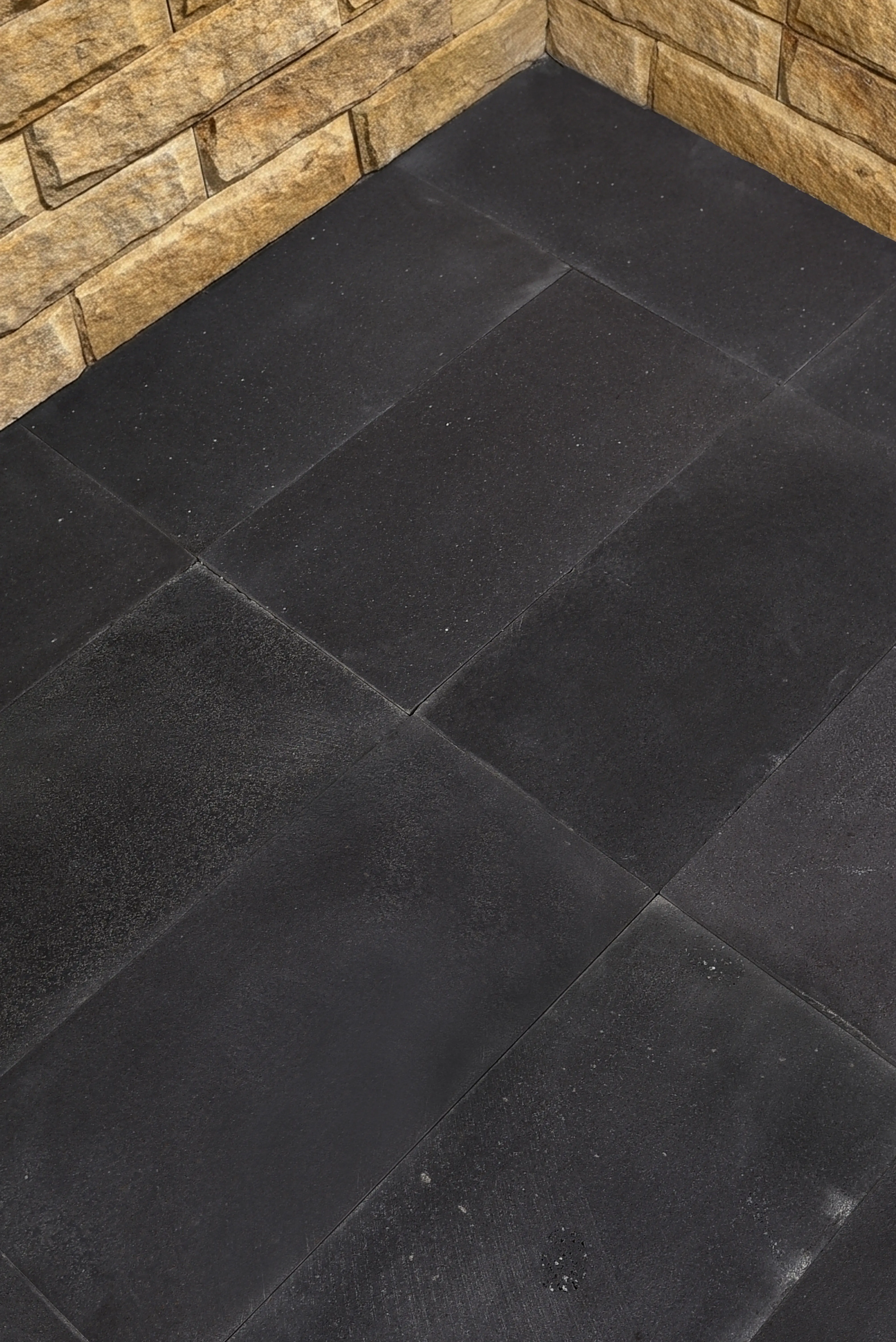
- Dry-lay the first two or three rows before committing to mortar — this lets you blend tonal variation across the batch and identify any sizing inconsistencies before they affect the layout
- For rectangular slabs in a random coursed pattern, maintain a minimum overlap of one-third of the slab length at every cross-joint to prevent linear cracking paths through the field
- On steep slopes or terraced sites, orient the longer slab dimension perpendicular to the slope — this distributes load more evenly across the mortar bed on graded ground
- Mark the centre lines of the area before laying so that border cuts remain balanced on opposite edges
Ordering, Logistics, and Lead Times
Blue black slate paving slabs are a dense material — standard 20mm calibrated slabs in a 600 × 600 format run approximately 28–30 kg per slab — and your truck access conditions at the delivery point need to be confirmed before ordering. A standard pallet of slate paving covers roughly 15m² and weighs between 750–900 kg depending on thickness. For projects requiring multiple pallets, confirm whether your site can accommodate a tail-lift vehicle or whether a forklift-compatible delivery point needs to be arranged in advance.
Citadel Stone maintains warehouse stock of blue black slate paving slabs for national dispatch, which typically compresses lead times to one to two weeks compared to the six-to-eight-week import cycle that can affect project scheduling when sourcing direct. Verify warehouse availability when you confirm your quantity — particularly for larger orders above 50m² where batch consistency becomes relevant, as material from a single warehouse batch will show tighter tonal matching than stock consolidated from multiple arrivals. According to USGS dimension stone production and use data, slate remains a consistently supplied dimension stone category in the US market, supporting reliable national availability through established stone distributors.
Maintenance and Long-Term Performance
Routine maintenance for blue black slate paving slabs is straightforward, which is one of the practical advantages of specifying this material over more porous alternatives. A pressure wash at 1,200–1,500 PSI annually clears biological growth from the riven texture without damaging the surface. Avoid using a rotating-head lance directly on the jointing compound — the concentrated pressure can erode polymeric joints faster than the surrounding stone, creating a recessed line that collects debris.
- Inspect joints annually in freeze-thaw regions — any cracked or hollow sections should be re-pointed before winter to prevent water ingress that expands on freezing
- Moss and algae establish in the micro-texture of riven slate in shaded or damp positions — treat with a dilute sodium hypochlorite solution rather than mechanical scrubbing, which can widen the natural fissures over time
- Replace individual slabs showing delamination along the cleavage plane — this is a material defect that doesn’t spread to adjacent sound slabs, so early replacement is cost-effective
- Re-seal every four to six years if an impregnating sealer was applied originally — do a water bead test first; if water absorbs rather than beads, the sealer has degraded
Field experience with this material consistently shows that installations maintained at proper joint capacity and sealed on schedule perform well beyond twenty years without structural intervention. The riven surface that gives black garden paving slabs their slip resistance also self-cleans more effectively than smooth finishes because rainfall carries surface particulates into the joints rather than leaving them on the face.
Decision Points
Specifying blue black slate paving slabs well comes down to a sequence of decisions that compound on each other — get the base preparation right and everything above it has a stable platform; choose the correct mortar and pointing system and the joints outlast the fashion cycles that will come and go around them. Your terrain assessment should happen before any material is ordered, because a sloped or terraced site changes your sub-base depth requirements, your drainage geometry, and your slab orientation choices in ways that affect the total material and labour budget meaningfully.
At Citadel Stone, we source this material directly from selected quarries in the Middle East, with each batch reviewed for consistent cleavage quality and tonal range before it reaches our warehouse — because the difference between a visually cohesive installation and a patchy one is often decided at the quarry level, not on site. For your project timeline, confirm truck access details when you request a quote so delivery logistics don’t create a scheduling gap between base completion and laying. As you plan related hardscape elements alongside your slate installation, blue quarry paver pricing and options covers complementary material considerations worth reviewing. Blue black slate paving slabs from Citadel Stone arrive with riven surfaces, giving foot traffic natural grip in rainy climates.
Related reading: belgian bluestone slab · blue limestone rock geology · blue limestone types compared.