

What Actually Sets These Two Materials Apart
Belgian bluestone slab comparisons trip up even experienced specifiers because the naming overlap is genuinely confusing — both materials carry a blue-grey palette, both come in slab format, and both get called “bluestone” in casual conversation. The structural and mineralogical differences, though, are significant enough to change your specification entirely. Belgian bluestone is a dense, fine-grained limestone with a dark blue-grey appearance, a compressive strength typically exceeding 180 MPa, and virtually no visible fossil content. Blue limestone — often sourced from quarries across the Middle East and parts of Turkey — tends to present with visible fossilised shell inclusions, a slightly warmer tone, and a more open pore structure that affects both sealing requirements and frost behaviour.
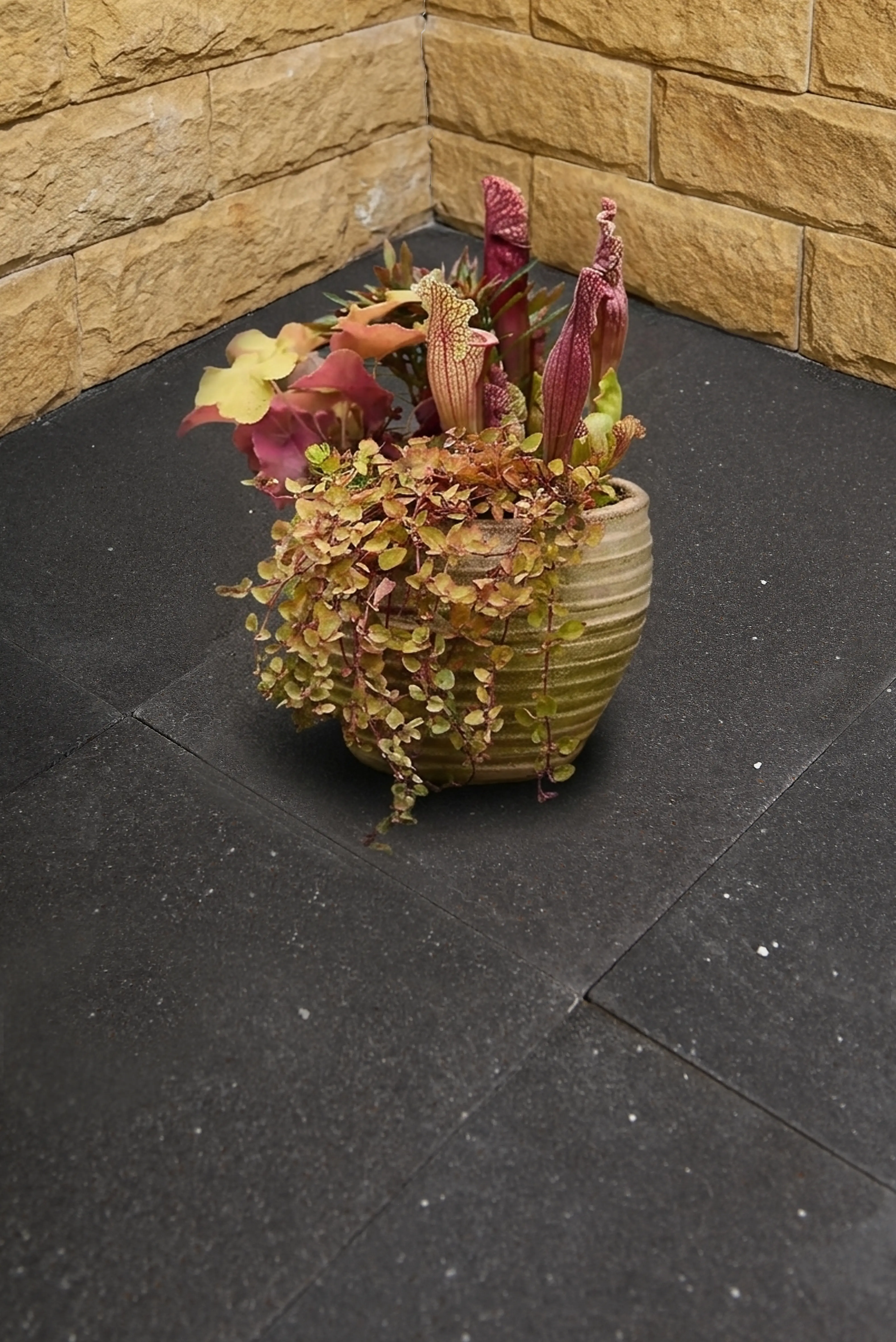
You’ll also notice a difference in how these materials feel underfoot. Belgian bluestone has a naturally smooth surface that hones to an almost pewter-like finish, while blue limestone produces a warmer, slightly more textured result that many designers prefer for outdoor residential settings. That tactile difference matters when you’re committing to a large area installation.
Mineralogy, Density, and Why They Matter for Your Project
Belgian bluestone is technically a limestone — a Carboniferous-era formation — but its calcite crystals are so tightly interlocked that it behaves more like a dense calcarenite. Its water absorption rate typically sits below 0.5%, which is exceptional for any calcium carbonate-based material. That near-impermeability is what gives the Belgian bluestone slab its reputation for outdoor durability without heavy sealing maintenance. The material’s density hovers around 2,700–2,750 kg/m³, and that mass contributes to excellent acoustic damping as well as thermal stability in covered outdoor areas.
Blue limestone from Middle East quarries generally runs at water absorption rates of 0.8–1.5%, which is still very manageable but does require a penetrating impregnator applied before and after installation — especially in freeze-thaw regions. According to NSI limestone specifications and properties, absorption rate is one of the primary variables governing limestone’s suitability for exterior applications, and the threshold most specifiers use for cold-climate exposure is under 3%, so both materials qualify — but Belgian bluestone carries a meaningful safety margin.
Your choice between the two often comes down to this: if the project demands near-zero maintenance and the budget supports the premium, Belgian bluestone slab products deliver on that promise. Blue limestone requires a modest maintenance protocol but returns genuine value in cost per square foot and warmer aesthetic character.
Surface Finish Options and Their Real-World Trade-offs
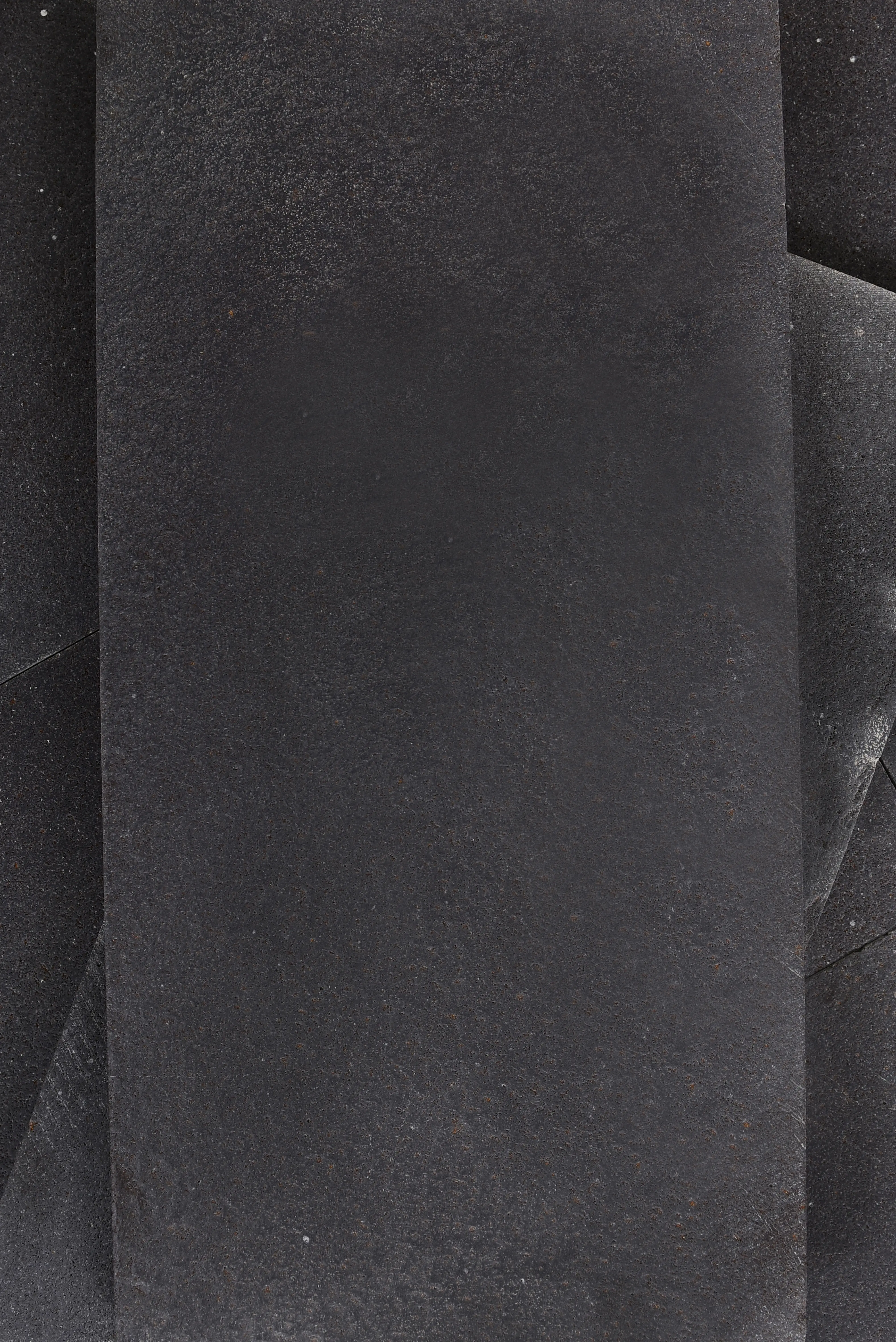
The finish you specify on a Belgian bluestone slab changes the material almost beyond recognition. In its natural sawn state, the surface has a matte, slate-like quality with fine saw marks that weather to a consistent silver-grey over the first two or three seasons. Honed Belgian bluestone develops a mirror-like sheen that rivals polished granite — it’s one of the only limestones where honing produces a finish that’s genuinely dramatic rather than simply smooth. Brushed finishes add texture while preserving the dark tone, and they’re the go-to choice for pool surrounds where wet slip resistance is non-negotiable.
Blue limestone’s finish options tell a different story. The material’s subtle fossil inclusions mean that polishing reveals visual complexity — light plays differently across the surface, catching the edges of embedded shell material. Many designers consider this a feature, not a flaw. Honed blue limestone provides a clean, consistent look but without the deep pewter quality Belgian bluestone achieves. For exterior paving where slip resistance is the priority, a sawn or lightly brushed finish on either material outperforms polished options, particularly in areas exposed to pooling water or heavy dew.
- Belgian bluestone slab: honed finish achieves coefficient of friction above 0.60 when properly maintained
- Blue limestone: brushed or flamed finishes typically reach COF 0.65–0.75 for wet applications
- Polished finishes on both materials drop wet COF below 0.40 — exterior use requires a textured additive or texture treatment
- Thermal finishes are viable on blue limestone but can cause micro-fracturing in denser Belgian bluestone sections thinner than 30mm
Thickness, Structural Loading, and Slab Sizing
Specifying the right thickness is where projects either succeed or create expensive callbacks. For a Belgian bluestone slab in a pedestrian paving context, 30mm is the practical minimum for slabs up to 600×600mm. Once you push into large-format territory — say, 900×600mm or 1200×600mm — you need to step up to 40mm, particularly if vehicle overrun is a possibility. Belgian bluestone’s flexural strength of approximately 18–22 MPa gives it a meaningful advantage over many softer limestones in spanning unsupported base voids, which matters enormously on less-than-perfect subgrades.
Blue limestone at equivalent dimensions runs slightly lower in flexural strength — typically 14–18 MPa — which shifts the required thickness up by 5–10mm for the same span conditions. That sounds minor, but across a 100m² project it adds measurable weight to your delivery logistics and affects both truck payload planning and lifting requirements on site. Citadel Stone’s technical team can help you work through the slab sizing matrix for your specific loading scenario before you finalise your order, which prevents the costly realisation mid-installation that your specified thickness won’t carry the intended load.
Your Belgian bluestone slab comparison also needs to factor in the grading tolerance of each material. Belgian bluestone maintains tight dimensional consistency — ±1mm on thickness is achievable from leading quarries. Blue limestone from Middle East sources can run ±2–3mm, which affects joint consistency and requires more attention during installation if you’re targeting a precision finish.
Subgrade Conditions, Soil Challenges, and Long-Term Stability
Here’s a detail that separates good slab installations from ones that require costly remediation within five years: the relationship between your subgrade soil type and your chosen material’s deflection tolerance. Both Belgian bluestone slab products and blue limestone are rigid materials — they don’t flex to accommodate movement beneath them. Any differential settlement in your base transmits directly to the surface as cracking or lippage. The soil conditions below your base course are therefore not a secondary concern; they’re a primary specification variable.
Expansive clay soils are the most challenging substrate for both materials. Clay expands when wet and contracts when dry, generating cyclic vertical movement of 10–25mm in severe cases. On a Belgian bluestone slab, which has minimal tolerance for differential deflection, even 8–10mm of seasonal movement can generate hairline cracks at mid-span. The mitigation is a deepened aggregate base — typically 200–250mm of compacted crushed stone — combined with a geotextile separation layer that prevents clay migration into the aggregate over time. Sandy soils present a different problem: settlement under point loading without the lateral restraint that clay provides. Sandy subgrades require edge restraint systems and a well-graded aggregate that resists washout during heavy rain events.
- Expansive clay: specify minimum 200mm crushed aggregate base with geotextile separation fabric
- Caliche subgrades: mechanical scarification required before base installation — caliche hardpan blocks drainage and creates perched water that destabilises mortar beds
- Sandy or gravelly soils: prioritise compaction to 95% modified Proctor before base aggregate placement
- Rocky subgrades: irregular bearing creates stress concentrations — a 50mm sand-cement screed levelling layer reduces slab fracture risk significantly
According to usgs.gov/myb/vol1/2018/myb1-2018-dimension-stone.pdf”>USGS dimension stone production and use data, natural stone paving has consistently outperformed alternative materials in long-term durability assessments — but that performance is heavily contingent on base preparation quality rather than material selection alone. You can specify the most dimensionally stable Belgian bluestone slab available and still get a failing installation if the soil preparation work was shortchanged.
Colour, Tone, and How Each Material Weathers
The weathering behaviour of these two materials is one of the most underappreciated specification variables. A fresh Belgian bluestone slab is a deep, almost gunmetal blue-grey — it’s striking and distinctive in new condition. Over the first three to five years of outdoor exposure, it transitions through a range of lighter blue-grey tones as surface minerals react to UV and rainfall. The final weathered state is typically a consistent medium grey with subtle blue undertones, and most landscape architects consider it more elegant than the fresh material. The transition period, though, means your client needs to understand that what they see on delivery day is not what the finished project will look like at the five-year mark.
Blue limestone weathers differently — and more predictably. The Middle East quarries that produce this material tend to deliver a more consistent starting tone, and the weathering arc is gentler. You’ll see some lightening in the first two years, but the material settles into a stable appearance relatively quickly. The fossiliferous character actually helps here: the inclusions weather at a different rate to the surrounding matrix, which creates a subtle visual texture that many clients find more appealing than the flatter weathered tone of Belgian bluestone. For projects where the client wants visual stability in year two rather than year five, blue limestone is frequently the better match.
For a closer look at the full range of available material options, our natural bluestone options cover the specifications and finishes in detail worth reviewing before you finalise your selection.
Installation Requirements You Need to Get Right
The bedding system you choose matters as much as the stone itself. Belgian bluestone slab installations in exterior settings almost universally require full-bed mortar or full-coverage adhesive — this material’s density and rigidity mean any hollow spots beneath the slab create stress concentrations that lead to fracture under point loading. Dot-and-dab adhesive is not appropriate here, regardless of what product datasheets suggest for lighter materials. A full 10–12mm bed of flexible tile adhesive or a cement-sand mortar at 1:4 mix, with a slurry prime coat on the back of the slab, is the correct approach for slabs up to 40mm thickness.
Blue limestone’s slightly more open pore structure requires careful attention to adhesive penetration. Wet the back of the slab before bedding — not saturated, but visibly damp — to prevent the stone from drawing moisture out of the mortar too quickly. This is particularly important in warm conditions where evaporation rates accelerate the mortar’s open time. You’re looking at a window of about 20–25 minutes in moderate temperatures, which drops to 12–15 minutes in hot, dry climates. Planning your pour sequence and panel sizes around that reality prevents adhesion failures that don’t show up until the first frost cycle.
- Joint width for a Belgian bluestone slab: 3–5mm for cut slabs, 6–8mm for sawn-edge material to accommodate dimensional tolerance
- Expansion joints at maximum 4.5m intervals for exterior Belgian bluestone — tighter than the 6m often specified for less rigid materials
- Blue limestone: 5–7mm joints using a flexible, UV-stable grout or pointing mortar rated for exterior use
- Both materials: avoid cement-only pointing — the shrinkage cracking that results is a common warranty issue easily prevented with the correct flexible admixture
Cost, Lead Times, and Logistics Planning
Belgian bluestone slab material commands a premium that reflects both its extraction complexity and its limited quarry geography. Expect to pay 30–60% more per square metre than comparable blue limestone from Middle East quarries, depending on format and finish. That cost differential is real, but it narrows considerably when you factor in the reduced sealing frequency — Belgian bluestone in a non-polished finish outdoors often needs resealing only every five to seven years compared to every two to three years for most blue limestone specifications.
Lead time is the logistics variable that catches projects off-guard. Belgian bluestone is a quarried-to-order product for most North American projects — stock availability at any given warehouse is limited, and the standard import lead time runs eight to twelve weeks from order confirmation. Blue limestone from Middle East quarries has a slightly more predictable supply chain, but lead times of six to eight weeks are still standard for large project quantities. Citadel Stone maintains warehouse inventory of its most popular blue limestone formats, which can reduce project timelines to one to two weeks for standard sizes — a meaningful advantage when contractor schedules are already committed.
Your truck delivery planning should account for slab weight carefully. A pallet of 40mm Belgian bluestone in 900×600mm format typically weighs 1,200–1,400 kg — standard flatbed delivery requires a forklift or telehandler on the receiving end. Blue limestone at equivalent format and thickness runs 1,000–1,200 kg per pallet, slightly more manageable but still beyond manual offloading capability. Confirm your truck access route and offloading equipment availability before delivery is scheduled, not after.
Getting Your Belgian Bluestone Slab Decision Right
The honest summary of this comparison is that neither material is universally superior — they serve different project profiles well. Belgian bluestone slab products are the right call when the brief demands near-zero maintenance, a distinctive dark-tone aesthetic, and the budget exists to support the material’s premium. Blue limestone earns its place on projects where cost-efficiency, warmer visual character, and design flexibility matter more than specification minimalism. Both materials are genuinely durable when specified correctly and installed on a properly prepared subgrade.
The decision points that consistently separate successful specifications from regretted ones come down to three variables: your subgrade soil conditions and the base depth they demand, your maintenance commitment over the installation’s life, and your client’s visual expectations at the five-year mark rather than the delivery day. Address all three honestly before you commit to either material, and you’ll land on the right choice for your project’s specific circumstances. For a broader understanding of how these materials behave over time and what can go wrong in real-world conditions, common bluestone performance issues and fixes covers the practical remediation side of the equation in useful detail. Sourced direct from premium quarries in Turkey and the broader Middle East region, Citadel Stone bluestone slabs stay dimensionally stable outdoors.
Related reading: Blue Limestone Countertops: A Practical Design Guide · 7 Pavers With Black Border Ideas That Define Space · black block paving driveway installation.