

Base preparation is where black block paving driveway installations succeed or fail — and most of the callbacks professionals deal with trace back to decisions made before a single paver was set. The mix of compressive loading from vehicles, drainage demands, and the thermal cycling that affects every climate zone in the country creates a specification environment that rewards precision. Get the sub-base depth, bedding layer, and joint compound right, and you’re looking at a 25-to-30-year installation. Cut corners on any of those three, and you’ll be releveling within a decade.
Why Black Block Paving Works for Driveways
The visual case for a black block paving driveway is obvious, but the structural case is what matters for long-term performance. Dense black natural stone — particularly basalt and black limestone sourced from Middle East quarries — carries compressive strengths well above 15,000 PSI, which puts it in a different performance category from concrete block alternatives. That density also means lower water absorption rates, typically under 0.5%, which becomes critical in climates with significant temperature swings between seasons.
You’re also working with a material that distributes point loads efficiently when correctly bedded. A properly specified black block paving driveway handles the static weight of parked vehicles and the dynamic loading of turning movements without the surface cracking that plagues thinner, lower-density alternatives. The block format — as opposed to large-format slabs — gives the system natural flexibility at joints, which is exactly the property that makes it resilient across freeze-thaw cycles.
- Compressive strength typically exceeds 15,000 PSI for dense black basalt and black limestone units
- Water absorption below 0.5% limits freeze-thaw damage at the paver body level
- Block format allows controlled joint movement, reducing cracking risk under thermal cycling
- Natural stone colour runs through the full depth of the unit — no surface wear pattern reveals a different substrate
- Abrasion resistance exceeds most engineered alternatives, sustaining surface quality under repeated tyre contact
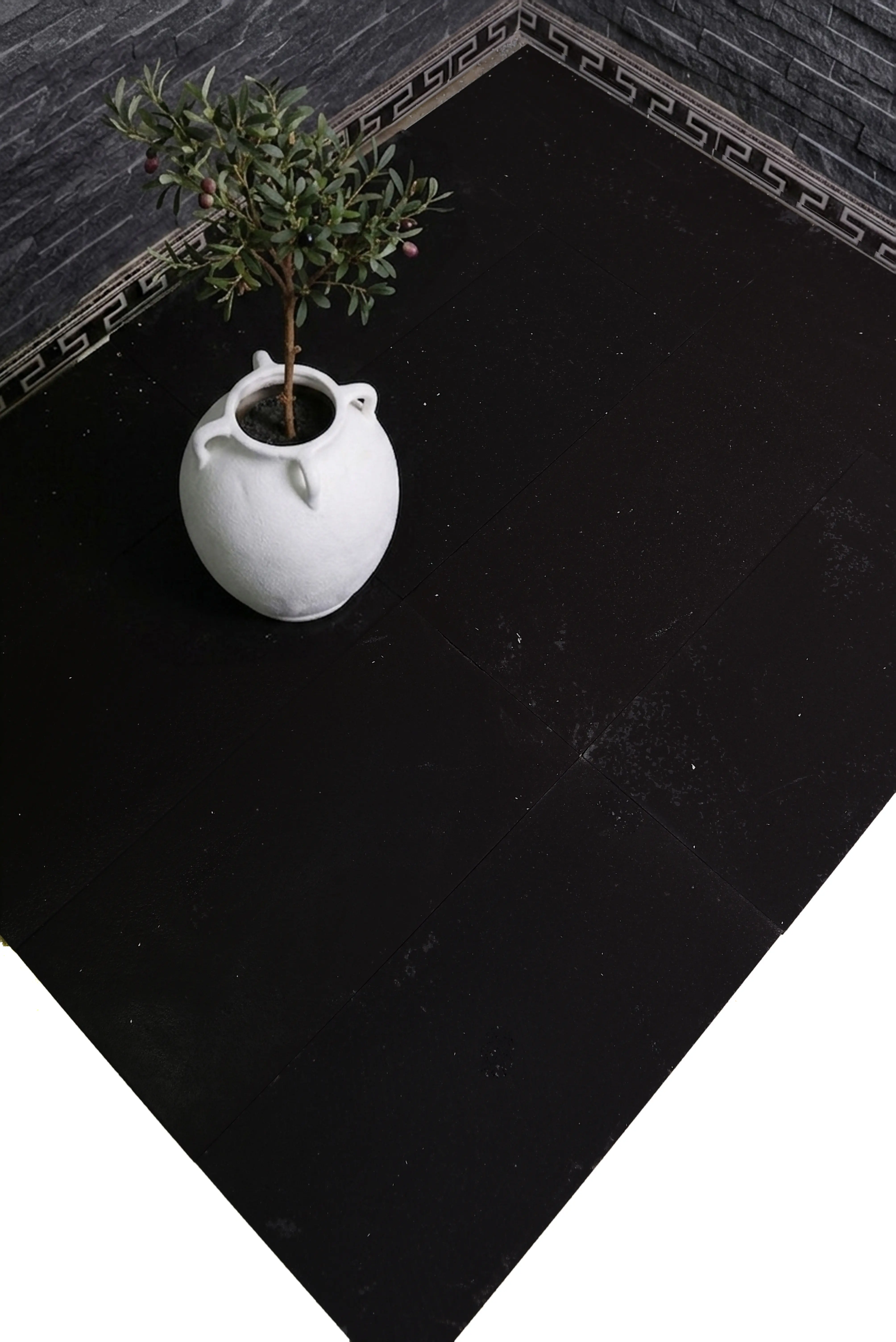
Sub-Base Specification: The Layer That Determines Longevity
Your sub-base is the structural foundation of the entire system, and it needs to be engineered to your actual loading conditions — not copied from a residential concrete specification. For a standard private driveway with passenger vehicle traffic, a minimum of 150mm of compacted angular aggregate is the starting point. For driveways that will see heavier vehicles — delivery trucks, SUVs with trailers, or construction equipment during a building phase — you should be looking at 200mm to 250mm, with a CBR test on the existing subgrade to confirm bearing capacity before you spec the depth.
Angular crushed aggregate is non-negotiable here. Rounded gravel might compact adequately in the short term, but it lacks the interlock that angular material provides under dynamic loading. Over time, rounded aggregate migrates laterally under load, and you’ll see settlement channels develop directly under tyre paths. According to ASTM compressive strength standards for driveway paving stone, base material performance is as critical as surface stone specification in determining system longevity. Use Type 1 or equivalent crushed limestone or granite aggregate, compacted in 75mm lifts to at least 95% Proctor density.
- Minimum 150mm compacted angular aggregate for standard passenger vehicle driveways
- Increase to 200-250mm where delivery trucks or heavier vehicles will access regularly
- Compact in 75mm lifts — single-lift compaction of 150mm+ rarely achieves uniform density
- CBR testing on native subgrade before specifying depth — clay-heavy soils need geotextile separation layer below aggregate
- Geotextile membrane between subgrade and aggregate prevents clay migration into your base over time
Bedding Layer and Laying Pattern for Black Block Paving
The bedding layer for a black block paving driveway installation sits between the compacted sub-base and the paver units, and it does two things simultaneously: it provides a level, consistent surface for seating the blocks, and it allows minor adjustment during laying. Sharp sand at 30-40mm uncompacted depth — which consolidates to 25-30mm under compaction — is the industry standard for natural stone block work. Avoid the temptation to use building sand here; its finer, rounded particles don’t provide adequate interlocking support under load, and you’ll see differential settlement develop in tyre-track zones within two or three years.
Your laying pattern affects both the visual outcome and the structural behaviour of the finished surface. For driveways, a 45-degree herringbone pattern is the strongest option — it distributes load diagonally across joints, meaning no continuous joint line runs parallel to the direction of travel. That matters because traffic loading tends to open joints that run with the direction of vehicle movement. Basketweave and running bond patterns work visually but create weaker joint lines under directional loading. Stack bond should be avoided on driveways entirely — it’s a surface pattern designed for pedestrian loading only.
- 30-40mm sharp sand bedding layer (uncompacted) — consolidates to 25-30mm after plate compaction
- 45-degree herringbone is structurally optimal for driveway applications — diagonals distribute directional loading
- Avoid building sand — rounded particles don’t interlock adequately under vehicle loads
- Establish consistent string lines before laying — height variations of more than 3mm between adjacent units create trip hazards and accelerate joint erosion
- Check flatness with a 2-metre straightedge during laying — correction is straightforward before compaction, expensive after
Working With Grey Block Paving and Charcoal Border Details
A grey block paving with charcoal border approach is one of the most effective design moves in driveway specification — it defines the edges of the driving surface, frames the approach to the property, and lets the darker perimeter anchoring work visually with the lighter field. The critical installation detail most contractors miss is the thickness matching requirement. Your border units need to match the field paver thickness exactly — or within 2mm — to allow uniform bedding depth across the transition.
Charcoal border units sourced from Middle East quarries typically come in 50mm or 60mm nominal thickness. If your field pavers are 60mm and your border units are 50mm, you need to adjust the bedding depth in the border zone, not compensate with a thicker sand layer. A thicker sand layer under a thinner unit creates a soft point at the transition that will settle differentially under the edge loading that border zones always experience. Thickness-matching at the specification stage eliminates this problem entirely.
The Natural Stone Institute cobblestone and sett specifications recommend verifying dimensional tolerances across a representative sample of your delivery before installation begins. At Citadel Stone, we check thickness consistency at the warehouse before orders leave — pulling measurement samples across multiple pallets to confirm the tolerances hold across the batch, not just on the top layer of the sample pallet.
Light and Dark Grey Block Paving: Specification Considerations
Specifying light and dark grey block paving together in a single driveway surface requires a sourcing discipline that goes beyond colour matching. Natural stone varies in tone from quarry cut to quarry cut, and two grey limestone units that look identical in a showroom sample can appear noticeably different once installed at scale in daylight. The solution is to source your light and dark grey units from the same quarrying programme — where the stone is being extracted from the same formation — rather than matching samples from two separate sources.
Check with your supplier about batch consistency across the quantity you need. For most residential driveways in the 50-to-100 square metre range, a single warehouse consignment from one production run will maintain visual consistency. Larger projects — commercial forecourts, estate driveways above 200 square metres — need a written batch confirmation before you sign off on the order. Colour drift between early deliveries and back-order fulfilment is a documented issue in natural stone supply that affects installed appearance significantly.
- Source light and dark grey units from the same quarrying programme to control tone consistency
- Request batch confirmation numbers for large orders — confirm all pallets come from the same production run
- Review units wet as well as dry — some grey limestone reads significantly darker when wet, affecting the light/dark contrast ratio
- Specify finished surface drainage falls of 1:50 minimum across all zones — grey limestone at lower absorption rates sheds water efficiently but still needs positive drainage geometry
Freeze-Thaw and Thermal Cycling Effects on Block Paving Joints
Temperature cycling between day and night — and across seasonal extremes — creates cumulative mechanical stress in black block paving driveway joints that’s easy to underestimate at specification stage. The expansion and contraction cycle for natural stone runs approximately 4-6 × 10⁻⁶ per °F depending on stone density and mineral composition. For a 10-metre run of dark basalt pavers, a 60°F swing between a summer afternoon high and a winter night low produces linear movement of roughly 3-4mm across the full run. That’s movement the joint system has to absorb cycle after cycle, year after year.
In freeze-thaw regions, water infiltration into joints followed by expansion during freezing is the primary failure mechanism. Ice expands at approximately 9% by volume, and if the joint filler is saturated and frozen, that expansion force acts laterally on the paver sides. Over repeated cycles, this progressively widens joints beyond their designed tolerance, allowing more water infiltration and accelerating the deterioration. The solution isn’t just joint filler selection — it’s the combination of adequate sub-base drainage and the right jointing compound.
For regions where you expect more than 20 freeze-thaw cycles per year, specify a polymer-modified kiln-dried sand jointing compound rather than standard brush-in sand. Polymer binders maintain joint cohesion through expansion cycles and resist the washout that opens joints to water infiltration in the first place. The cost difference between standard and polymer-modified jointing is typically recovered within the first two or three winters by eliminating the joint releveling that standard sand requires after heavy freeze-thaw seasons.
- Natural stone linear expansion: 4-6 × 10⁻⁶ per °F — calculate movement across your total run length before finalising joint width
- Design joint width to 3-5mm for standard block paving — narrower joints are visually cleaner but allow less thermal movement accommodation
- Polymer-modified jointing compound is the correct specification for freeze-thaw regions — standard kiln-dried sand washes out and opens joints over winter cycles
- Perforated drainage pipe at the base of the sub-base prevents water saturation that makes freeze-thaw damage worse
- Day-to-night temperature swings of 30°F or more in hot-dry climates create cumulative joint stress comparable to moderate freeze-thaw regions — don’t assume only cold climates need the polymer jointing specification
Cutting and Edge Detailing for a Clean Finish
The quality of your edge cuts determines the finished appearance of the entire driveway more than any other single variable. Plan your laying pattern from the centre of the field outward so that cut units at the perimeter are the largest possible size — cutting a unit down to less than one-third of its original dimension creates a visually weak edge that also lacks the bedding support of a full unit. For herringbone patterns, your edge cuts will be diagonal — use a diamond blade wet saw rather than an angle grinder for these. Angle grinders create rough, chipped edges on dense black stone that are impossible to hide once pointed.
Edge restraint is a structural requirement, not just a trim detail. Concrete haunching to a minimum 100mm depth on both sides of the edge restraint prevents lateral migration of the sub-base and bedding layer. On a black block paving driveway without adequate edge restraint, you’ll see the perimeter pavers migrate outward within a few years under vehicle turning movements, opening up joints and allowing bedding sand to wash out from below. That’s a progressive failure once it starts — water enters, the bedding layer erodes, and settlement follows.
For projects where you’re specifying our black and grey driveway pavers, we can advise on the cutting characteristics of specific stone types before your order ships — dense black basalt cuts cleanly but requires slower feed rates than limestone to prevent blade loading and overheating on longer cuts.

Sealing and Long-Term Maintenance for Black Block Paving
Sealing decisions for a black block paving driveway installation depend on the stone type you’ve specified. Dense black basalt with absorption rates below 0.3% technically doesn’t need sealing for waterproofing purposes — its pore structure is so tight that water infiltration at the paver body level isn’t the primary performance concern. However, a penetrating impregnator sealer on black stone enhances the colour depth significantly and provides oil resistance that matters on driveways, where engine oil and hydraulic fluid drips are unavoidable over time.
Black limestone from selected Middle East quarries typically has slightly higher absorption — in the 0.5-1.0% range — which makes sealing a stronger recommendation for driveway applications. Allow the installation to fully cure for a minimum of 28 days before applying any sealer; jointing compounds need that cure time to reach full hardness, and sealing over uncured joints traps residual moisture and can cause surface haze. Apply two coats of penetrating impregnator, not a topical film sealer — topical sealers on driveways peel under tyre contact and UV exposure within 18-24 months.
- Dense black basalt: penetrating impregnator for oil resistance — waterproofing benefit is secondary for low-absorption stone
- Black limestone: sealing is a stronger recommendation — absorption rates of 0.5-1.0% make the material more vulnerable to oil staining without protection
- 28-day minimum cure before sealing — jointing compound must reach full hardness first
- Penetrating impregnator over topical film sealer — topical sealers peel under tyre contact and UV exposure on driveways
- Re-seal every 3-5 years depending on traffic levels and exposure — inspect by water-bead test annually
- Pressure washing before re-sealing removes joint debris that would otherwise be locked in by the new coat
Ordering, Delivery, and Project Planning
Your project timeline needs to account for warehouse availability across your required batch, not just delivery lead time. Natural stone block paving in specific colours and thicknesses can move quickly when multiple projects are ordering simultaneously, and a four-to-six-week gap between your first and second deliveries — if the warehouse needs to replenish — creates a site programme problem. Confirm your full quantity, including a 10-15% wastage allowance for cuts and breakage, is available as a single consignment before committing to a start date.
Truck delivery access is a practical constraint that affects how efficiently your material gets from the kerb to the laying area. Most pallet deliveries arrive on flatbed or curtainside trucks that require a reasonably level, solid access point. On tight urban driveways or properties with restricted kerb access, you may need to arrange offloading positions in advance and plan for additional manual handling from the truck drop point to the laying area. Factor that labour into your programme — moving 10 tonnes of natural stone block paving by hand over any distance adds a half-day to your site setup time. Citadel Stone coordinates truck delivery logistics nationally and can advise on delivery configurations before dispatch to avoid site access problems on the day.
- Order 10-15% over your calculated area requirement — account for cuts, diagonal herringbone waste, and breakage
- Confirm full batch availability as a single consignment — mixing batches from different production runs creates colour inconsistency
- Truck access assessment before ordering — confirm your kerb drop or site access point can accommodate delivery vehicle turning radius
- Material should be stored on a flat, firm surface covered with a breathable tarpaulin — not waterproof sheeting, which traps moisture in the pallet stack
The ASLA driveway paving material and environmental performance guidance covers permeable sub-base configurations that allow surface water to drain through the paving system rather than run off — worth reviewing if your project site has drainage constraints or if local planning requirements address surface water management.
Expert Summary
A black block paving driveway installation rewards specification precision at every layer — from the compacted angular aggregate sub-base through to the jointing compound and sealing programme. The decisions that separate a 25-year installation from a 10-year one aren’t in the stone selection; they’re in the base depth relative to actual loading, the laying pattern relative to traffic direction, and the joint specification relative to your climate’s thermal cycling demands. Get those three decisions right and the surface material does exactly what it’s engineered to do.
Your stone selection — whether dense black basalt, black limestone from Middle East quarries, or a combination of light and dark grey block paving tones — feeds into your sealing and maintenance specification, not your structural approach. The structural specification doesn’t change materially between stone types for standard residential driveway loading. What changes is the absorption rate, which affects sealing frequency and oil-stain resistance, and the cutting behaviour, which affects edge detailing labour. Both are manageable with the right pre-installation planning. For complementary hardscape ideas that use stone borders to define and frame outdoor spaces, pavers with black border design ideas offers practical inspiration worth reviewing alongside your driveway specification.
Freeze-thaw cycling can widen joints in block paving driveways over time — Citadel Stone recommends a compacted angular aggregate sub-base of at least 150mm to limit movement.
Related reading: Blue Sandstone vs Blue Limestone for Outdoor Paving · blue limestone countertops guide · blue limestone rock geology.