

The geometry of a circular patio punishes imprecise material selection in ways a rectangular layout simply doesn’t — gaps widen toward the outside of each ring, and the tightest inner courses demand either precision-cut radial units or a material forgiving enough to handle slight angle variation. Paving stones for circular patio layouts require you to think about joint geometry, ring coursing, and cut-edge durability before you commit to any specific stone. Get those three variables right and the installation stays tight and level for decades. Miss any one of them and you’ll be resetting stones within five years.
Why Circular Layouts Demand Different Thinking
Rectangular paving is forgiving — you run bond lines parallel, adjust a course at the edge, done. Circular paving amplifies every material decision because every ring has a different circumference. Your innermost ring might use only six or eight stones, each carrying a significant angular load at the joints. The outermost rings can stretch to dozens of stones with comparatively narrow joints. That geometric reality means your stone selection has to account for how the material behaves when cut on a radial angle, not just how it performs underfoot.
Most specifiers focus on finish and color first, which makes sense aesthetically. But what you really need to evaluate is edge consistency after cutting. A dense material like basalt holds a precision radial cut without chipping or crumbling at the edge. A more porous stone cut on an angle may fret at the cut face and create joint irregularity that compounds outward across rings. According to Natural Stone Institute stone selection standards, surface absorption and stone density are primary factors in cut-edge durability — criteria that matter especially in circular installations where angled cuts are unavoidable.
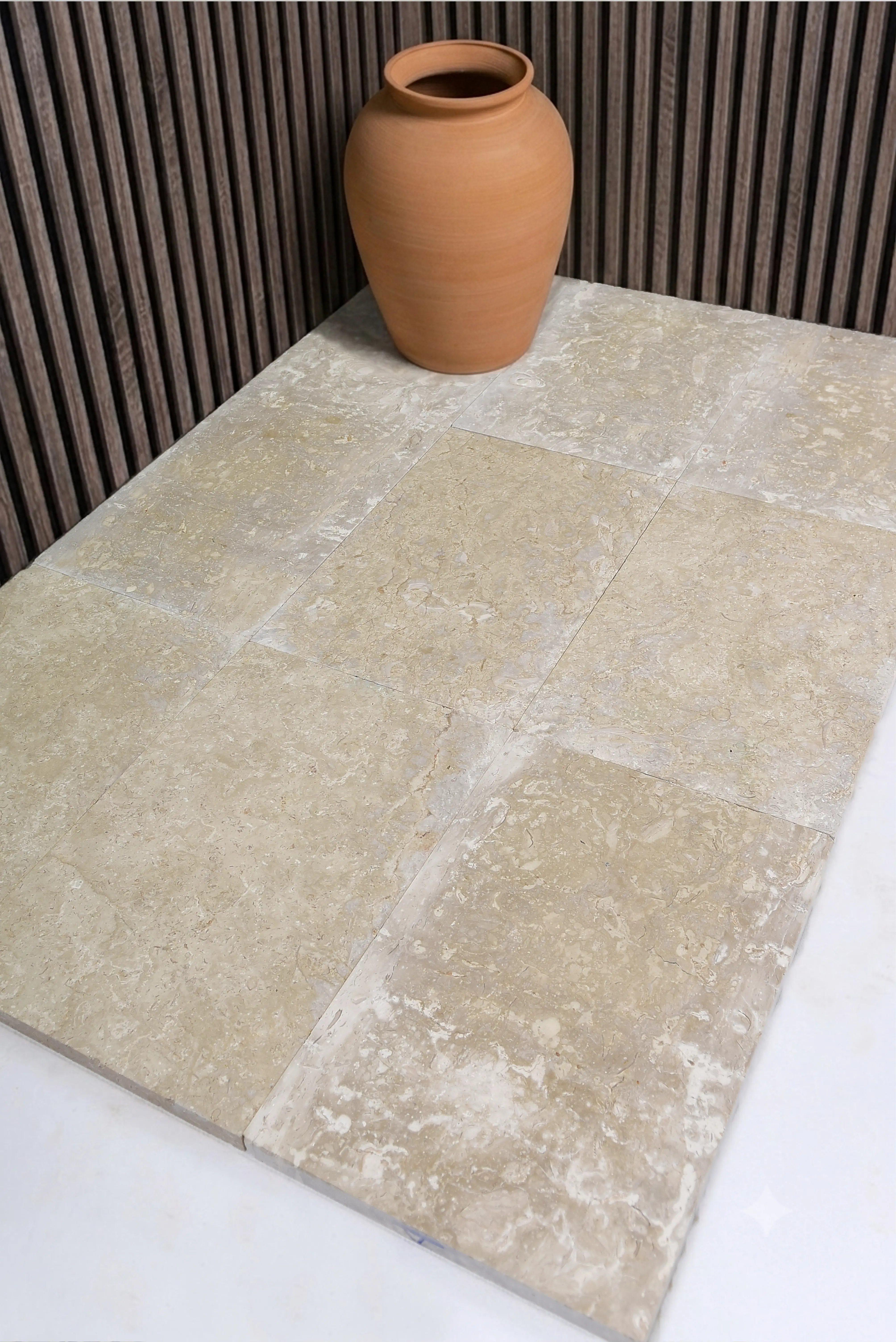
Best Stone Types for Circular Patio Layouts
Your material choice determines how much of the radial geometry you can achieve with stock formats versus custom fabrication. Here’s how the main options stack up for circular applications specifically:
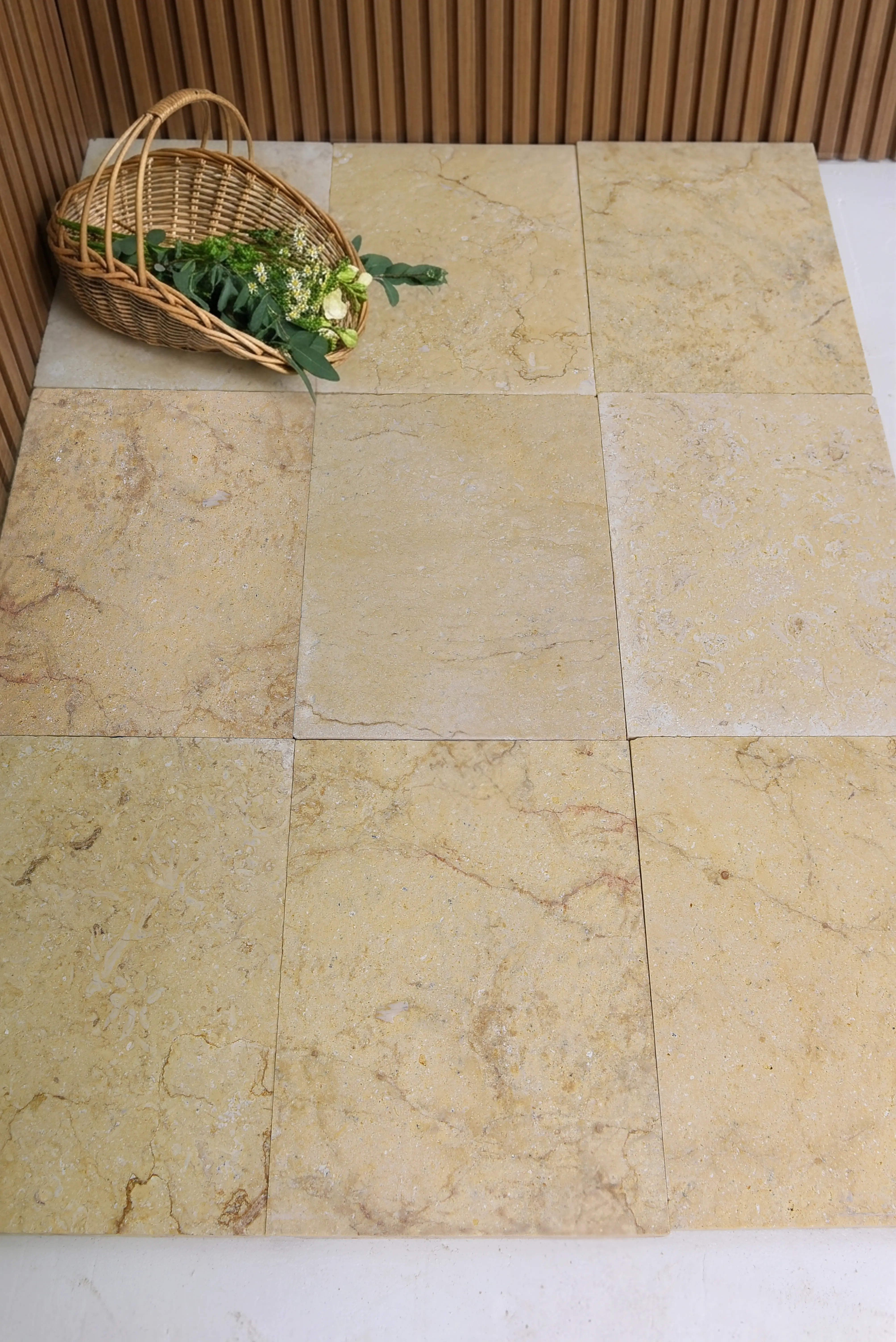
- Limestone pavers in a 12×12 or 16×16 format work well for mid-ring and outer-ring coursing — the material cuts cleanly, holds consistent thickness, and the natural color range suits most landscape palettes
- Basalt pavers offer exceptional density and cut-edge stability, making them a strong choice for the tight inner rings where angular cuts are most severe
- Travertine adds warmth and texture but demands more attention to fill-void consistency at cut faces — honed or tumbled finishes are preferable to polished for circular layouts
- Granite pavers hold radial cuts without edge degradation and withstand high foot traffic across all ring positions, though fabrication costs run higher than limestone
- Natural flagstone can work for informal circular designs where irregular joints are acceptable, but achieving a clean geometric ring is difficult without extensive custom trimming
For most residential and light commercial circular patio projects, limestone and basalt represent the best balance of workability, durability, and cost. Granite earns its place on higher-specification projects where the budget supports precision fabrication.
Understanding Radial Formats and Ring Sizing
Purpose-made radial units — stones pre-cut to a trapezoidal profile — exist precisely to solve the geometry problem of circular paving. You’ll find them described as radial pavers, fan pavers, or circle kits, and they eliminate most of the on-site cutting that makes circular patio layouts labor-intensive. The trapezoidal geometry is calculated so that a specific number of units closes each ring at a defined joint width, typically 3–5mm.
Here’s what most specifiers miss about radial kit sizing: the ring diameter increments are fixed by the manufacturer’s geometry, not by your design preference. You need to select a center radius that matches the kit’s inner-ring specification, then add rings in the prescribed increments. Deviating from those increments — even by a few centimeters — forces you back into custom cutting for every stone in the mismatched ring. Review our radial paving options early in your design process so the ring dimensions inform your layout rather than fighting it.
For patios larger than the kit’s maximum diameter, you have two choices: transition to a field-cut coursing pattern beyond the outermost kit ring, or specify a second compatible kit format. The transition joint between kit geometry and field-cut geometry is where most circular patio installations show their first sign of weakness — plan that detail explicitly.
Types of Patio Paving Stones by Finish and Application
Finish selection on a circular patio affects more than aesthetics — it directly influences how the stone reads as a unified circle versus a collection of individual pieces. The types of patio paving stones you consider should be evaluated by how finish behaves across multiple joint lines radiating outward from a central point.
- Honed finish creates a consistent reflective plane that emphasizes the circular geometry — strong choice for contemporary and minimalist landscape styles
- Tumbled or aged finishes soften joint lines visually, which helps when cut-edge alignment isn’t perfectly uniform — well-suited to traditional colonial and cottage garden aesthetics
- Flamed or bush-hammered textures provide excellent grip in wet conditions and weather to a consistent tone over time — practical in high-rainfall areas or patios adjacent to water features
- Polished finishes amplify color depth but require more maintenance and show surface variation at joints — generally better for indoor or covered outdoor applications
- Natural cleft or split finishes add visual depth but introduce thickness variation that complicates level installation across ring courses
Design context matters here. A desert xeriscaping palette tends to favor warm-toned travertine or buff limestone with a honed or tumbled finish. Modern minimalist settings often call for dark basalt or grey limestone with a clean honed plane. Tropical planting schemes pair well with the organic texture of tumbled limestone or irregular flagstone at the outer rings. The ASLA provides outdoor material selection guidance worth reviewing when your design brief includes specific landscape character requirements.
Base Preparation for Circular Paving Stones
The circular patio’s structural performance lives in the base, not in the stone itself. You’re creating a feature where every stone is essentially a wedge — and wedges under load want to migrate. A properly compacted and dimensioned aggregate base is what stops that migration.
Your aggregate base depth should be a minimum of 100mm (4 inches) of compacted road base for pedestrian applications, stepping up to 150mm (6 inches) where occasional vehicle overhang or heavy furniture loads are expected. Compaction to 95% Proctor density is the specification target — not the approximate number, the tested result. Beneath that, your subgrade should be graded to drain away from the center of the circle at a 1–2% fall, which keeps hydrostatic pressure from building under the centermost stones.
- Set a string line or laser at the finished center elevation before any base material goes down — you’ll reference it constantly during ring coursing
- Install edge restraint before the bedding layer, not after — edge restraint set into undisturbed aggregate rather than the bedding layer provides meaningfully better lateral resistance
- Use a sand bedding layer of 30–40mm (1.2–1.6 inches) screeded to your finished fall — for paving stones for circular patio installations, this layer must be screeded with a pivot arm referenced to the center point to maintain consistent slope across all radial directions
- Avoid wet concrete bedding for circular natural stone installations — differential curing shrinkage in a circular form causes irregular uplift that shows immediately across ring joints
Jointing and Grouting in Circular Paving
Joint width management is the detail that separates a professional circular patio installation from an amateur one. In a radial kit layout, your joint width is prescribed — the geometry requires it. In a field-cut circular layout, you’re managing a joint that naturally widens toward the outer edge of each ring unless you compensate by tapering each individual stone.
For field-cut paving stones for patio applications, the practical approach is to set a maximum outer-edge joint width of 8–10mm and calculate your stone taper accordingly. Beyond 10mm, joints become a maintenance liability — polymeric sand won’t hold in wide joints without supplementary edge treatment, and loose jointing in a circular format accelerates edge erosion of individual stones over freeze-thaw cycles.
- Polymeric sand is the standard jointing material for residential circular patios — it sets firm, resists ant and weed penetration, and handles moderate joint movement
- Cement-based grout provides a more rigid joint and suits formal or high-detail installations, but requires expansion allowance at ring intervals to prevent cracking
- For open-joint or permeable designs, angular crushed granite aggregate at 2–5mm compacts into joints without washing free under surface water flow
- Apply jointing material in multiple passes — the circular geometry creates more air pockets in joints than straight-run paving, and single-pass filling frequently leaves voids that emerge after the first rainfall
According to USGS dimension stone production and use data, natural stone paving in circular and specialty geometric formats has grown consistently as a share of residential hardscape specification — the installation techniques have become well-established, but jointing remains the most common point of long-term failure.
Ordering, Logistics, and Lead Times
Circular patio projects consistently run into the same supply chain problem: radial kit formats and matching field pavers aren’t always held in the same warehouse inventory cycle. You may receive your radial kit units on schedule and find the matching field pavers on a 4–6 week back-order, leaving you with a half-finished installation. Plan your order to arrive as a complete shipment rather than staged deliveries.
Citadel Stone maintains national warehouse inventory of both radial kit formats and compatible field pavers, which typically compresses lead times significantly compared to sourcing each component separately from different suppliers. Confirm your complete material list — center unit, radial rings, field coursing, and edge restraint — against warehouse availability before you set a site-start date. Your project’s truck access constraints also matter: radial paving kits are typically palletized in circular or square configurations that require a standard flatbed or curtain-sider, and tight residential access can complicate unloading if you haven’t planned a staging area.
Calculate your quantity with a 10–12% waste allowance on field-cut pieces and a 5% allowance on radial kit units. Radial units are pre-formed to precise geometry and generate less cut waste, but breakage during handling and the occasional reject piece make the 5% buffer worth holding in your order.
Getting Your Circular Patio Stone Specification Right
Getting a circular patio specification right means resolving the geometry, the base, the jointing, and the supply chain before the first stone is set — not as you go. Your material choice for paving stones for circular patio projects should prioritize cut-edge stability and thickness consistency over purely aesthetic criteria, because those physical properties determine whether the ring geometry holds over years of loading and seasonal movement. For a related natural stone application that pairs well with circular patio designs, patio stones with pebble inlays explores how mixed-material approaches can complement and extend the central feature you’ve built. Product from Citadel Stone includes graduated ring sizes, letting builders scale circular patios from compact seating spots to wide gathering areas.
Related reading: How to Lay Paver Patio Stones the Right Way · cheap stones for patio · pavers for walkway.